NHS Band 8c Take Home Pay Calculator 2026/27
2026/27 • Agenda for Change
Band 8c is one of the most senior tiers in the NHS Agenda for Change framework. It covers highly experienced clinical leaders, advanced specialists, and senior operational managers who carry significant strategic responsibility.
In 2026/27, the Band 8c salary range in England runs from approximately £74,290 to £85,601 per year. That sounds substantial — but once income tax, National Insurance, and NHS pension contributions are deducted, your actual take-home figure is considerably lower than the headline number suggests.
This guide breaks down exactly what Band 8c staff take home at every pay point, across all UK nations, and for both full-time and part-time contracts.
Band 8c Pay Points 2026/27: Gross Salary Overview
Band 8c has three pay points in England. Each step represents a meaningful jump in gross pay.
| Pay Point | Annual Gross Salary | Monthly Gross |
|---|---|---|
| Pay Point 1 | £74,290 | £6,190 |
| Pay Point 2 | £79,838 | £6,653 |
| Pay Point 3 | £85,601 | £7,133 |
Progression moves automatically each year on your incremental date until you reach the top of the band. There is no performance gate — time served at each point determines progression.
Band 8c Take Home Pay After Deductions: England 2026/27
Three deductions hit every Band 8c payslip: income tax, employee National Insurance, and NHS pension contributions.
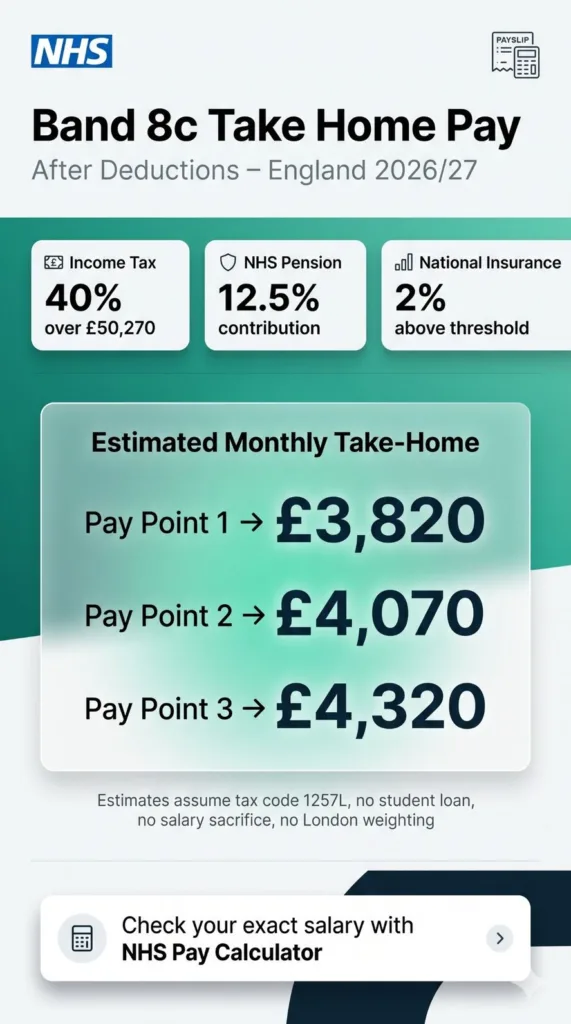
At this salary level, all three are significant. Band 8c staff pay the higher rate of income tax (40%) on earnings above £50,270. NHS pension contributions sit at 12.5% across the entire Band 8c range. National Insurance is 2% on earnings above £50,270 — reduced from the standard 12% rate that applies on lower earnings.
Estimated Monthly Take Home — Band 8c England 2026/27
| Pay Point | Gross Monthly | Est. Net Monthly | Est. Net Annual |
|---|---|---|---|
| Pay Point 1 | £6,190 | £3,820 | £45,840 |
| Pay Point 2 | £6,653 | £4,070 | £48,840 |
| Pay Point 3 | £7,133 | £4,320 | £51,840 |
These figures assume a standard 1257L tax code, no student loan, no salary sacrifice, and no London weighting. Your personal circumstances will shift these numbers. Use the NHS Pay Calculator for a precise figure matched to your tax code and deductions.
Why the Gap Between Gross and Net Is So Large at Band 8c
Many Band 8c professionals are surprised by how much of their salary disappears before it reaches their bank account. The reason is the combined effect of three overlapping deductions on a salary that straddles the higher rate tax threshold.
At Pay Point 1 (£74,290), the deductions break down roughly like this per month:
- Income tax: approximately £1,720 (20% on £12,570–£50,270, 40% on the remainder)
- National Insurance: approximately £200 (2% on earnings above £50,270)
- NHS pension at 12.5%: approximately £773
Total monthly deductions: approximately £2,693 Net take home: approximately £3,497–£3,820 depending on tax code
The NHS pension contribution is the single largest deduction after income tax. However, it is worth remembering that the NHS defined benefit pension is one of the most valuable employment benefits in the UK. The employer contribution rate is 23.7%, meaning the total pension input on a £74,290 salary is over £23,000 per year — the vast majority of which is funded by the employer.
Band 8c Hourly Rate 2026/27
Understanding your hourly rate matters for bank shifts, locum work, overtime calculations, and job offer comparisons.
Band 8c hourly rate formula: Annual salary ÷ 52.14 ÷ 37.5
| Pay Point | Annual Salary | Gross Hourly Rate |
|---|---|---|
| Pay Point 1 | £74,290 | £38.01 |
| Pay Point 2 | £79,838 | £40.85 |
| Pay Point 3 | £85,601 | £43.80 |
After tax and deductions, the net effective hourly rate sits in the range of £19.70–£22.25 per hour for full-time staff, depending on pay point and personal tax circumstances.
Who Works at NHS Band 8c?
Band 8c is not a single-role band. It spans a wide range of clinical, operational, and professional functions across NHS trusts, ICBs, and specialist services.
Clinical Roles at Band 8c
- Consultant physiotherapists and advanced practice leads
- Consultant radiographers (reporting and advanced practice)
- Consultant speech and language therapists
- Highly specialist clinical psychologists and neuropsychologists
- Lead pharmacists and chief pharmacists in smaller trusts
- Consultant nurses with trust-wide or regional responsibility
- Specialist dietitians at consultant level
- Senior occupational therapy leads
Non-Clinical and Operational Roles at Band 8c
- Deputy directors of nursing
- Head of nursing (for a division or large directorate)
- Senior operational managers (chief operating officer deputies)
- Associate directors of finance or HR
- Heads of estates and facilities management in large trusts
- Senior informatics and digital transformation leads
The common thread across all Band 8c roles is a combination of expert-level technical or professional knowledge, budget responsibility, and strategic influence on service delivery.
Case Study: Band 8c Consultant Physiotherapist
James is a consultant physiotherapist at a large NHS foundation trust in the Midlands. He sits at Pay Point 2, earning £79,838 per year.
His monthly gross is £6,653. After income tax (approximately £1,870/month), NI (approximately £200/month), and NHS pension at 12.5% (approximately £831/month), his net monthly take-home is approximately £3,752.
James also does two bank Saturday shifts per month. His Saturday enhancement rate is 30% above his standard hourly rate:
£40.85 × 1.30 = £53.10/hr gross on Saturdays
Those two shifts (7.5 hours each) add approximately £796 gross per month, or roughly £430 net — bringing his effective monthly take-home to around £4,180.
Case Study: Band 8c Head of Nursing in London
Fatima is a Head of Nursing at an inner London NHS trust. She is at Pay Point 3 (£85,601) and receives Inner London HCAS (20% of salary, capped at £8,065 per year).
Her pensionable pay for HCAS calculation: £85,601 + £8,065 = £93,666
This pushes her into the next NHS pension tier — 13.5% rather than 12.5%.
Monthly gross: approximately £7,805 Monthly deductions (tax, NI, 13.5% pension): approximately £3,510 Net monthly take-home: approximately £4,295
London weighting adds gross pay but also increases deductions significantly. The net benefit of HCAS at this salary level is approximately £250–£350 per month rather than the full £672 headline figure.
Band 8c Pay Across the Four UK Nations
NHS pay is devolved. Scotland, Wales, and Northern Ireland each set their own AfC rates, though they broadly track England with some variation.
| Nation | Band 8c Min (Approx) | Band 8c Max (Approx) |
|---|---|---|
| England | £74,290 | £85,601 |
| Scotland | £77,000 | £88,900 |
| Wales | £75,100 | £86,600 |
| Northern Ireland | £74,290 | £85,601 |
Scotland consistently offers the highest Band 8c pay in the UK. The gap is meaningful at this salary level because it sits squarely in higher rate tax territory — a difference of £2,700 in gross salary translates to only around £900 extra in net pay after tax.
Band 8c Part-Time Take Home Pay
Band 8c is not exclusively a full-time band. Many experienced NHS professionals at this level negotiate part-time arrangements — particularly clinical specialists returning from career breaks, those managing long-term health conditions, or those transitioning toward retirement.
Part-time pay is pro-rated by WTE (Whole Time Equivalent).
Example: Band 8c Pay Point 1 at 0.8 WTE (30 hours/week)
- Pro-rated annual salary: £74,290 × 0.8 = £59,432
- Monthly gross: £4,953
- Income tax: lower overall tax bill since less income crosses the 40% threshold
- NHS pension: still at 12.5% on the pro-rated pay
- Estimated net monthly: approximately £3,270
At 0.8 WTE, the effective tax rate drops noticeably because a smaller proportion of salary sits above the £50,270 higher rate threshold. This means part-time Band 8c workers often retain a higher proportion of each pound earned than full-time colleagues at the same pay point.
For an accurate pro-rated net pay figure, the NHS Part-Time Pay Calculator handles WTE adjustments automatically for all bands.
NHS Pension at Band 8c: What You Actually Pay and Get
The NHS pension contribution for Band 8c staff is 12.5% of pensionable pay. This is the employee contribution — the employer contributes an additional 23.7%.
On a Band 8c Pay Point 1 salary of £74,290, the monthly employee pension deduction is approximately £773. Over a full year, that is £9,286 coming out of your gross pay.
In return, for every year of NHS membership in the 2015 Career Average scheme, you build up a pension of 1/54th of your pensionable earnings for that year. On £74,290, that is approximately £1,376 of annual pension built up in a single year — a guaranteed, inflation-linked, defined benefit that no private sector equivalent can easily match.
Band 8c staff who are 10–15 years from retirement often find that their pension accrual significantly outweighs what they could achieve in a private sector role offering a higher basic salary but only a defined contribution pension.
Band 8c vs Band 8b and Band 8d: Is the Step Up Worth It?
A question many NHS professionals at Band 8b ask is whether the jump to 8c is financially meaningful after deductions.
| Band | Pay Range | Est. Net Monthly (Mid-point) |
|---|---|---|
| Band 8b | £62,215–£72,293 | £3,380–£3,720 |
| Band 8c | £74,290–£85,601 | £3,820–£4,320 |
| Band 8d | £88,168–£105,376 | £4,420–£5,020 |
The step from Band 8b top to Band 8c bottom delivers approximately £100–£150 extra per month in net pay — less dramatic than the gross gap suggests, but meaningful when compounded over several years and especially valuable for pension accrual, as higher pensionable pay in your final working years increases your career average pension significantly.
The Band 8c to 8d jump is more substantial in net terms and usually comes with a change in job title — typically moving from associate director to director level.

Band 8c and Student Loan Repayments
Many Band 8c professionals in clinical or professional roles completed postgraduate training and carry Plan 2 or Postgraduate Loan balances.
Plan 2 repayment threshold in 2026/27: £27,295. Repayment rate: 9% of earnings above the threshold.
On a Band 8c Pay Point 1 salary of £74,290:
- Earnings above threshold: £74,290 − £27,295 = £46,995
- Annual Plan 2 repayment: £46,995 × 9% = £4,229
- Monthly deduction: approximately £352
This is a substantial additional deduction that reduces net monthly take-home by around £352 on top of tax, NI, and pension. A Band 8c professional at Pay Point 1 with a Plan 2 loan could see their net monthly pay drop to approximately £3,465–£3,520.
Postgraduate loan repayment adds a further 6% on earnings above £21,000, potentially adding another £220–£250 per month in deductions.
Unsocial Hours Pay at Band 8c
Band 8c staff are not automatically exempt from unsocial hours enhancements — it depends on the nature of the role and whether the post carries an on-call or out-of-hours requirement.
For those who do qualify, the standard AfC enhancements apply:
- Weekday nights (8pm–6am): +37%
- Saturdays (all hours): +30%
- Sundays and bank holidays: +60%
A Band 8c consultant nurse on-call over a bank holiday Sunday earns approximately £43.80 × 1.60 = £70.08/hour gross at top of band. This is why on-call supplements at senior band level can add £8,000–£15,000 to a Band 8c annual package in some specialties.
Many Band 8c managerial roles carry a notional on-call supplement instead, typically a flat addition negotiated at trust level rather than hourly enhancement.
How Band 8c Compares to Similar Senior Roles Outside the NHS
A common question from Band 8c professionals is whether they would earn more in the private sector, local government, or NHS management consultancy.
In broad terms:
- NHS Band 8c clinical specialist: £74,290–£85,601 + defined benefit pension worth approximately 25–30% of salary
- Equivalent private hospital clinical lead: £75,000–£95,000, typically with defined contribution pension only (3–8% employer contribution)
- Local authority director (equivalent seniority): £75,000–£90,000, often LGPS pension (defined benefit, slightly less generous than NHS)
- Management consultancy equivalent (healthcare): £80,000–£110,000 base, but typically no defined benefit pension and higher job insecurity
When the NHS pension employer contribution of 23.7% is added to gross salary as a total compensation figure, Band 8c becomes highly competitive — particularly for those with 15+ years of NHS membership already built up.
Band 8c Salary Sacrifice and Flexible Benefits
Some NHS trusts offer salary sacrifice schemes that can reduce your taxable income — and therefore increase your net take-home — at Band 8c.
Common options include:
- Cycle to Work scheme (reduces taxable salary by the cost of the bike, typically £1,000–£5,000)
- Electric vehicle salary sacrifice (increasingly common in NHS trusts)
- Additional voluntary pension contributions through salary sacrifice
- Childcare vouchers (legacy schemes only; most have closed to new entrants)
At Band 8c, salary sacrifice schemes are particularly tax-efficient because a portion of your income that would be taxed at 40% and subject to 12.5% pension contribution is instead redirected into a benefit. Effective savings can reach 52.5p in the pound on salary sacrificed into an EV scheme (40% tax + 12.5% pension saved).
Band 8c Take Home Pay: Quick Reference Summary
For anyone who wants the headline figures without working through the full maths:
- Band 8c Pay Point 1 gross: £74,290 → net approximately £45,840/year (£3,820/month)
- Band 8c Pay Point 2 gross: £79,838 → net approximately £48,840/year (£4,070/month)
- Band 8c Pay Point 3 gross: £85,601 → net approximately £51,840/year (£4,320/month)
These figures are for England, standard tax code, no student loan, no London weighting, no salary sacrifice. Every variable you add — location, loan plan, WTE fraction — changes the output.
For a Band 6 comparison to benchmark where you started, the NHS Band 6 Take Home Pay Calculator shows how significantly deductions have grown between mid-band and senior roles.
FAQs: NHS Band 8c Take Home Pay
What is the Band 8c take home pay per month in 2026/27?
Approximately £3,820/month at Pay Point 1, £4,070 at Pay Point 2, and £4,320 at Pay Point 3 — based on England rates, standard tax code, no student loan.
What pension rate applies to Band 8c in 2026/27?
12.5% employee contribution. If London weighting pushes total pay above the next tier threshold, 13.5% may apply.
Is Band 8c subject to higher rate income tax?
Yes. The entire Band 8c salary range sits above the £50,270 higher rate threshold, so all pay above that point is taxed at 40%.
What is the Band 8c hourly rate in 2026?
Approximately £38.01/hr at Pay Point 1, £40.85 at Pay Point 2, and £43.80 at Pay Point 3 — all gross figures.
Does Band 8c pay differ in Scotland?
Yes. Scotland’s Band 8c range is approximately £77,000–£88,900, slightly higher than England’s £74,290–£85,601.
How does part-time affect Band 8c take home pay?
Salary is pro-rated by WTE. Working 0.8 WTE on Pay Point 1 gives approximately £59,432 gross, with a proportionally lower tax bill since less income crosses the 40% threshold.

Daniel Carter is a senior NHS Payroll Accountant with over 10 years of experience in Agenda for Change pay structures, tax, and pensions. He created the NHS Pay Calculators platform to help NHS staff easily understand their take-home pay, sick pay, maternity pay, and pension entitlements through simple, accurate online tools.