NHS Non Clinical Support Worker Salary 2026/27 Pay Guide
Did you know that over 300,000 NHS workers in England hold non-clinical support roles — and many of them have never been told exactly what they will take home after all the deductions are made? If you are one of them, or you are thinking about joining the NHS in a support role such as a ward clerk, receptionist, porter, or admin assistant, this guide is written specifically for you.
NHS non clinical support worker salary refers to the gross and net pay earned by NHS employees in non-patient-facing or administrative roles, governed by the Agenda for Change (AfC) pay framework. Most non-clinical support roles sit in Band 2 or Band 3, with some senior admin roles reaching Band 4.
In this article you will learn: which pay band your role falls into, exactly what the 2026/27 salary figures are, how deductions like income tax, National Insurance, and your NHS pension reduce your take-home, and what your career progression looks like. Everything is explained in plain English — no accounting jargon, no confusing abbreviations left unexplained.
What Is NHS Non Clinical Support Worker Salary?
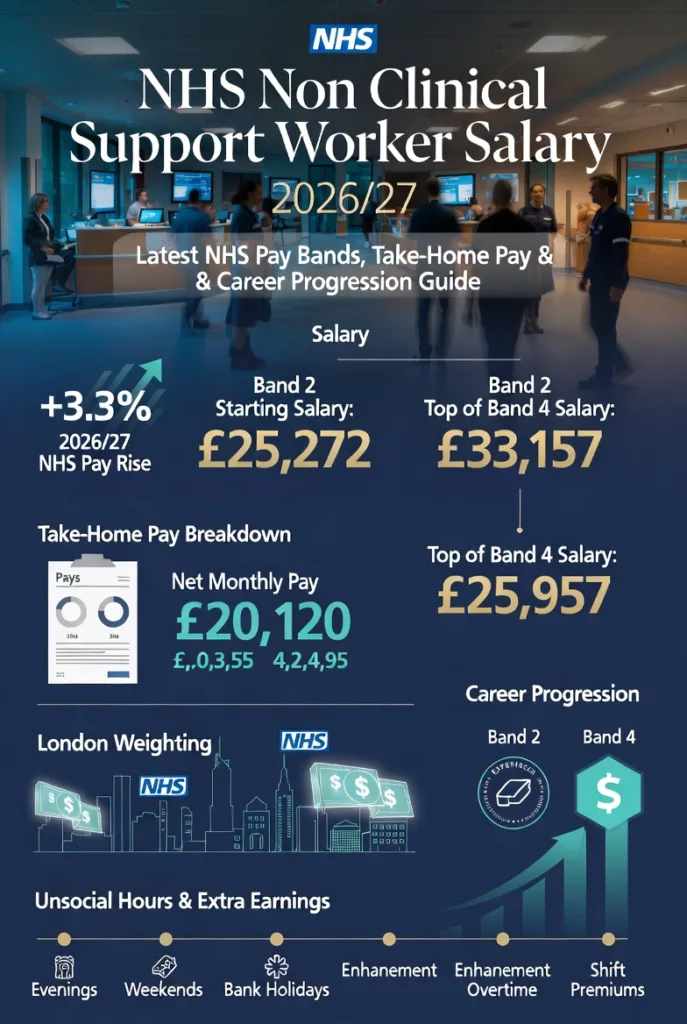
NHS non clinical support worker salary in 2026/27 ranges from £25,272 at Band 2 to £31,157 at the top of Band 4, following the confirmed 3.3% Agenda for Change pay rise from 1 April 2026. After income tax, National Insurance, and NHS pension contributions, most Band 2 and 3 non-clinical support workers take home between £1,700 and £1,900 per month in England. Staff in London receive additional High Cost Area Supplements. Pay increases automatically as you progress through pay points within your band, and you can increase your earnings further through unsocial hours work or by moving into a higher band role.
Beyond the headline salary, the NHS pension, generous annual leave, sick pay, and job security make non-clinical support roles a competitive package overall — particularly for people entering or returning to the workforce.
How Does the NHS Pay System Work for Support Staff?
Understanding how your pay is calculated takes a few simple steps. Once you know the process, your payslip will make much more sense.
- Your role is assigned a pay band. When you join the NHS in a support role, your job is evaluated and placed in a band. Each band reflects the level of responsibility, knowledge, and skill required. For non-clinical support workers this is usually Band 2, Band 3, or Band 4.
- Your band has a salary range. Each band has defined salary points. Band 2 has a single fixed salary. Band 3 and Band 4 have an entry point and a higher point you reach after gaining more experience.
- You receive an annual pay rise. Every April, the government sets an NHS-wide pay uplift. For 2026/27 that rise is 3.3%, which has been applied to all bands from April 2026.
- Deductions are made from your gross salary. Before the money reaches your bank account, three main deductions are taken: income tax, National Insurance contributions (NIC), and your NHS pension contribution. What remains after these deductions is called your take-home pay or net pay.
- You progress through your band over time. After completing the required years at your entry point and demonstrating the required standards in your annual appraisal, your salary moves to the higher pay point within your band.
Think of your gross salary as a pie. The NHS pension, income tax, and National Insurance each take a slice, and what is left over is the slice you actually get to eat — your take-home pay.
NHS Non Clinical Support Worker Salary 2026/27: The Exact Figures
The following figures are based on the confirmed 2026/27 Agenda for Change pay award of 3.3%, effective from 1 April 2026, for full-time staff in England working 37.5 hours per week.
Band 2 Salary 2026/27
Band 2 is the most common entry band for non-clinical support roles including receptionists, domestic assistants, porters, healthcare assistants in non-clinical functions, and basic admin staff.
| Detail | Amount |
| Annual gross salary | £25,272 |
| Monthly gross salary | £2,106 |
| Hourly rate (37.5 hrs/week) | £12.92 |
| NHS pension contribution (6.5%) | -£137 per month |
| Income tax (approx.) | -£184 per month |
| National Insurance (approx.) | -£85 per month |
| Estimated monthly take-home pay | ~£1,700 |
At Band 2, there is only one salary point — meaning there is no automatic pay progression within the band itself. However, once you gain experience and qualifications, you can apply for Band 3 roles.
Band 3 Salary 2026/27
Band 3 covers more senior non-clinical support roles including senior admin assistants, clerical officers, ward clerks with additional responsibilities, pharmacy assistants, and theatre support workers.
| Pay Point | Annual Gross | Monthly Gross | Approx. Monthly Take-Home |
| Entry (Year 1) | £25,760 | £2,147 | ~£1,730 |
| Top of Band (Year 2+) | £27,476 | £2,290 | ~£1,840 |
At Band 3, you start at the entry point and move to the top of the band after completing 2 years in the role, subject to a satisfactory appraisal. Your take-home pay at the top of Band 3 is meaningfully higher than at Band 2 entry.
Band 4 Salary 2026/27
Band 4 represents senior admin and support roles including bed managers, senior clerical staff, administrative team leaders, and some specialist support roles. This band requires more independent working and often involves supervising others.
| Pay Point | Annual Gross | Monthly Gross | Approx. Monthly Take-Home |
| Entry | £28,392 | £2,366 | ~£1,900 |
| Top of Band (after 3 yrs) | £31,157 | £2,596 | ~£2,060 |
Take-home estimates above are based on England tax rates 2026/27, standard tax code 1257L, no student loan, and the relevant NHS pension tier. Your exact figure may differ slightly. Use an NHS pay calculator for a personalised result.
What Gets Deducted From Your NHS Salary?
This is the most important section for understanding the difference between your advertised salary and your actual take-home pay. Three deductions reduce your gross pay every month.
1. Income Tax
Everyone in the UK gets a personal allowance of £12,570 per year, which is the amount you can earn completely tax-free. On earnings above that threshold, you pay 20% income tax (the basic rate). This applies to most Band 2, 3, and 4 NHS workers, since all of these bands sit below the higher rate threshold of £50,270.
Example: A Band 3 worker earning £25,760 a year pays income tax only on £25,760 minus £12,570, which equals £13,190. At 20%, that is £2,638 per year in income tax, or around £220 per month.
2. National Insurance (NI)
National Insurance is a separate deduction from income tax. In 2026/27, employees pay 8% NI on earnings between £12,570 and £50,270. At Band 2 or Band 3 salary levels, your NI bill is modest — typically between £80 and £120 per month for non-clinical support workers.
3. NHS Pension Contribution
All NHS staff are automatically enrolled in the NHS Pension Scheme, which is one of the most valuable benefits of NHS employment. Your contribution rate depends on your salary band, as shown below.
| Annual Salary Range | Pension Contribution Rate | Approx. Monthly Deduction (Band 2) |
| Up to £13,259 | 5.2% | – |
| £13,260 to £26,831 | 6.5% | ~£137/month (Band 2) |
| £26,832 to £28,855 | 6.5% | ~£148/month (Band 3 top) |
| £28,856 to £35,156 | 8.3% | ~£197/month (Band 4 entry) |
Your pension contribution is deducted before income tax is calculated. This means your pension saving actually reduces your tax bill — an important benefit that is often overlooked. While you take home less each month, your employer also contributes an additional 23.7% of your salary into your pension on your behalf. For a Band 2 worker, that is worth around £499 per month in employer pension contributions that you never see on your payslip but are being built up for your retirement.
Does Your Location Affect Your NHS Support Worker Pay?
Yes — where you work in the UK can make a significant difference to your pay, in two ways.
High Cost Area Supplements (HCAS) for London
If you work in or around London, you receive an additional payment called the High Cost Area Supplement (HCAS) on top of your basic salary. This is designed to help offset the higher cost of living in and around the capital.
| Zone | Supplement | Min Payment | Max Payment |
| Inner London | 20% of basic salary | £5,794/year | £8,746/year |
| Outer London | 15% of basic salary | £4,701/year | varies |
| London Fringe | 5% of basic salary | £1,300/year | varies |
For a Band 2 worker in Inner London, the minimum HCAS payment of £5,794 per year takes total pay to around £31,066 per year. This is pensionable, meaning it increases both your pension contributions and your pension entitlement. HCAS is paid to staff based on the location of their workplace, not where they live.
Scotland, Wales, and Northern Ireland
Scotland negotiated a separate two-year pay deal, resulting in a 3.75% uplift for 2026/27 rather than 3.3%. Scottish NHS staff also benefit from a reduction in their working week to 36 hours from April 2026, which effectively increases their hourly rate further. Wales and Northern Ireland generally follow the England pay settlement, though with minor local variations. If you work outside England, always check your specific regional pay circular for confirmed figures.
Do NHS Support Workers Get Extra Pay for Evenings, Nights, and Weekends?
Yes. If your role requires you to work outside standard Monday to Friday daytime hours, you are entitled to unsocial hours enhancements under the Agenda for Change rules. These are paid on top of your basic hourly rate and can meaningfully boost your monthly earnings.
| When You Work | Enhancement Rate |
| Weekday evenings (8pm to 6am) | Time plus 30% (×1.3) |
| Saturday (midnight to midnight) | Time plus 30% (×1.3) |
| Sunday (midnight to midnight) | Time plus 60% (×1.6) |
| Bank holidays | Time plus 60% (×1.6) |
Example: A Band 3 porter earning a basic hourly rate of £13.17 would receive £21.07 per hour for working a Sunday shift. Over a 12-hour Sunday shift that is £252.84 gross before tax. Working regular unsocial hours can add hundreds of pounds per month to your take-home pay, and these enhancements are also pensionable.
NHS Non Clinical Support Worker Career Progression and Pay
One of the genuine advantages of working in the NHS is that your career path and pay progression are transparent and structured. You do not need to negotiate or hope your manager notices you — the system is built on clear criteria.
Progression Within Your Band
Band 2 has a single salary point, so there is no within-band progression. At Band 3 and Band 4, you move to the higher pay point after the required years of service, provided your annual appraisal confirms you are meeting the standards required for your role. This progression is essentially automatic if you are performing your job well.
Moving Up to a Higher Band
To move from Band 2 to Band 3, or from Band 3 to Band 4, you typically need to apply for a new post at the higher band. Many NHS trusts advertise internal vacancies first, giving existing staff the chance to apply before external candidates. You may also be able to build toward a higher band through additional qualifications, such as an NVQ Level 3 in Business Administration or a relevant healthcare support qualification. Some trusts offer apprenticeship routes that allow you to earn while you train toward a higher-band role.
Band Progression Overview
| Band | Typical Non-Clinical Roles | Salary Range 2026/27 | Years to Top |
| Band 2 | Receptionist, porter, domestic assistant, admin assistant | £25,272 (fixed) | No progression within band |
| Band 3 | Senior admin, ward clerk, clerical officer, pharmacy assistant | £25,760 – £27,476 | 2 years |
| Band 4 | Admin team leader, senior clerical, bed manager, specialist support | £28,392 – £31,157 | 3 years |
Is an NHS Non Clinical Support Role a Good Job? The Full Benefits Picture
Salary is only part of the story. NHS employment comes with a package of benefits that significantly adds to the overall value of working for the NHS, even at Band 2 or Band 3.
- NHS Pension Scheme. The NHS pension is one of the best workplace pensions available in the UK. It is a defined benefit scheme, meaning you receive a guaranteed income for life in retirement based on your career average earnings. Your employer contributes 23.7% of your salary — far above the typical private sector employer contribution of 3 to 5%. At Band 2, that employer contribution is worth roughly £6,000 per year in pension building, even though you never see it as cash in hand.
- Annual leave. NHS support workers are entitled to 27 days of annual leave per year on joining, rising to 29 days after 5 years and 33 days after 10 years of NHS service. Bank holidays are in addition to this.
- Job security. NHS employment offers significantly more job security than most private sector roles. Redundancy is rare for support staff, and if your role is affected by service changes, the NHS has strong redeployment protections.
- Sick pay. NHS sick pay entitlement is much more generous than the statutory minimum. From your first month of service you receive one month on full pay and two months on half pay. After a year of service this increases to two months full and two months half pay, rising further with longer service.
- Free or subsidised parking and facilities. Many NHS sites offer subsidised parking, on-site canteens, and staff discounts through NHS Blue Light Card and NHS Discounts schemes, which cover restaurants, travel, electronics, and more.
- Training and development. NHS trusts are required to support staff development. For non-clinical support staff this can mean funded NVQs, apprenticeships, and in-house training programmes.
FAQs: NHS non clinical support worker salary
How much does an NHS non clinical support worker earn per hour in 2026/27?
A Band 2 non-clinical support worker earns £12.92 per hour based on a 37.5-hour full-time week. A Band 3 worker earns between £13.17 and £14.04 per hour depending on their pay point. These are basic rates before any unsocial hours enhancements.
How much does an NHS non clinical support worker earn per hour in 2026/27?
A Band 2 non-clinical support worker earns £12.92 per hour based on a 37.5-hour full-time week. A Band 3 worker earns between £13.17 and £14.04 per hour depending on their pay point. These are basic rates before any unsocial hours enhancements.
What is the monthly take-home pay for an NHS Band 2 support worker?
After income tax, National Insurance, and NHS pension contributions at 6.5%, a Band 2 support worker in England on £25,272 per year takes home approximately £1,700 per month. Your exact figure will depend on your tax code, any student loan repayments, and whether you receive any additional payments such as overtime or unsocial hours enhancements.
Do I have to pay into the NHS pension?
You are automatically enrolled in the NHS Pension Scheme when you start working for the NHS. You can opt out, but this is rarely advisable given the employer contribution of 23.7% and the guaranteed retirement income the scheme provides. Most financial advisers would consider the NHS pension one of the most valuable benefits of NHS employment.
Can NHS non-clinical support workers get London weighting?
Yes. If you work at an NHS site in Inner London, Outer London, or the London Fringe area, you receive a High Cost Area Supplement on top of your basic salary. The Inner London supplement is at least £5,794 per year at Band 2, regardless of what 20% of your basic salary would calculate to.
Are NHS non-clinical support jobs open to people without qualifications?
Yes. Many Band 2 roles such as porter, domestic assistant, and basic admin positions do not require formal qualifications. You typically need good literacy and numeracy, reliability, and the right attitude for working in a healthcare environment. Band 3 and above may require GCSEs, prior admin experience, or vocational qualifications such as an NVQ Level 2 or 3.
What is the difference between a clinical and non-clinical support worker in the NHS?
A clinical support worker assists with direct patient care under the supervision of a registered clinician — for example, a healthcare assistant who takes patient observations or assists with personal care. A non-clinical support worker provides essential support to the hospital or clinical teams without direct patient care responsibilities — for example, a receptionist, porter, ward clerk, or medical records assistant. Both are vital to the NHS and are paid under the same Agenda for Change system.
To calculate your own personalised take-home pay including your exact pension tier, tax code, student loan deductions, and any London weighting, use the NHS pay calculator at nhspaycalculatorss.co.uk.
Disclaimer: Pay figures shown are based on the confirmed 2026/27 Agenda for Change pay award (3.3% for England, effective 1 April 2026). Take-home estimates are approximate and based on standard tax code 1257L, no student loan, and England tax rates. Your actual take-home pay may differ. For exact figures, use an NHS pay calculator or contact your payroll department.

Daniel Carter is a senior NHS Payroll Accountant with over 10 years of experience in Agenda for Change pay structures, tax, and pensions. He created the NHS Pay Calculators platform to help NHS staff easily understand their take-home pay, sick pay, maternity pay, and pension entitlements through simple, accurate online tools.