NHS Salary Sacrifice Calculator 2026/27 | Tax Savings
NHS salary sacrifice schemes reduce your gross pay before tax and National Insurance are calculated, meaning you save on both — not just one. For a Band 5 nurse sacrificing £400 per month for an EV, the actual net cost is significantly lower once tax and NI relief are applied at source. Savings vary by band because higher earners pay more tax, making sacrifice schemes proportionally more valuable the further up the AfC scale you sit. This calculator shows your exact monthly saving, net cost, and take-home impact for EV, cycle to work, childcare, and pension sacrifice — by band and sacrifice amount.
| Nominal Gross Salary Reduction | -£450.00 /mo |
| PAYE Income Tax Saving (Relief) | +£90.00 /mo |
| National Insurance Saving (Relief) | +£36.00 /mo |
| NHS Pension Contribution Cash Saving | +£44.10 /mo |
| HMRC Benefit-in-Kind (BIK) Net Tax Outgo | -£19.00 /mo |
| Combined Monthly Take-Home Cost | -£280.12 |
| Cumulative Annual Net Cash Savings | £2,038.80 /yr |
The Tax Shield: Because reductions apply to your pay **before income tax and National Insurance are computed**, your structural tax liabilities drop instantly.
NHS Pension Warning: Under standard NHS pension framework operational processing rules, entering a salary sacrifice arrangement **reduces your pensionable pay**. This means while you experience an immediate extra monthly cash saving on contributions, your career-average pension (CARE value) accrued for this tax year will drop permanently unless the program is explicitly protected under local contract variations or top-up protections.
This guide covers everything an NHS worker on any Agenda for Change band needs to understand about salary sacrifice in 2026/27: what it is, how it works, which schemes are available, what it does to your pension, and the important trade-offs you must weigh before signing up.
What Is NHS Salary Sacrifice?
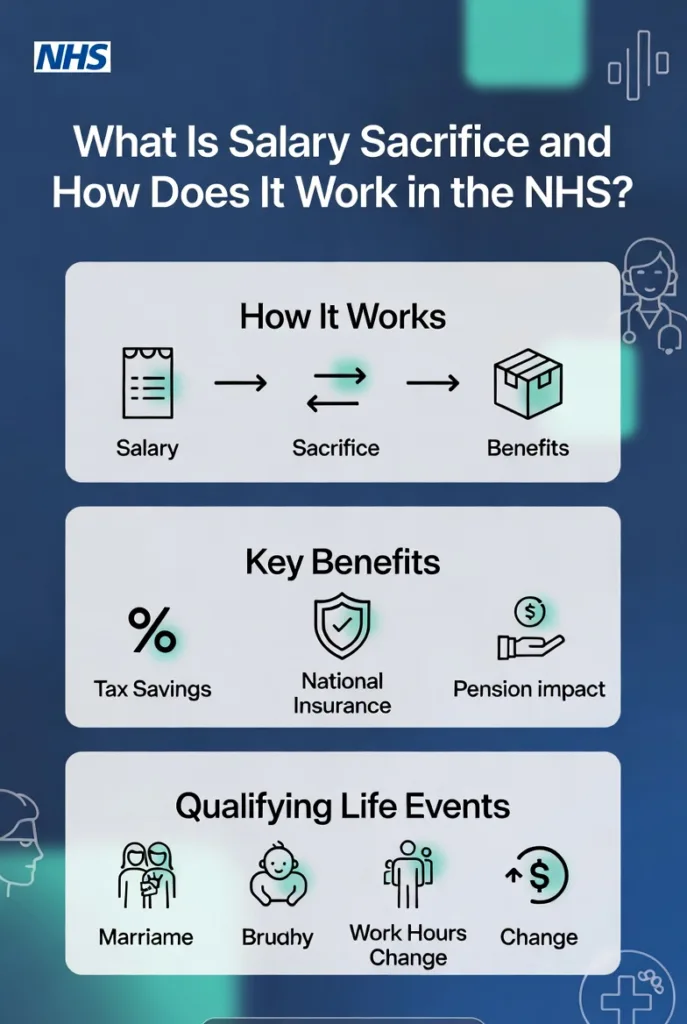
NHS salary sacrifice is a contractual agreement between you and your NHS employer to reduce your gross pay by an agreed amount, in exchange for a non-cash benefit of equivalent value. The key advantage is that your Income Tax and National Insurance contributions are calculated on your lower salary, not your original one — so you immediately pay less tax each month. Think of it like this: instead of buying something with money that has already been taxed, you get it before the taxman takes his cut.
The legal term you may also hear is ‘salary exchange’ — it means exactly the same thing. Your employment contract is temporarily varied to reflect the new, lower salary for the period of the scheme.
| Important distinctionThere is a difference between salary sacrifice and a salary deduction scheme. In a salary deduction scheme, the cost is taken after your pension and tax have already been calculated — so you do not get the same tax saving. Always confirm with your payroll department which type applies to any benefit you are offered. |
How Does NHS Salary Sacrifice Work? Step by Step
Let us walk through exactly what happens to your pay when you enter a salary sacrifice arrangement.
- You choose a benefit offered by your NHS Trust — for example, a lease car.
Your HR or payroll department will present the options your Trust has signed up to. Not every Trust offers every scheme, so always check what is available locally.
- You agree to reduce your contractual gross pay by the monthly cost of that benefit.
This is a formal variation to your employment contract. The reduction is a fixed monthly amount for the duration of the scheme — usually 12 to 36 months depending on the benefit.
- Your Tax and National Insurance are calculated on your new, lower gross salary.
This is where the saving comes in. If you earn £35,000 a year and sacrifice £1,200 for a bicycle scheme, HMRC treats your salary as £33,800 for that year. You pay Income Tax and National Insurance on £33,800, not £35,000.
- Your employer provides the benefit directly.
They purchase or lease the item on your behalf and provide it to you as a non-cash benefit. The monthly lease or hire cost is deducted from your gross pay before anything else is calculated.
- You use and enjoy the benefit throughout the scheme period.
The arrangement typically stays in place for a fixed term. You usually cannot exit early unless you experience a qualifying lifestyle change such as pregnancy, marriage, or redundancy.
Real Example: A Band 5 Nurse on the Cycle to Work Scheme
To make this concrete, here is how the numbers look for an NHS Band 5 nurse earning approximately £29,970 in 2026/27 who joins the cycle to work scheme with a £1,000 bike.
| Without Salary Sacrifice | With Salary Sacrifice (£1,000 bike) | |
| Gross Salary | £29,970 | £28,970 |
| Income Tax Paid (approx.) | £3,594 | £3,394 |
| National Insurance (approx.) | £2,157 | £2,037 |
| Net Saving Per Year | — | ~£320 |
| Effective cost of £1,000 bike | — | ~£680 |
A basic-rate taxpayer saves roughly 32p for every £1 sacrificed (20% Income Tax + approximately 8% NI after the 2024/25 threshold changes). Higher-rate taxpayers on Band 8b and above save even more.
Which NHS Salary Sacrifice Schemes Are Available in 2026/27?
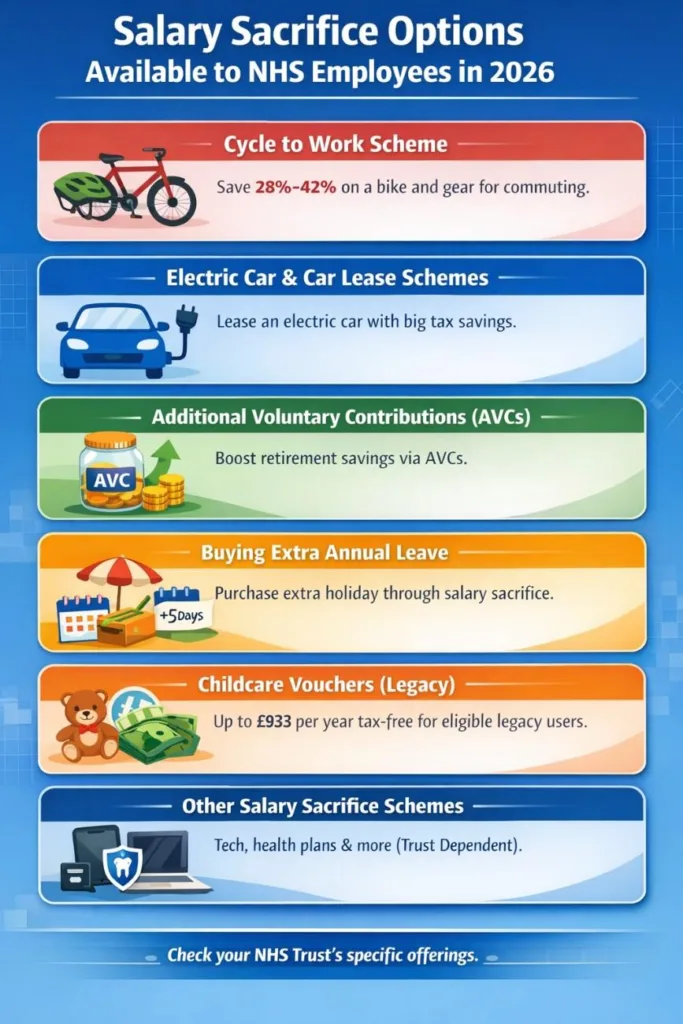
The specific schemes on offer depend on your NHS Trust, but most larger organisations offer the following options. It is worth noting that following changes introduced in April 2017, only certain schemes still qualify for both Income Tax and National Insurance savings. Those that do are highlighted below.
1. Cycle to Work Scheme (NHS Bike Scheme)
This is the most widely available NHS salary sacrifice scheme. Your Trust purchases a bicycle and cycling safety equipment, and you hire it back via monthly salary deductions over 12 to 18 months. At the end of the term, you typically have the option to buy the bike at a fair market value.
Savings: Both Income Tax and National Insurance savings apply. A basic-rate taxpayer saves around 32% on the cost of the bike; a higher-rate taxpayer saves around 42%.
- Covers standard bikes, e-bikes, and safety gear including helmets and lights
- No upper limit on the bike value for NHS employees (unlike some private sector schemes)
- Does not reduce your pensionable pay in Scotland for qualifying arrangements
2. NHS Electric Car Scheme (EV Salary Sacrifice / Green Car Scheme)
One of the fastest-growing NHS employee benefits in 2026/27 is the electric vehicle lease scheme. Your Trust leases a brand-new electric vehicle on your behalf, and the monthly cost is deducted from your gross salary before tax.
The crucial tax advantage here is Benefit-in-Kind (BiK) tax. Pure electric vehicles currently carry a BiK rate of just 2% for 2025/26 and 2026/27 — compared to 20-37% for petrol or diesel cars. This means the normally feared company car tax is almost negligible for EVs, making the overall saving substantial.
- Typical package includes insurance, breakdown cover, servicing, and MOT
- Most NHS Trusts access EV schemes through the Crown Commercial Service (CCS) framework — a government pre-approved buying arrangement
- No personal credit check required in most CCS-framework schemes
- If you leave the NHS or change Trusts, you can usually return the car without penalty if you have had it for more than three months
| Benefit-in-Kind Tax Warning for Non-EVsIf you choose a petrol or diesel car, the Benefit-in-Kind tax can easily wipe out all of your salary sacrifice savings and leave you worse off. Always calculate your full tax position — including BiK — before committing to a non-EV car lease. |
3. NHS Car Lease Scheme (Non-EV)
NHS Trusts also offer salary sacrifice for conventional petrol, diesel, and hybrid vehicles. The mechanics are the same as for EVs, but the Benefit-in-Kind tax rate is significantly higher depending on the car’s CO2 emissions. Hybrids, despite their green image, have seen rising BiK rates in recent years, making pure EVs the far more tax-efficient option for most staff.
4. Childcare Support (Tax-Free Childcare)
The government’s Tax-Free Childcare (TFC) scheme works differently from a traditional salary sacrifice arrangement, but it remains one of the most valuable financial benefits available to NHS parents. You set up a government-backed childcare account through the GOV.UK website, and for every £8 you pay in, the government adds £2 — up to £2,000 per child per year (£4,000 for children with disabilities).
Note: The older employer-supported childcare voucher scheme closed to new entrants in October 2018. If you were enrolled before that date and your employer still offers the scheme, you may still benefit — but check with your payroll team. You cannot use both Tax-Free Childcare and childcare vouchers at the same time.
- Available for children up to age 11 (12 for children with disabilities)
- Can be used alongside 15 or 30 hours of government-funded free childcare
- No salary sacrifice of your NHS pay is involved — contributions are from your net, post-tax salary
5. Home Electronics and Technology Scheme
Many NHS Trusts partner with technology providers to allow staff to spread the cost of computers, tablets, smartphones, smart TVs, and white goods (such as washing machines and refrigerators) via monthly payroll deductions over an agreed contract length.
Important: Since April 2017, home electronics schemes do not qualify for Income Tax or National Insurance savings in the same way as cycles or EVs. The cost is typically deducted from net pay, not gross pay, so there is no tax saving — but you still benefit from spreading the cost interest-free. Always confirm with your payroll department whether your specific scheme is a true salary sacrifice or a salary deduction arrangement.
6. Car Parking
Some NHS Trusts offer hospital car parking as a salary sacrifice benefit. As with home electronics, car parking no longer attracts Income Tax or National Insurance savings following the 2017 rule changes. The benefit is the convenience of spreading the parking cost across monthly pay, not a tax reduction.
7. Gym Membership
A number of NHS organisations include gym membership in their salary sacrifice or staff discount offering. Again, post-2017 rules mean there is no Income Tax or NI saving, but some Trusts negotiate significantly reduced rates for NHS staff, making it a worthwhile perk even without the tax angle.
Quick Reference: NHS Salary Sacrifice Schemes 2026/27
| Scheme | Tax Saving? | NI Saving? | Affects Pension? |
| Cycle to Work | Yes | Yes | Yes |
| Electric Car (EV) | Yes (low BiK) | Yes | Yes |
| Petrol/Diesel Car | Yes (offset by high BiK) | Yes | Yes |
| Tax-Free Childcare | Government top-up only | No | No |
| Home Electronics | No (post-2017) | No | No |
| Car Parking | No (post-2017) | No | No |
| Gym Membership | No (post-2017) | No | No |
NHS Salary Sacrifice and Your Pension — The Hidden Cost Most People Miss
This is the section of every salary sacrifice guide that most websites either skip or bury at the bottom. We are putting it front and centre because it is arguably the most important thing you need to understand before signing any agreement.
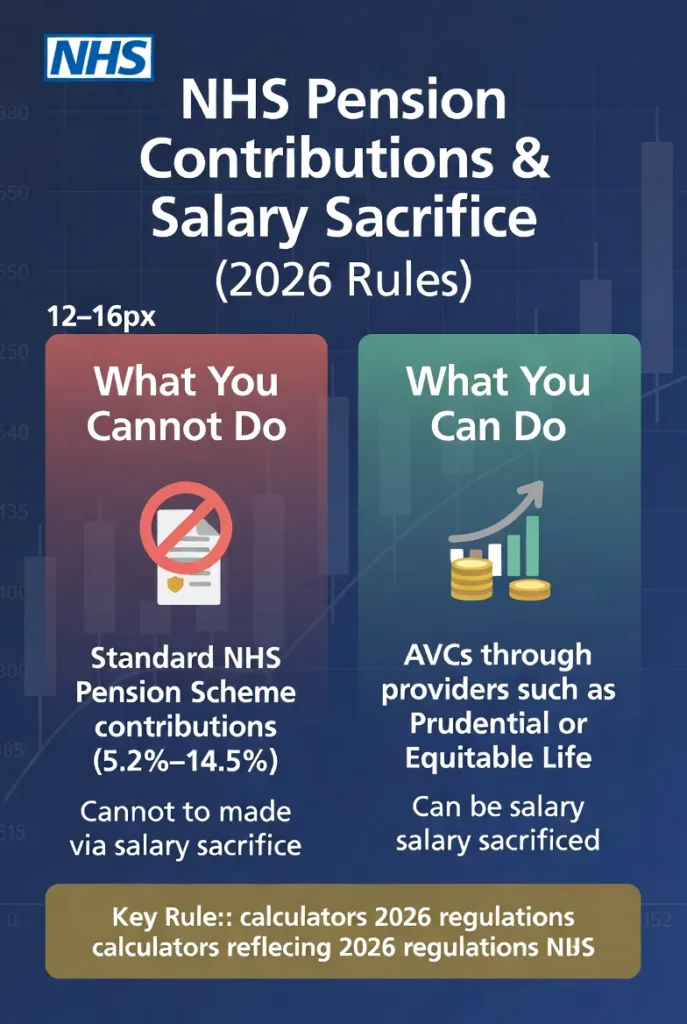
When you sacrifice part of your salary, your pensionable pay — the figure used to calculate your NHS pension benefits — is reduced by the same amount. This is not a minor administrative detail. It can have real consequences for your retirement income, your death-in-service benefit, and your ill-health retirement entitlement.
How the 2015 CARE Pension Scheme Is Affected
Most NHS staff are now in the 2015 Career Average Revalued Earnings (CARE) scheme. In this scheme, your pension benefit for each year is built up as 1/54th of your pensionable earnings for that year. So if you sacrifice £3,000 from your salary in a given year, the pension you build up in that year is calculated on a salary that is £3,000 lower.
Over a full career, multiple years of salary sacrifice can add up to a noticeably smaller pension pot. The effect compounds quietly year by year, which is why it deserves serious thought before you commit — especially to a long-term arrangement like a three-year car lease.
The Tier Shift Benefit — When Sacrifice Can Help
There is one scenario where a salary sacrifice can actually improve your pension position. NHS pension contributions are tiered — the percentage you pay rises as your salary crosses certain thresholds. If your salary sits just above a tier boundary, a modest sacrifice could drop your contribution tier, reducing the percentage of your salary that goes towards your pension and increasing your take-home pay.
This is a complex calculation. Use an NHS salary sacrifice calculator to model your specific position before making decisions based on this possibility.
Impact on the 1995 and 2008 Sections
If you are still in the older 1995 or 2008 final salary sections of the NHS Pension Scheme (some longer-serving staff remain in these), the effects are more complex. These schemes calculate your pension based on your final or best pensionable pay, and a salary sacrifice that reduces that figure close to retirement can permanently reduce your lifetime pension benefit. The BMA strongly advises members in these sections to model the pension impact carefully or seek independent financial advice before entering a salary sacrifice arrangement.
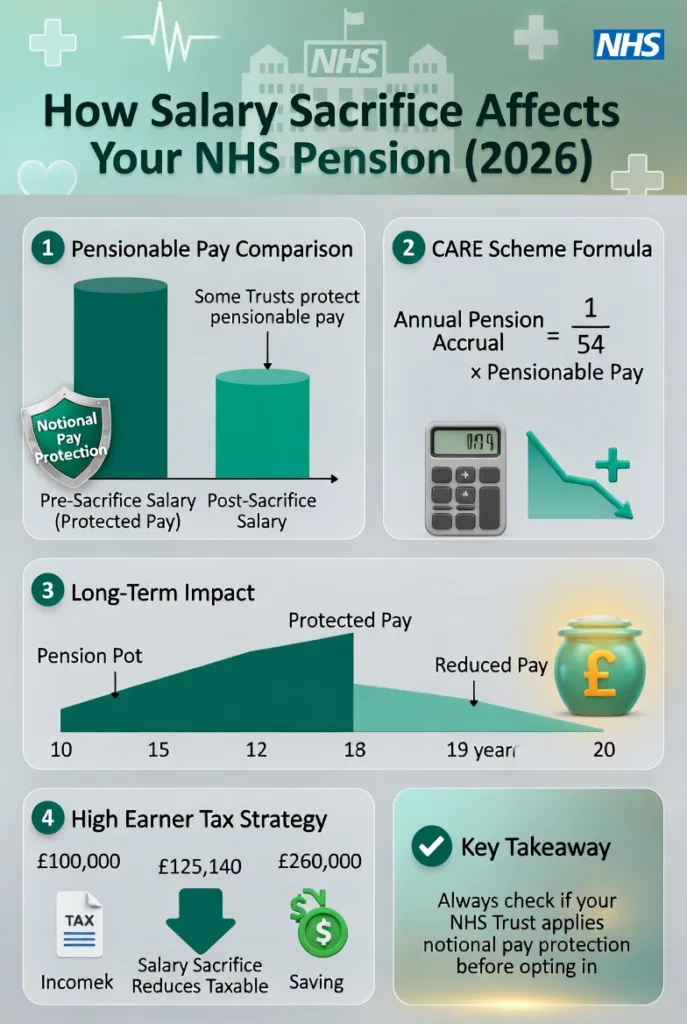
| Scotland: Different Rules ApplyIn Scotland, salary sacrifice arrangements for childcare vouchers and the cycle to work scheme do not reduce your pensionable pay. All other salary sacrifice arrangements in Scotland have reduced pensionable pay since December 2023. If you are an NHS Scotland employee, confirm the specific rules with your payroll team before signing up. |
How NHS Salary Sacrifice Affects Your Take-Home Pay
Let us look at three real-world examples across different Agenda for Change bands to show exactly what salary sacrifice does to monthly take-home pay in 2026/27. These figures are illustrative and based on England rates; your actual figures will depend on your step point, student loan status, pension tier, and Trust.
| Scenario | Band | Gross Salary | Sacrifice | Approx. Monthly Saving |
| Cycle to Work (£1,000 bike over 12 months) | Band 3 | £24,071 | £83/month | ~£27/month |
| EV Lease Car | Band 6 | £37,338 | £350/month | ~£112/month |
| EV Lease Car (higher rate) | Band 8b | £70,417 | £500/month | ~£210/month |
Higher-rate taxpayers save more because they avoid 40% Income Tax rather than 20%, plus the 2% National Insurance reduction above the upper earnings limit.
Salary Sacrifice and Maternity Pay — What NHS Staff Must Know
This is a critical area that catches many NHS staff off guard. If you are pregnant and currently in a salary sacrifice arrangement, your Occupational Maternity Pay is calculated based on your average weekly earnings during a specific reference period — typically around weeks 18 to 25 of your pregnancy.
Because your sacrificed salary reduces your recorded gross pay, your average earnings figure will be lower during this period. This directly reduces the full pay and half pay amounts you receive while on maternity leave.
- Many NHS Trusts allow you to exit a salary sacrifice arrangement on becoming pregnant, to protect your maternity pay
- You usually need to give a specific period of notice to exit — ask HR as soon as possible
- Statutory Maternity Pay (SMP) is calculated by HMRC using your average earnings, so a lower sacrificed salary affects SMP as well as Occupational Maternity Pay
- Always confirm your Trust’s specific policy with your HR department before you begin maternity leave
Salary Sacrifice and Mortgage Applications
Another trade-off that NHS staff sometimes discover too late: when you apply for a mortgage, lenders look at your income to decide how much they will lend you. Salary sacrifice complicates this picture.
- Some lenders use your contractual (pre-sacrifice) salary — the higher figure — when calculating affordability
- Others use your reduced net pay or P60 salary — which is lower — and this can reduce the maximum you are able to borrow
- If you are planning to buy a home or remortgage, speak to a mortgage broker before committing to a new multi-year salary sacrifice arrangement
Your death-in-service benefit and life assurance cover may also be calculated differently depending on your Trust’s policy. Most Trusts use your pre-sacrifice salary for these calculations, but it is vital to confirm this in writing before signing a high-value sacrifice agreement.
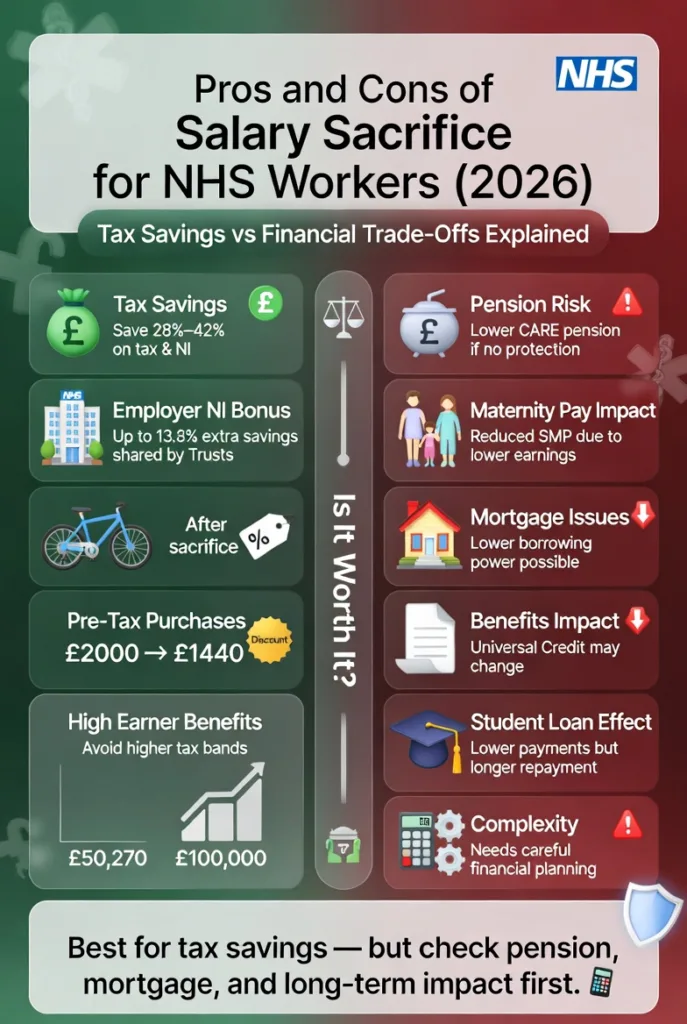
NHS Salary Sacrifice: The Pros and Cons at a Glance
| Advantages | Disadvantages |
| Save on Income Tax and National Insurance immediately | Reduces your pensionable pay (2015 CARE scheme) |
| Access benefits (cars, bikes) at a lower real cost | Can affect maternity and sick pay calculations |
| EVs are especially tax-efficient due to low BiK rates | May lower your mortgage borrowing capacity |
| No upfront cost for most schemes (no deposit for EV leases) | Usually locked in for 12-36 months — hard to exit early |
| National Insurance saving for your employer too | Life assurance and redundancy pay may be based on lower salary (Trust-dependent) |
Who Is Eligible for NHS Salary Sacrifice?
Eligibility depends on your specific Trust and the scheme in question, but the general requirements are:
- You must be employed directly by an NHS Trust on a permanent or fixed-term contract
- Your remaining salary after the sacrifice must not fall below the National Minimum Wage — your employer is legally obliged to ensure this
- Some schemes have minimum service requirements (e.g., three or six months of employment)
- Bank, agency, and locum workers are generally not eligible, but check with your employer
If your salary is close to the minimum wage threshold, your employer may not be able to offer you salary sacrifice at all — or may need to reduce the sacrifice amount to remain compliant. NHS Employers note that non-compliant organisations can face significant HMRC penalties.
How to Access NHS Salary Sacrifice Schemes
The process for joining a scheme is straightforward, though the exact steps vary by Trust and benefit type.
- Check what your Trust offers. Visit your Trust’s HR intranet or speak to HR directly. Not every Trust offers every scheme, and some operate on limited windows for applications.
- Check your eligibility. Confirm your employment type, length of service, and whether your post-sacrifice salary will remain above the NMW.
- Get a full breakdown of costs and savings. Ask HR or payroll to provide you with a written breakdown of your pre- and post-sacrifice net pay, and confirm the impact on your pension and any other benefits.
- Consider the timing. If you are planning to apply for a mortgage or go on maternity leave within the next year, factor those plans into your decision before signing.
- Sign the salary sacrifice agreement. This is a formal variation to your employment contract. Read it carefully, noting the term length, exit conditions, and what happens if you leave NHS employment.
- Enjoy the benefit. Payments are taken automatically from your gross pay each month.
Frequently Asked Questions (FAQ)
Does NHS salary sacrifice affect my pension contributions?
Yes. In the 2015 CARE scheme, sacrificing salary reduces your pensionable pay for the year in question, which reduces the pension benefit you build up in that year. In the older 1995/2008 sections, it can reduce your final pensionable pay, potentially lowering your lifetime pension. In Scotland, cycle to work and childcare arrangements are exempt from this rule.
Can I leave a salary sacrifice scheme early?
Generally, no — not without a qualifying lifestyle change. Life events that typically allow early exit include pregnancy, marriage, divorce, your partner becoming redundant, or a significant change in your financial circumstances. Your specific Trust may also define additional qualifying events. Always read the terms of your agreement before signing.
Will salary sacrifice show on my P60 or payslip?
Yes. Your P60 and payslip will show your reduced (post-sacrifice) gross salary, not your original contractual salary. This is the figure HMRC uses for all tax calculations. It is also what most mortgage lenders see unless you provide additional documentation from your employer.
Can I do salary sacrifice and Tax-Free Childcare at the same time?
Tax-Free Childcare is a government-run scheme, not a workplace salary sacrifice arrangement, so yes — you can use both. However, you cannot use Tax-Free Childcare at the same time as old-style employer childcare vouchers. If you are still on the legacy childcare voucher scheme, check with your payroll team before switching.
Is the NHS EV car scheme available to all NHS staff?
No. Only NHS Trusts that are part of a Crown Commercial Service (CCS) framework or a similar approved arrangement can offer the EV salary sacrifice scheme. Ask your HR department whether your Trust participates. If it does not, you can always request that they explore joining — it costs the Trust nothing to offer the scheme and saves them employer National Insurance too.
Does salary sacrifice affect my redundancy pay?
Redundancy pay in the NHS is typically calculated using your reckonable pay — which most Trusts define as your pre-sacrifice (contractual) salary. However, this is not universal, so you must confirm your Trust’s specific policy in writing before entering a high-value sacrifice arrangement.
What is the difference between salary sacrifice and salary deduction?
Salary sacrifice reduces your gross pay before tax and National Insurance are calculated — so you pay less of both. A salary deduction is taken from your pay after tax and NI have already been deducted, meaning you get no tax saving. The end result (a lower take-home amount) looks similar on your payslip, but the financial impact is very different. Always ask your payroll team which type applies.
Summary: Key Points for NHS Staff in 2026/27
- NHS salary sacrifice lets you pay for approved benefits from your pre-tax salary, reducing your Income Tax and National Insurance.
- The schemes that still attract both Tax and NI savings in 2026/27 are: cycle to work, electric vehicles, and employer-supported pension contributions.
- Most other schemes (home electronics, gym, parking) are salary deductions, not true salary sacrifices — so check before assuming a tax saving.
- Your pensionable pay is reduced by the amount sacrificed — this matters most if you are in the 2015 CARE scheme or approaching retirement in the older sections.
- Salary sacrifice can reduce your maternity pay, mortgage borrowing capacity, and sometimes your life assurance cover — weigh these against the tax saving.
- Always get a written breakdown from your payroll team showing your pre- and post-sacrifice net pay before signing anything.
Updated for the 2026/27 tax year. NHS Agenda for Change pay rates reference the 3.3% pay award effective April 2026. Always verify your specific band salary and Trust scheme availability with your HR or payroll department.

Daniel Carter is a senior NHS Payroll Accountant with over 10 years of experience in Agenda for Change pay structures, tax, and pensions. He created the NHS Pay Calculators platform to help NHS staff easily understand their take-home pay, sick pay, maternity pay, and pension entitlements through simple, accurate online tools.