NHS Healthcare Navigator Salary: 2026/27 Pay Explained
Nearly one in three NHS care navigators reports feeling underpaid for the demands of their role — yet many workers in the same position are unaware of the exact pay band they sit in or what they are legally entitled to earn. If you are in a care navigator or healthcare navigator role and want a plain-English answer to “how much should I be getting paid?”, this article is for you.
Table of Contents
The NHS healthcare navigator salary is set by the Agenda for Change (AfC) pay framework, which means your pay is determined by your band, your years of service, and the 2026/27 national pay award. In this article you will find the full pay band breakdown for navigator roles, a clear explanation of take-home pay after tax and pension deductions, a look at how experience and location affect your wages, and honest answers to the most common questions NHS staff ask about this role and its pay.
What Is an NHS Healthcare Navigator?
An NHS healthcare navigator — also called a care navigator, patient navigator, or PCN care navigator — is a trained member of the healthcare team whose primary job is to help patients find the right service, at the right time, through the right route. Rather than providing hands-on clinical treatment, the navigator acts as a guide through what can feel like a very complicated NHS system.
Think of it like having a knowledgeable friend inside the NHS who knows exactly which door to send you to, whether that is a physiotherapist, a social prescriber, a mental health service, or simply a better-informed GP appointment. The navigator saves both the patient’s time and the NHS’s resources by making sure people are not sent to services they do not need. Check NHS Non Clinical Support Worker Salary 2026/27 Pay Guide on our website.
Healthcare navigator roles exist across several settings, including:
- Primary Care Networks (PCNs) and GP surgeries
- Urgent treatment centres and walk-in services
- Community health teams and integrated care boards
- Hospital outpatient departments and cancer pathways
- Social prescribing and community referral hubs
Is a Care Navigator the Same as a Receptionist?
No — and this is one of the most common misconceptions about the role. While a receptionist’s primary job is administrative (answering phones, booking appointments, managing the front desk), a care navigator’s job is clinical navigation. They are trained to carry out brief consultations with patients, assess which service will best meet the patient’s needs, and signpost or refer accordingly. Many care navigator posts require knowledge of local health and social care pathways, which goes well beyond standard reception duties. In practice, some GP practices have retrained receptionists as care navigators, but the role itself carries greater responsibility and should be paid at a higher band.
What Pay Band Is an NHS Healthcare Navigator?
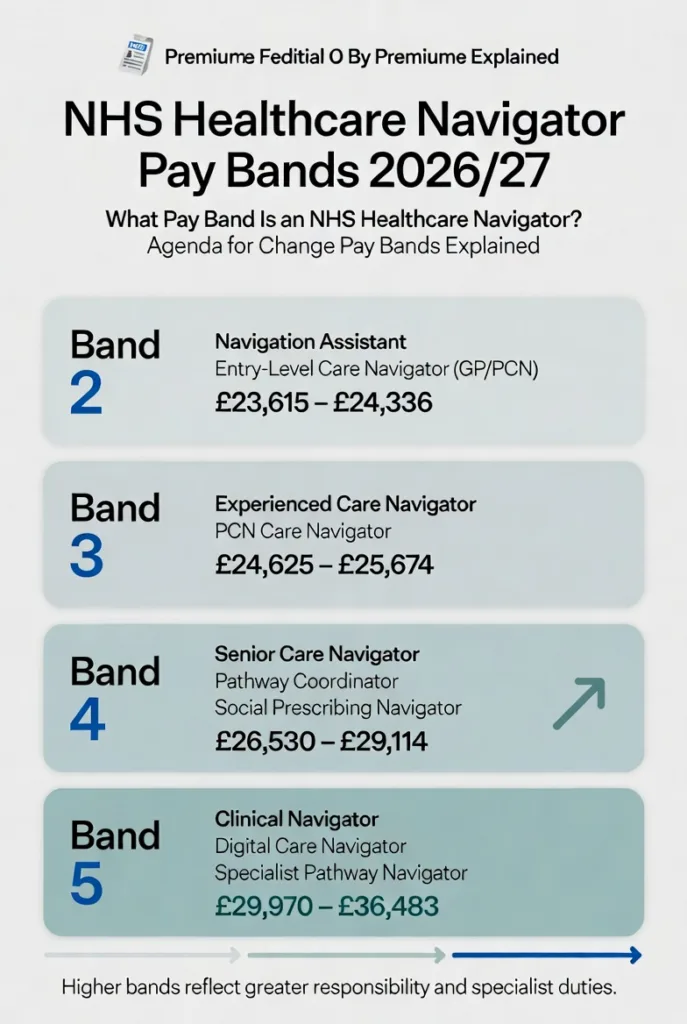
Under the Agenda for Change pay framework, NHS healthcare navigator roles most commonly sit at Band 2, Band 3, or Band 4, depending on the setting and the level of responsibility involved. This is the most important thing to understand about your pay: your band determines your starting salary, your pay progression points, and your annual increment steps.
Here is what each of those bands typically means for a healthcare navigator:
| Pay Band | Typical Navigator Role | 2026/27 Salary Range (England) |
| Band 2 | Navigation assistant, entry-level care navigator (GP/PCN) | £23,615 – £24,336 per year |
| Band 3 | Experienced care navigator, PCN care navigator | £24,625 – £25,674 per year |
| Band 4 | Senior care navigator, pathway coordinator, social prescribing navigator | £26,530 – £29,114 per year |
| Band 5 | Clinical navigator, digital care navigator, specialist pathway navigator | £29,970 – £36,483 per year |
Important: These figures reflect the 2026/27 Agenda for Change pay framework for England. Pay in Scotland, Wales, and Northern Ireland is set separately and may differ.
The 2026/27 NHS pay award has not yet been fully confirmed at the time of writing. However, the government’s pay review body recommendation and ongoing negotiations suggest a pay uplift for all AfC bands. We will update these figures as soon as the final award is published.
How Does NHS Healthcare Navigator Pay Work?
Understanding your pay under Agenda for Change is simpler once you know the three key building blocks: your band, your pay point, and your annual increment. Here is how it all fits together.
- Step 1 — Your Band. Your pay band is set by your job description.
Every NHS role is matched to an AfC band through a process called job evaluation. Your band is not based on your title but on the actual duties you carry out. If your role involves independently assessing patient needs and deciding on pathways, that is more likely to be Band 3 or 4 than Band 2. If your responsibilities are primarily signposting from a list of pre-agreed options, Band 2 may apply.
- Step 2 — Your Starting Pay Point. You start at the bottom of your band.
When you join a new NHS role, you normally start at the first pay point within your band — unless you have previous NHS experience, in which case your employer may place you higher. Each band has several pay points, and you move through them automatically based on years of service.
- Step 3 — Pay Progression. You receive an annual increment until you reach the top of your band.
In most AfC bands, you move up one pay point each year on your increment date. For a Band 3 navigator, this means moving from £24,625 to £25,674 over two to three years of service. Once you reach the top of your band, your pay only increases if there is a national pay award — or if you are promoted or regraded to a higher band.
- Step 4 — The Annual Pay Award. National pay awards uplift all pay points.
Each year the government accepts (or modifies) a recommendation from the NHS Pay Review Body. This is the “pay rise” that applies to all NHS staff. For 2025/26, AfC staff received a 5.5% uplift. The equivalent for 2026/27 is still being negotiated, but any agreed percentage will apply to every pay point in every band.
A Real-World Pay Example: PCN Care Navigator
Sarah is a care navigator working for a Primary Care Network in the East Midlands. She was appointed at Band 3, starting point, in April 2024, giving her a salary of £24,071 under the 2024/25 rates. In April 2025 she received the 5.5% national pay award, which brought her salary to £25,395. In July 2025 her annual increment moved her to the next pay point within Band 3. Under the expected 2026/27 pay framework, she would be earning approximately £25,674 before deductions. Her take-home pay after income tax, National Insurance, and her NHS pension contribution is around £1,680 to £1,750 per month, depending on her pension tier.
NHS Healthcare Navigator Take-Home Pay: What Actually Lands in Your Bank Account
Your gross salary — the number on your contract — is not the same as your take-home pay. Three things are deducted from your wages every month before you see any money: income tax, National Insurance contributions, and your NHS pension. Understanding each one helps you budget accurately and avoid surprises on payday.
Income Tax
Everyone in the UK has a personal allowance — currently £12,570 for the 2025/26 tax year — which means you pay no income tax on the first £12,570 of your earnings. Above that, you pay 20% on earnings up to £50,270 (the basic rate). The vast majority of NHS care navigators fall into this basic rate band.
National Insurance
You pay National Insurance (NI) contributions on earnings above £12,570 per year. The standard employee rate is 8% on earnings between £12,570 and £50,270. At a Band 3 salary, you would typically pay around £100 to £130 per month in NI.
NHS Pension
As an NHS employee, you are automatically enrolled in the NHS Pension Scheme, which is one of the best workplace pensions in the country. Your contribution rate depends on your earnings tier. For most Band 2 to Band 4 navigators, the employee contribution rate is 5.2% of your pensionable pay. This comes out of your gross salary before tax, which means it slightly reduces your tax bill at the same time.
| Band | Gross Annual Salary | Approx. Monthly Take-Home (England, 2026/27) |
| Band 2 (starting) | £23,615 | £1,540 – £1,580 |
| Band 3 (starting) | £24,625 | £1,590 – £1,640 |
| Band 3 (top) | £25,674 | £1,640 – £1,700 |
| Band 4 (starting) | £26,530 | £1,700 – £1,750 |
| Band 4 (top) | £29,114 | £1,850 – £1,920 |
| Band 5 (starting) | £29,970 | £1,890 – £1,960 |
These take-home estimates are approximate for England and assume standard personal allowance, basic rate income tax, 8% NI, and a 5.2% NHS pension contribution. Your actual pay may vary. Use the NHS pay calculator on nhspaycalculatorss.co.uk for a personalised figure.
What Qualifications Do You Need to Be an NHS Care Navigator?
One of the most frequently asked questions about this role is: do you need a degree to become a care navigator? The straightforward answer is no. A degree is not required for most care navigator positions, particularly at Band 2 and Band 3. What employers are looking for is a combination of relevant experience, good communication skills, and an understanding of NHS pathways and services.
The typical entry-level requirements for a Band 2 or Band 3 NHS care navigator post include:
- GCSEs in English and Maths (or equivalent), typically at grade C/4 or above
- NVQ Level 2 in Business Administration, Customer Service, or Health and Social Care (desirable, not always essential)
- Previous experience in a customer-facing, administrative, or healthcare environment
- Basic IT skills, including familiarity with Microsoft Word and clinical systems such as SystmOne or EMIS
- Good communication skills and the ability to remain calm under pressure
For senior navigator roles at Band 4 and above, employers often look for:
- Previous NHS experience, ideally in a patient-facing or care coordination role
- Knowledge of local health and social care pathways and referral processes
- Experience of working with vulnerable or complex patient groups
- A relevant Level 3 qualification, such as a BTEC Health and Social Care or an NVQ Level 3
No degree required. Most NHS care navigator roles ask for GCSEs, some customer service or healthcare experience, and good communication skills. Employers value attitude and aptitude over formal qualifications at this level.
What Does a Healthcare Navigator Actually Do Day to Day?
The day-to-day work of an NHS healthcare navigator is a mix of patient interaction, clinical signposting, and administrative coordination. At its core, the job is about making sure patients end up in the right place without unnecessary delays or wasted appointments.
A typical day for a GP practice care navigator might include:
- Answering calls from patients requesting an appointment and carrying out an initial triage-style conversation to understand what the patient actually needs
- Signposting patients to appropriate services — which could be a physiotherapist, a social prescriber, a pharmacist, or a mental health worker — rather than automatically booking a GP appointment
- Referring patients into community services or specialist pathways using agreed protocols
- Updating patient records on clinical systems such as SystmOne or EMIS Web
- Liaising with other members of the primary care or community health team to coordinate patient care
- Supporting patients who are navigating complex or multiple conditions through the system, including following up on referrals
In a hospital or urgent care setting, the navigator may also:
- Meet patients on arrival and direct them to appropriate clinical areas or waiting lists
- Coordinate discharge planning and onward referrals to community services
- Act as a point of contact for patients during a care pathway, for example a cancer patient navigator tracking a patient’s progress through diagnosis and treatment
How Does Location Affect NHS Care Navigator Salary?
The Agenda for Change pay framework sets the same base salary for all equivalent bands across England. However, if you work in or near London, you are entitled to a High Cost Area Supplement — often called “London weighting” — which is added on top of your AfC band salary. This can add between 5% and 20% to your pay, depending on where you are based.
| Location | Band 3 Starting Salary | Band 3 with London Supplement |
| Rest of England | £24,625 | N/A |
| Outer London | £24,625 | £26,696 (approx. +8.5%) |
| Inner London | £24,625 | £29,127 (approx. +18.2%) |
| Scotland | Separate AfC scale | £25,468 (approx. Scotland rate) |
| Wales | Separate AfC scale | Similar to England base rate |
If you work part-time, your salary is calculated pro rata — meaning proportional to your contracted hours. A Band 3 care navigator working 22.5 hours per week (a 0.6 whole-time equivalent) would earn approximately 60% of the full-time Band 3 salary.
Career Progression and Pay for NHS Healthcare Navigators
One of the genuine strengths of working in an NHS navigator role is that the AfC framework gives you a clear, transparent route to pay progression — something that is not always available in other sectors.
A realistic career pathway for an NHS care navigator looks like this:
| Stage | Typical Role | Band | Approx. Salary Range |
| Entry level | Navigation assistant / Band 2 care navigator | Band 2 | £23,615 – £24,336 |
| Developing | Care navigator / PCN navigator | Band 3 | £24,625 – £25,674 |
| Experienced | Senior care navigator / pathway coordinator | Band 4 | £26,530 – £29,114 |
| Advanced | Clinical / specialist navigator / social prescribing lead | Band 5 | £29,970 – £36,483 |
| Leadership | Care navigation team leader / service manager | Band 6+ | £37,338+ |
Progression between bands is not automatic — you typically need to apply for a higher-banded post, go through a job evaluation, or take on additional responsibilities that are then formally recognised through a re-banding process. However, many navigators find that the skills they develop — particularly knowledge of complex pathways, multi-agency working, and patient communication — make them strong candidates for senior roles in care coordination and health advisory positions.
NHS Healthcare Navigator Benefits Beyond Salary
Your gross pay is only part of the picture. NHS employment comes with a package of additional benefits that have real monetary value, and many workers underestimate how significant these are when comparing an NHS role with a private sector equivalent.
- The NHS Pension is a defined benefit pension — meaning your retirement income is based on your salary and years of service, not on stock market performance. Your employer contributes 23.7% of your pensionable pay into the scheme on top of your salary, which is worth thousands of pounds per year in additional retirement savings. NHS Pension Scheme.
- Depending on your length of service, you receive between 27 and 33 days of annual leave per year, plus eight general public holidays. This is significantly more than the UK statutory minimum of 28 days Annual Leave.
- NHS staff have access to Blue Light Card discounts and a wide range of NHS staff discounts covering retail, travel, healthcare, and more. NHS Discount Schemes.
- If you become ill, the NHS sick pay scheme provides full pay for a period based on your length of service (typically one month full pay after four months, rising to six months full pay after four years), which is far more generous than statutory sick pay. Occupational Sick Pay.
- Most NHS navigator roles are available on a part-time or flexible basis, which makes them accessible to carers, parents, and people with other commitments. Flexible Working and Part-Time Options.
FAQs Healthcare Navigator Salary
How Much Does an NHS Navigator Get Paid Per Hour?
At Band 3, an NHS care navigator earns approximately £12.62 to £13.16 per hour, based on a 37.5-hour working week. At Band 4, the equivalent hourly rate is roughly £13.60 to £14.93. These figures are for England and will differ slightly in Scotland, Wales, and Northern Ireland.
Do Care Navigators Get Unsocial Hours Pay?
If your role includes working evenings, weekends, or bank holidays, you are entitled to unsocial hours enhancements under AfC. The enhancement rates are: 30% on top of your basic hourly rate for Saturday work and evenings between 8pm and midnight; 60% for Sundays and bank holidays; and 100% (double time) for bank holidays in some trusts. For GP practices and PCN-employed navigators, the position can vary — check your contract.
Is a Care Navigator a Good Career Choice for Pay and Security?
For those entering or already working in the NHS at a support worker level, a care navigator role offers competitive pay relative to the qualifications required, excellent job security, and a clear progression path. The role is also growing in importance as the NHS moves toward a “social prescribing” and community-first model of care, which means demand for skilled navigators is increasing rather than shrinking.
What Is the Difference Between a Care Navigator and a Care Coordinator in Terms of Pay?
Care coordinator roles in the NHS — particularly those introduced under the PCN Additional Roles Reimbursement Scheme (ARRS) — tend to sit at Band 5 or above and involve a greater degree of clinical assessment and ongoing case management. NHS care navigators typically sit at Band 2 to Band 4. The ARRS-funded care coordinator role is specifically supported by NHS England funding to PCNs, which makes it a more secure and better-paid position than many navigator posts.
Frequently Asked Questions
What qualifications do I need to be a care navigator?
Most Band 2 and Band 3 care navigator roles require GCSEs in English and Maths, basic IT skills, and customer service or healthcare experience. A degree is not required. For Band 4 and above, a Level 3 qualification in health and social care and previous NHS experience are usually expected.
Do you need a degree to be a patient navigator?
No. The patient navigator role in the NHS does not require a degree. The focus is on communication skills, knowledge of local services, and the ability to work with patients empathetically. Many people move into this role from administration, reception, or care assistant backgrounds.
How much does an NHS navigator get paid?
In 2026/27, an NHS care navigator earns between £23,615 (Band 2 starting point) and £29,114 (Band 4 top of band) per year in England. Specialist or clinical navigator roles at Band 5 can earn up to £36,483. Take-home pay after tax, National Insurance, and pension is approximately £1,540 to £1,920 per month depending on band and pay point.
Is a care navigator a receptionist?
No. While some GP practices have rebranded reception staff as care navigators, the roles are distinct. A care navigator is trained to assess patient needs and signpost or refer them to appropriate services, which requires additional knowledge of care pathways. The role carries more clinical responsibility than a standard receptionist post and should be paid at a higher AfC band.
What does a navigator do in healthcare?
A healthcare navigator helps patients find the right service for their needs, often acting as the first point of contact in a GP practice, PCN, urgent care centre, or hospital setting. They assess what the patient needs, explain the available options, and direct or refer them accordingly. They do not provide clinical treatment but play a vital role in reducing unnecessary GP appointments and ensuring patients reach the right part of the NHS quickly.
Final Thoughts: Is Your NHS Navigator Pay Fair?
If you are working in an NHS care navigator role and feel uncertain about whether your band is right for your responsibilities, you have options. The first step is to review your job description against the AfC job evaluation criteria and compare it to published band descriptors. If your actual day-to-day duties are significantly beyond what your band suggests, you can request a formal job evaluation through your line manager or HR department.
You can also use the NHS pay calculator at nhspaycalculatorss.co.uk to get a precise breakdown of your gross salary, take-home pay, pension contributions, and how your pay compares across bands — all presented in plain English without the jargon.
The NHS navigator role is expanding. More PCNs, integrated care boards, and acute trusts are investing in navigation capacity. That means better-defined career pathways, more Band 4 and Band 5 posts, and growing recognition of the skill this work requires.
Understanding your pay is not just about money — it is about knowing your value and making sure you are fairly recognised for the genuinely important work you do within the NHS.
Related Calculators on This Site: NHS Take Home Pay Calculator | NHS Part-Time Pay Calculator | NHS Pension Calculator | NHS AfC Pay Bands 2026/27

Daniel Carter is a senior NHS Payroll Accountant with over 10 years of experience in Agenda for Change pay structures, tax, and pensions. He created the NHS Pay Calculators platform to help NHS staff easily understand their take-home pay, sick pay, maternity pay, and pension entitlements through simple, accurate online tools.