Transferring Previous Pensions into NHS Scheme
NHS employees can transfer previous pension rights from other employers into the NHS Pension Scheme, converting a cash transfer value into additional NHS pension service or added pension. The process is governed by NHSBSA rules and must be completed within 12 months of joining the NHS scheme. A £50,000 transfer value might buy approximately 1.5 to 3 years of additional NHS pension membership depending on your age and scheme section.
This guide covers how the transfer process works, what the calculations look like, the genuine advantages and disadvantages, and when transferring makes financial sense for NHS staff in 2026/27. You can easily calculate NHS pension according to Afc 2026/27.
How NHS Pension Transfers Work
When you join the NHS Pension Scheme, you can request a transfer of pension rights built up in a previous employer’s scheme — including workplace defined contribution pensions, defined benefit schemes from other public sector employers, and personal pensions. The transfer does not move money into your pocket — it converts a cash equivalent transfer value (CETV) from your old scheme into either additional membership credit or added pension within the NHS scheme.
The NHS Pension Scheme accepts transfers into both the 1995/2008 Section and the 2015 Scheme. Most NHS staff joining today are in the 2015 CARE Scheme. Transfers into the 2015 Scheme buy added pension — a fixed annual pension amount added to your eventual NHS pension at retirement. The employees are also given an option to opt out of NHS pension.
The 12-Month Rule — Critical Deadline
You must apply to transfer previous pensions into the NHS scheme within 12 months of joining. This deadline is strict. NHSBSA has discretion to extend it in exceptional circumstances, but extensions are rarely granted.
If you have previous pension entitlements and are within your first 12 months of NHS membership, this decision needs to be made promptly. After the deadline passes, the option is permanently closed for that employment.
For staff who have previously been in the NHS scheme, left, and rejoined — the 12-month clock resets from the date of rejoining, subject to scheme rules on aggregation of previous NHS service.
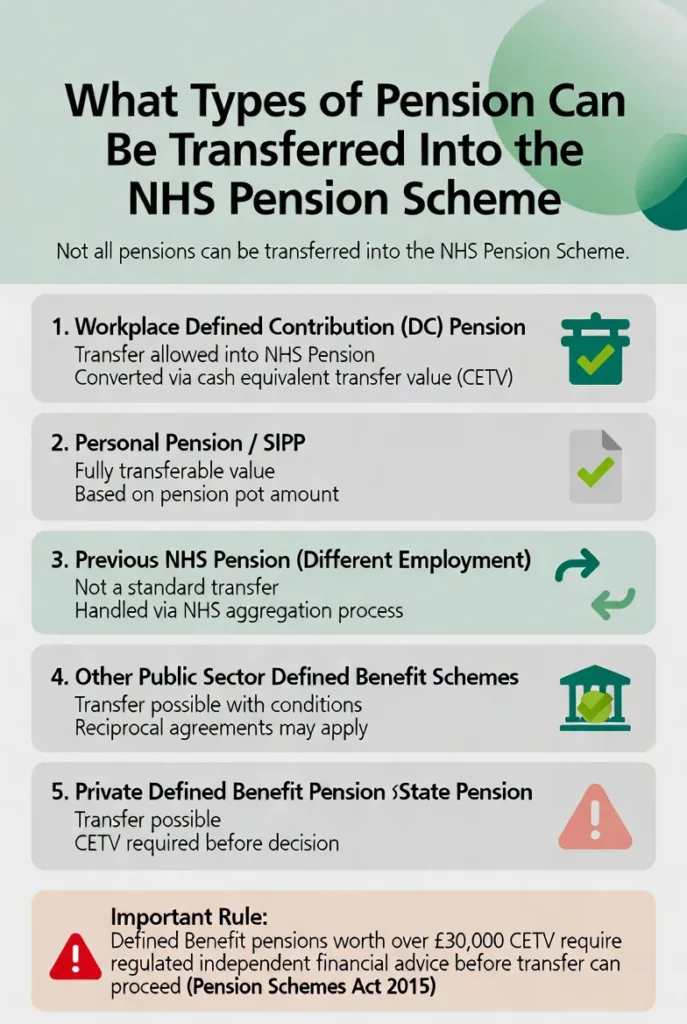
What Types of Pension Can Be Transferred In?
| Pension Type | Transferable? | Notes |
|---|---|---|
| Workplace defined contribution (DC) | Yes | Cash value transfers as CETV |
| Personal pension / SIPP | Yes | Full transfer value available |
| Previous NHS pension (different employment) | Via aggregation — not standard transfer | Separate aggregation process |
| Other public sector DB schemes (teachers, civil service) | Yes — with conditions | Some schemes have reciprocal arrangements |
| State Pension | No | Cannot be transferred |
| Defined benefit from private employer | Yes | CETV required; may need financial advice |
Transfers from defined benefit schemes with a CETV above £30,000 require regulated independent financial advice before the transfer can proceed — this is a legal requirement under the Pension Schemes Act 2015, not an NHS rule.
How the Transfer Calculation Works — 2015 NHS Scheme
In the 2015 NHS CARE Scheme, a transfer buys added pension — a fixed annual pension amount payable from your Normal Pension Age (currently State Pension Age, typically 67).
The amount of added pension your transfer value buys depends on:
- The cash equivalent transfer value (CETV) from your previous scheme
- Your age at the time of transfer
- NHSBSA actuarial factors current at the time of the calculation
Older members receive less added pension per pound transferred because the pension will be paid for fewer years. Younger members receive more added pension per pound because the pension is expected to be paid over a longer retirement.
Illustrative Transfer Calculation — 2015 Scheme
| Transfer Value | Age at Transfer | Approximate Added Pension/Year |
|---|---|---|
| £20,000 | 30 | ~£900 |
| £20,000 | 40 | ~£750 |
| £20,000 | 50 | ~£580 |
| £50,000 | 30 | ~£2,250 |
| £50,000 | 40 | ~£1,875 |
| £50,000 | 50 | ~£1,450 |
These are illustrative figures only. NHSBSA provides a formal transfer quotation showing the exact added pension your specific CETV will purchase at your age. Request this before making any decision.
What Your Previous Pension Is Actually Worth — CETV
Before evaluating a transfer, you need your Cash Equivalent Transfer Value from your previous scheme. Request this directly from your previous pension provider. CETVs are free to obtain and providers must supply one within three months of request.
Key points about CETVs:
- CETVs from defined benefit schemes may be significantly lower than the notional value of the pension promised — DB schemes frequently offer poor transfer value relative to what staying in the scheme would deliver
- CETVs from defined contribution schemes reflect the actual fund value — what you see is what transfers
- CETVs are guaranteed for three months from the date of calculation; if you do not act within that window, you need a new valuation
- Defined benefit CETVs above £30,000 legally require regulated financial advice before transfer — factor in adviser costs (typically £1,500 to £3,000) when evaluating whether a transfer makes financial sense
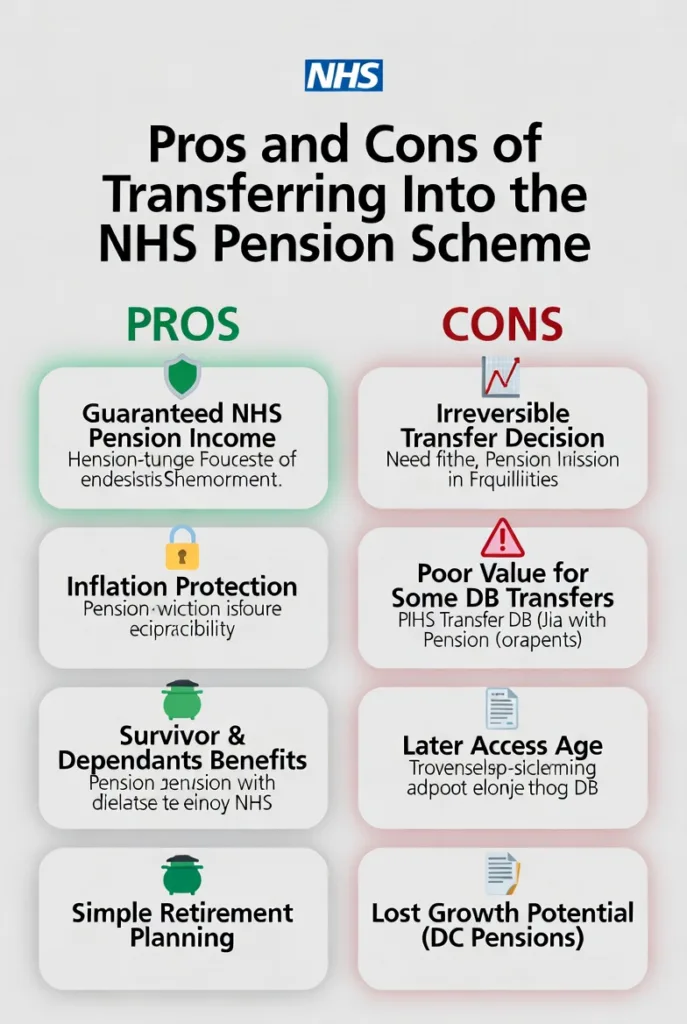
Pros of Transferring Into the NHS Pension Scheme
1. Consolidation into a Defined Benefit Scheme
The NHS Pension Scheme is a defined benefit scheme — your pension is guaranteed regardless of investment performance. Transferring a defined contribution pension (which depends on fund performance) into the NHS scheme converts uncertain future income into guaranteed income. For risk-averse NHS staff, this is a significant advantage.
2. Inflation Linking
NHS pension is revalued each year in line with inflation (Consumer Prices Index). Added pension bought through a transfer carries the same inflation protection. A defined contribution pension fund does not guarantee inflation protection in the same way.
3. Survivors’ and Dependants’ Benefits
Added pension purchased through a transfer carries NHS Pension Scheme death benefits and dependants’ pension entitlements. A DC pension pot left untouched outside the NHS scheme may or may not carry equivalent protections depending on how it is structured.
4. Simplicity
Consolidating pensions into the NHS scheme means one pension to manage, one scheme to understand, and one retirement income stream. For NHS staff who have had multiple previous employers, this reduces administrative complexity significantly.
5. No Investment Risk
Once transferred into the NHS scheme, your added pension is no longer subject to investment market risk. The NHS scheme absorbs that risk — your added pension amount is fixed and guaranteed.
Cons of Transferring Into the NHS Pension Scheme
1. Irreversible Decision
A transfer into the NHS Pension Scheme cannot be reversed. Once your CETV is converted to added pension, you cannot transfer it back out or to a different scheme. If your circumstances change — for example, you leave the NHS — you cannot recover the transfer as a separate pot.
2. Poor Value for Defined Benefit Transfers
If your previous pension is a defined benefit scheme — teacher’s pension, civil service pension, local government pension — the CETV is often poor value relative to what the scheme would pay you if you left the pension where it is. In many cases, leaving a previous DB pension untouched and drawing it separately at retirement produces better total retirement income than transferring it into the NHS scheme.
3. Normal Pension Age Is 67
Added pension bought through a transfer is payable from your Normal Pension Age — currently State Pension Age (67 for most NHS staff). If your previous scheme had an earlier Normal Pension Age — for example, the 1995 NHS Section has NPA 60 — transferring into the 2015 Scheme means waiting longer to access the transferred pension.
4. Financial Advice Costs
Transfers from DB schemes above £30,000 require regulated financial advice — typically costing £1,500 to £3,000. For modest transfer values, advice costs may consume a disproportionate share of the transferred pension benefit.
5. Inflation Risk on DC Transfers
If your DC pension pot has grown significantly, transferring it now locks in today’s actuarial conversion rate. If you are young and your DC fund would have continued growing, the opportunity cost of early transfer can be significant.
Transfer vs Keeping Pensions Separate — Which Is Better?
There is no universal answer. The decision depends on the type of previous pension, your age, your career plans and your attitude to risk.
When transferring IN makes sense:
- Your previous pension is a defined contribution pot and you prefer guaranteed income over investment-dependent income
- You are young (under 40) and the actuarial factors are favourable
- You have a small DC pot (under £10,000) where managing it separately adds little value
- You intend to spend your entire career in the NHS and want a simple consolidated pension picture
When keeping pensions separate makes more sense:
- Your previous pension is a defined benefit scheme with valuable guaranteed benefits — especially one with an earlier Normal Pension Age
- Your DC pension has significant growth potential and you are comfortable with investment risk
- The CETV is above £30,000 and financial advice costs reduce the net benefit
- Your previous scheme has a lower Normal Pension Age than the 2015 NHS Scheme’s NPA 67
Worked Example — Is This Transfer Worth It?
Scenario: Band 6 NHS nurse, age 35, rejoined NHS after five years in the private sector. Has a defined contribution workplace pension worth £28,000. Considering transfer into 2015 NHS Scheme.
Option A: Transfer into NHS scheme
- CETV: £28,000
- Age 35 actuarial factor (illustrative): £28,000 buys approximately £1,260 added pension per year
- Payable from age 67
- Inflation-linked, guaranteed
- No financial advice required (DC transfer, under £30,000)
Option B: Leave DC pension invested
- Current value: £28,000
- Assumed growth rate: 5% per year net of charges
- Value at age 67 (32 years): approximately £131,000
- Annuity rate at 67 (illustrative 4.5%): approximately £5,895 per year — but not inflation-linked and dependent on annuity rates at retirement
At face value, Option B appears to deliver more annual income at retirement — but it carries investment risk, annuity rate risk, and no inflation protection during deferment. Option A delivers less nominal income but with certainty and inflation linking from day one of retirement.
For a risk-averse NHS nurse committed to a long NHS career, Option A has genuine merit. For a financially confident nurse comfortable with investment risk, Option B may deliver more total retirement income.
Annual Allowance — What to Check Before Transferring
The Annual Allowance is HMRC’s limit on pension accrual that benefits from tax relief — currently £60,000 per year in 2026/27. Transfers into the NHS scheme count as pension input for Annual Allowance purposes in the year of transfer.
A large transfer in the same tax year as significant NHS pension accrual could breach the Annual Allowance, triggering a tax charge. For most Band 5 to Band 7 NHS staff with modest transfer values, this is not a practical concern. For high earners at Band 8a and above with large CETVs, it warrants careful calculation before proceeding.
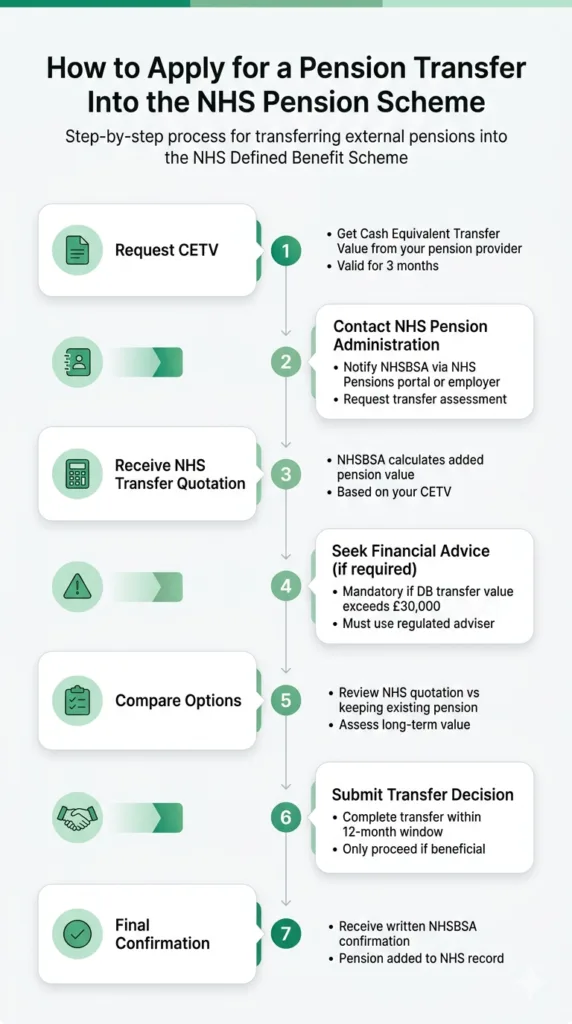
How to Apply for a Pension Transfer Into the NHS Scheme
- Request your CETV from your previous pension provider — free, valid for three months
- Notify NHSBSA that you wish to explore a transfer — contact via the NHS Pensions portal or your employer’s pension administrator
- Obtain a transfer quotation from NHSBSA showing the added pension your CETV will buy
- Take regulated financial advice if your DB transfer value exceeds £30,000 — legal requirement
- Compare the quotation against keeping your previous pension intact
- Submit the transfer application within your 12-month window if you decide to proceed
- Confirm receipt with NHSBSA — obtain written confirmation that the transfer has been applied to your record
Frequently Asked Questions
How long do I have to transfer a pension into the NHS scheme?
You must apply within 12 months of joining the NHS Pension Scheme. The deadline is strict and extensions are rarely granted. If you have previous pension entitlements, request your CETV and NHSBSA transfer quotation as early as possible after joining.
Can I transfer a defined benefit pension from another public sector job into the NHS scheme?
Yes, in most cases. Teachers’, civil service and local government pensions can be transferred. However, public sector DB schemes typically have valuable guaranteed benefits and favourable Normal Pension Ages — leaving them separate often produces better total retirement income than transferring. Regulated financial advice is required if the CETV exceeds £30,000.
Does transferring a pension affect my NHS pay or take-home?
No. A pension transfer does not affect your NHS salary, payslip deductions or take-home pay. It converts a lump sum transfer value into added pension — a one-time actuarial calculation with no ongoing impact on your monthly pay.
What happens to my transfer if I leave the NHS before retirement?
Added pension purchased through a transfer becomes deferred pension within the NHS scheme — it remains in the scheme, is revalued annually with inflation, and is payable from your Normal Pension Age regardless of when you leave NHS employment.
Is the Annual Allowance a concern for most NHS staff transferring pensions?
For most Band 5 to Band 7 staff with transfer values below £50,000, the Annual Allowance is unlikely to be a concern. For Band 8a and above staff with large transfer values in a year of significant NHS pension accrual, a calculation is advisable before proceeding.
Do I need a financial adviser to transfer a DC pension into the NHS scheme?
Not legally — regulated advice is only required for DB transfers above £30,000. However, independent financial advice is worthwhile for any significant transfer decision, particularly if you are unsure whether transferring or keeping pensions separate produces better retirement outcomes for your specific circumstances.
Summary
Transferring previous pensions into the NHS scheme converts a cash equivalent transfer value into guaranteed, inflation-linked added pension within the 2015 NHS CARE Scheme. The 12-month joining deadline is strict and non-negotiable. A £50,000 transfer value buys approximately £1,450 to £2,250 per year in added pension depending on age — with younger members receiving more per pound transferred.
Transfers make most financial sense for defined contribution pots where the certainty of NHS defined benefit is valued over investment-dependent income. Transfers from other defined benefit schemes are more complex — the CETV frequently undervalues the pension being surrendered, and leaving previous DB pensions intact often produces better total retirement income.
DB transfers above £30,000 require regulated financial advice by law. The decision is irreversible, so obtaining both a CETV from your previous scheme and a formal transfer quotation from NHSBSA before committing is essential.
This article provides general information only and does not constitute regulated financial advice. Pension transfer decisions involve complex trade-offs specific to individual circumstances. Consult a regulated independent financial adviser — particularly for defined benefit transfers above £30,000 — before making any transfer decision. NHS Pension Scheme rules are governed by NHSBSA; verify current rules and factors at nhsbsa.nhs.uk.

Daniel Carter is a senior NHS Payroll Accountant with over 10 years of experience in Agenda for Change pay structures, tax, and pensions. He created the NHS Pay Calculators platform to help NHS staff easily understand their take-home pay, sick pay, maternity pay, and pension entitlements through simple, accurate online tools.