NHS Bank Holiday & Weekend Pay 2026: Rates, Rules & TOIL Explained
If you work for the NHS, you already know that healthcare doesn’t stop for weekends or bank holidays. Patients need care 365 days a year, and the staff who provide that care outside normal working hours deserve proper compensation.
The short answer: NHS staff on Agenda for Change contracts receive unsocial hours enhancements for working weekends and bank holidays, ranging from 30% to 85% depending on the pay band and day worked. Bank holidays attract the highest rates (60-83% enhancement depending on band) plus a lieu day (TOIL) at plain time rates.
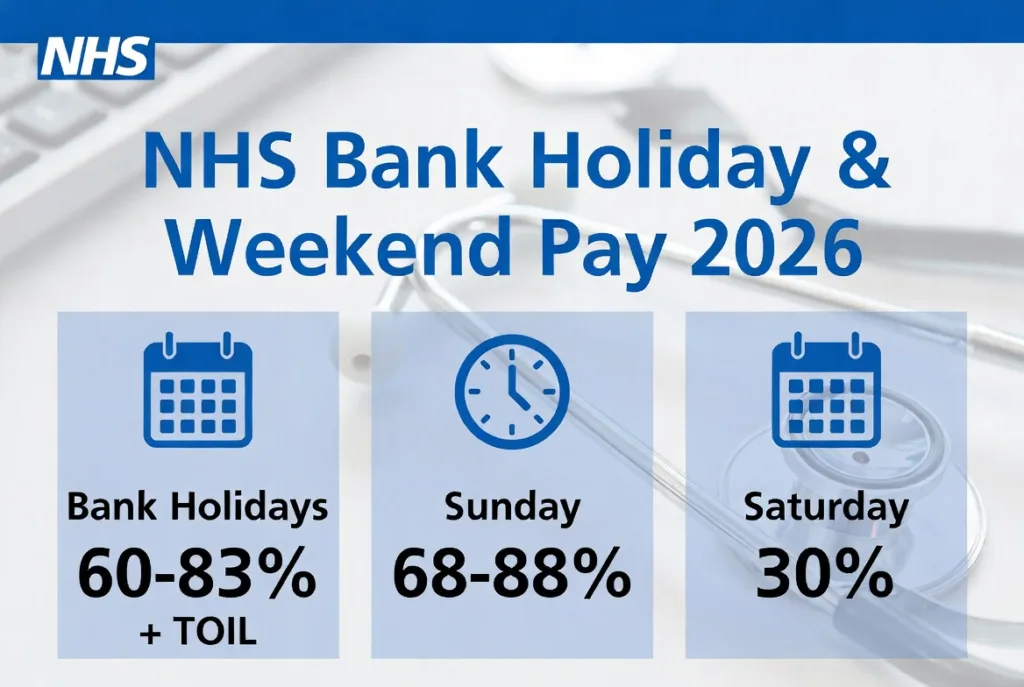
This guide covers everything you need to know about bank holiday and weekend pay enhancements in the NHS for 2026—the rates, the rules, the stacking effects, and how to calculate what you’re actually owed. For a complete overview of all NHS pay bands and their basic rates, see our NHS Pay Bands 2026-27 reference guide.
What Are Unsocial Hours Enhancements?
Unsocial hours enhancements are additional payments made to NHS staff who work outside normal daytime hours. These recognise the demands placed on workers who provide care when most people are off duty.
Under the Agenda for Change (AfC) framework, enhancements apply to:
- Evening shifts (typically 8pm–6am weekdays)
- Night shifts
- Saturday working
- Sunday working
- Bank holidays
- On-call periods
- Sleep-in duties
The amount you receive depends on your pay band, the day worked, and whether multiple enhancements apply simultaneously (known as “stacking”). To understand how these enhancements affect your overall take-home pay, use our NHS Take Home Pay Calculator which accounts for unsocial hours payments.
NHS Bank Holidays 2026: Complete List
For NHS staff in England and Wales, the 8 public/bank holidays for 2026 are:
| Date | Day | Bank Holiday |
|---|---|---|
| 1 January 2026 | Thursday | New Year’s Day |
| 3 April 2026 | Friday | Good Friday |
| 6 April 2026 | Monday | Easter Monday |
| 4 May 2026 | Monday | Early May Bank Holiday |
| 25 May 2026 | Monday | Spring Bank Holiday |
| 31 August 2026 | Monday | Summer Bank Holiday |
| 25 December 2026 | Friday | Christmas Day |
| 28 December 2026 | Monday | Boxing Day (substitute day) |
Note: Boxing Day 2026 falls on a Saturday, so the bank holiday is moved to Monday 28 December as a substitute day.
NHS Weekend and Bank Holiday Pay Rates 2026
The Enhancement Structure
Enhanced rates are paid on top of your basic hourly rate for unsocial hours. These enhancements are pensionable and taxable. To calculate your exact basic hourly rate before enhancements, use our NHS Hourly Rate calculator.
The standard enhancement structure under Agenda for Change is:
| Day/Period | Enhancement Range | Notes |
|---|---|---|
| Weekday nights (Mon–Fri, 8pm–6am) | 30–41% | Night enhancement only |
| Saturday (midnight to midnight) | 30% | Time-and-a-third equivalent |
| Sunday (midnight to midnight) | 68–88% | Time-and-two-thirds to nearly double |
| Bank Holiday (midnight to midnight) | 60–83% | Plus TOIL at plain time |
Source: NHS Terms and Conditions of Service Handbook
Enhancement Rates by Pay Band
Under the Section 2 provisions of the NHS Terms and Conditions Handbook, specific enhancements apply:
| Pay Band | Saturday Enhancement | Sunday/Public Holiday Enhancement | Bank Holiday Enhancement |
|---|---|---|---|
| Band 2 | 30% | 83% | 83% + TOIL |
| Band 3 | 30% | 69% | 69% + TOIL |
| Bands 4–9 | 30% | 60% | 60% + TOIL |
Source: NHS Terms and Conditions Handbook, Section 2
What This Means in Real Terms
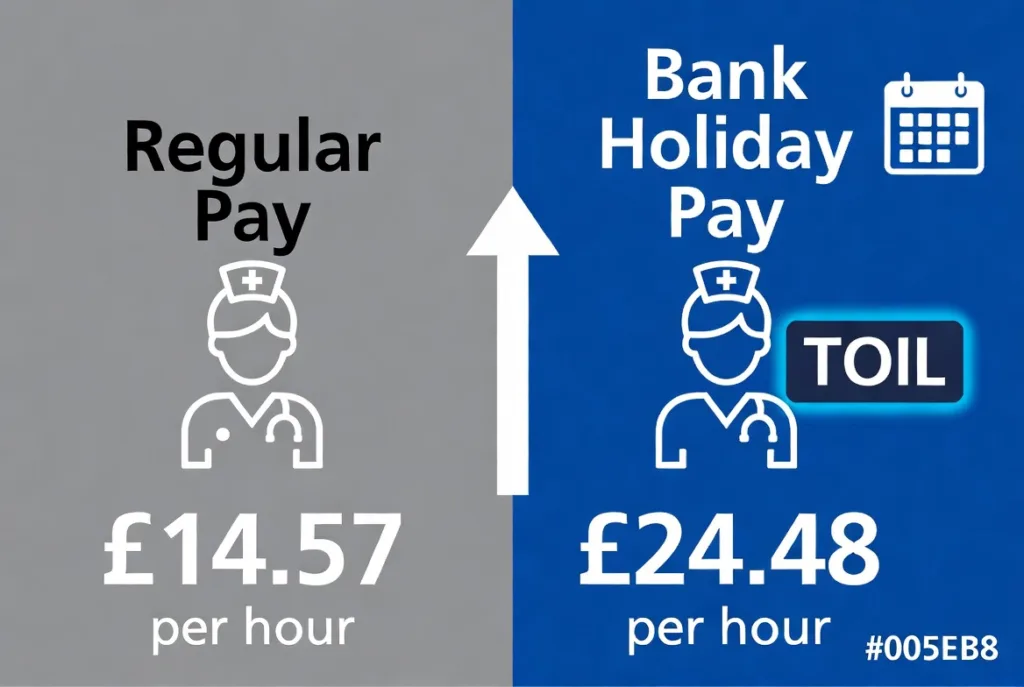
For a Band 5 nurse (2026/27 basic salary £28,407–£34,581, hourly rate approximately £14.57–£17.73):
- Saturday shift: £14.57 × 1.30 = £18.94 per hour (30% enhancement)
- Sunday shift: £14.57 × 1.68 = £24.48 per hour (68% enhancement)
- Bank Holiday shift: £14.57 × 1.68 = £24.48 per hour + a full day’s TOIL
For a Band 2 healthcare assistant (2026/27 basic hourly rate approximately £12.45):
- Saturday shift: £12.45 × 1.30 = £16.19 per hour
- Sunday/Bank Holiday: £12.45 × 1.83 = £22.78 per hour + TOIL on bank holidays
If you’re working overtime in addition to weekend or bank holiday shifts, you can calculate your total pay using our NHS Overtime Hours Calculator, which factors in both overtime rates and unsocial hours enhancements.
Enhancement Stacking: When Multiple Rates Apply
This is where NHS pay calculations get complex—and where you can significantly increase your earnings.
“Stacking” occurs when a shift falls into two or more unsocial hours categories simultaneously.
Stacking Scenarios
| Shift Type | Enhancements Applied | Total Uplift |
|---|---|---|
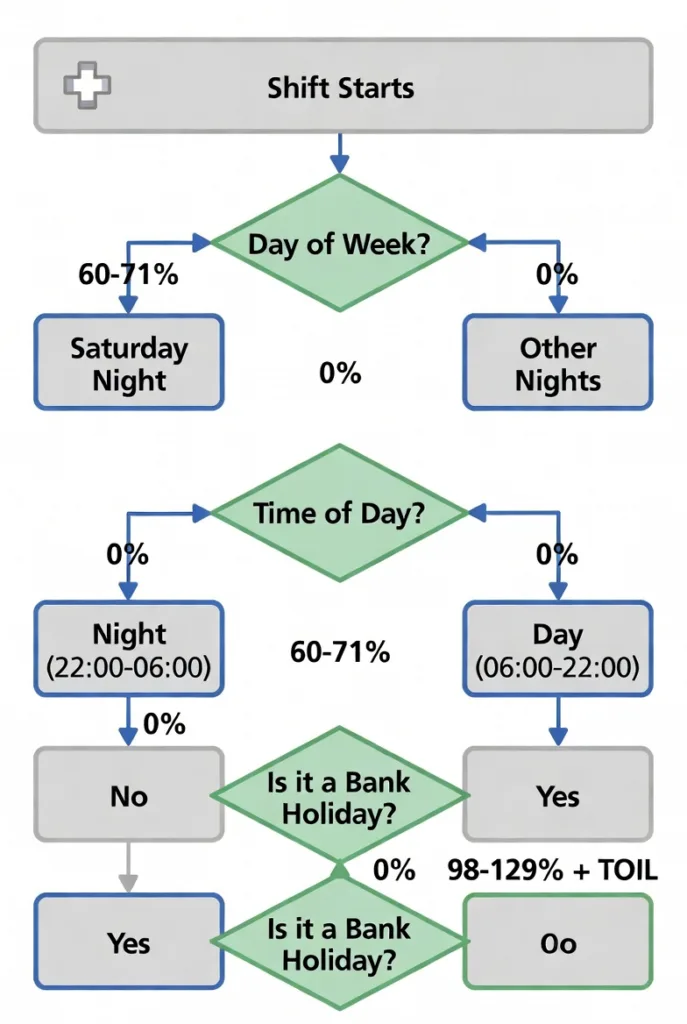
| Saturday night (8pm Sat – 6am Sun) | Night (30-41%) + Saturday (30%) | 60-71% |
| Sunday night (8pm Sun – 6am Mon) | Night (30-41%) + Sunday (68-88%) | 98-129% |
| Bank Holiday night | Night (30-41%) + Bank Holiday (60-83%) | 98-129% + TOIL |
| Friday night (after midnight) | Night only (may get Saturday rate locally) | 30-41% |
Source: NHS Unsocial Hours Calculator 2026/27
Real Example: Sunday Night Shift
A Band 5 nurse working a Sunday night (8pm Sunday to 6am Monday):
- Basic hourly rate: £14.57
- Night enhancement (30%): +£4.37 = £18.94
- Sunday enhancement (68%): +£9.91
- Total hourly rate: £28.82 per hour
That’s nearly double the basic rate—a 98% uplift from stacking both enhancements.
Important Caveat
Always check your local Agenda for Change agreement—some NHS Trusts cap maximum enhancements or interpret stacking differently. What’s paid can vary slightly between Trusts, so check your local intranet or speak to your payroll department.
Bank Holiday Pay: The TOIL (Time Off In Lieu) Factor
One of the most misunderstood aspects of NHS bank holiday pay is the TOIL element.
Under Section 13.4 of the NHS Terms and Conditions Handbook:
Staff who work on a bank holiday receive:
- The unsocial hours enhancement (60-83% depending on band) for hours worked
- Equivalent time off in lieu (TOIL) at plain time rates
What This Means in Practice
Working a bank holiday doesn’t just mean extra pay—it means:
- You get paid more for the hours you work (the enhancement)
- You get the day back as paid leave (the TOIL)
Example: A Band 5 nurse works an 8-hour bank holiday shift.
- Enhancement pay: 8 hours × £14.57 × 68% = £79.26 extra
- TOIL: 8 hours of paid leave to take at another time
- Total benefit: Enhancement pay PLUS a paid day off
Important: Most NHS staff on Agenda for Change contracts do not get a flat “double pay” rate for bank holidays. The combination of enhancement and TOIL is how the NHS compensates bank holiday working.
For a deeper understanding of how annual leave and TOIL work together, see our guide on NHS Annual Leave, TOIL and Carry Over.
NHS Bank Staff: Special Considerations
If you’re employed on an NHS Staff Bank, different rules may apply.
Key Points for Bank Staff
- Bank staff do accrue paid holiday from their first shift
- Holiday accrual is typically at 12.07% of hours worked under the Working Time Regulations 1998
- This is usually paid as rolled-up holiday pay (included in your hourly rate)
- However: Some NHS employers are reducing their bank rates of pay
The Royal College of Nursing (RCN) has raised concerns about bank rate reductions and is fighting these changes locally and nationally.
If you work on the bank, check your Trust’s current bank pay rates carefully—they may differ from substantive staff rates.
Part-Time Staff and Bank Holiday Entitlement
Part-time NHS staff are entitled to bank holidays on a pro-rata basis.
Under Section 13.6 of the NHS Terms and Conditions Handbook:
Part-time workers will be entitled to paid public holidays no less than pro-rata to the number of public holidays for a full-time worker, rounded up to the nearest half day.
How Pro-Rata Works
If you work 3 days per week (22.5 hours) instead of 5 days (37.5 hours):
- Full-time entitlement: 8 bank holidays
- Your pro-rata entitlement: 8 × (22.5 ÷ 37.5) = 4.8 bank holidays
- Rounded up to the nearest half day: 5 bank holidays
What About Overtime on Bank Holidays and Weekends?
When you work overtime that also falls during unsocial hours, both sets of rules apply.
Overtime + Unsocial Hours Stacking
- Standard overtime rate: Time-and-a-half (1.5×) or double time (2×) depending on agreement
- Unsocial hours enhancement: Applied on top of the overtime rate if the hours fall during unsocial periods
- On-call call-outs: When called in, you receive at minimum 1.5× with a minimum 1-hour payment per call-out; unsocial hours enhancements apply on top if working nights, weekends, or bank holidays during a call-out
Example
A Band 5 nurse called in for overtime on a bank holiday:
- Overtime rate (1.5×): £14.57 × 1.5 = £21.86
- Bank holiday enhancement (68% of basic): +£9.91
- Total hourly rate: £31.77 per hour
For a comprehensive calculation of your total pay including overtime and enhancements, use our NHS Overtime Hours Calculator.
How Much Could You Earn? Real-World Estimates
Based on the NHS Unsocial Hours Calculator 2026/27, here are estimated monthly enhancements for common shift patterns (Band 5, 2026/27 rates):
| Shift Pattern | Estimated Monthly Extra |
|---|---|
| Every weekend, Fri 8pm – Sun 6am | £850 – £1,500 |
| Rotating shifts (days, nights, weekends) | £650 – £1,100 |
| Saturday + Sunday day shifts every weekend | £1,300 – £2,100 |
| Permanent nights (Mon–Fri, 8pm–6am) | £450 – £750 |
| Christmas period (3 × 12h bank holiday shifts) | £450 – £750 (for the period) |
Source: NHS Unsocial Hours Calculator 2026/27 estimates
These figures are estimates only—actual amounts depend on your exact band, pay point, hours worked, and local Trust policies.
To see how these enhancements affect your net pay after tax and pension deductions, use our NHS Take Home Pay Calculator which provides a detailed breakdown of your monthly earnings.
Common Mistakes and How to Avoid Them
1. Assuming “Double Pay” for Bank Holidays
Mistake: Expecting 2× your normal rate for bank holidays.
Reality: You get an enhancement (60-83%) plus TOIL, not double pay.
2. Forgetting to Claim Stacking
Mistake: Only claiming the highest single enhancement.
Reality: Saturday nights and Sunday nights qualify for two enhancements (night + weekend).
3. Not Checking Your Payslip
Mistake: Assuming payroll automatically gets it right.
Reality: Payroll errors happen. The Electronic Staff Record (ESR) system can sometimes miscalculate, and delayed payments or fluctuating payments can lead to disputes.
4. Ignoring Local Variations
Mistake: Assuming all Trusts pay the same.
Reality: Some Trusts cap maximum enhancements or interpret stacking differently.
How to Check Your NHS Payslip for Weekend and Bank Holiday Pay
Your NHS payslip (via ESR) should show:
- Basic pay (your contracted hours at basic rate)
- Unsocial hours payments (separate line items for weekend and bank holiday enhancements)
- TOIL balance (accrued lieu days)
If you’re unsure whether you’ve been paid correctly:
- Check your roster against your payslip
- Verify the enhancement rates applied
- Compare with the Section 2 rates in the NHS Terms and Conditions Handbook
- Speak to your payroll department or HR
For a detailed breakdown of how to read your payslip and identify potential errors, see our comprehensive guide: NHS Payslip Explained.
Tax and Pension Implications
Enhancements for weekend and bank holiday work are:
- Taxable — they form part of your gross pay for income tax purposes
- Pensionable — they count towards your NHS Pension contributions and benefits
This means:
- Your take-home pay will be less than the gross enhancement after tax and National Insurance
- Your pension will be higher because pensionable pay includes enhancements
To calculate exactly how much tax you’ll pay on your enhanced earnings, use our NHS Tax Calculator. For information about how pension contributions are calculated on unsocial hours pay, see our NHS Pension Calculator.
National Variations: Scotland, Wales, Northern Ireland
While the Agenda for Change framework applies across the UK, there are some variations:
Scotland
- The full-time working week for Agenda for Change staff reduced from 37 hours to 36 hours from 1 April 2026
- Public holiday entitlements may differ—check your Board’s intranet for 2026-27 guidance
England and Wales
- Standard 37.5-hour week (reducing to 37 hours from 1 April 2026)
- 8 public/bank holidays per year
Northern Ireland
- Bank holiday count differs slightly from England/Wales
Always check your local Trust’s policies—while national frameworks set the baseline, local implementation can vary.
Frequently Asked Questions
Do NHS staff get paid for bank holidays if they don’t work?
Yes, if the bank holiday falls on a day you would normally work. You’re entitled to your normal pay for that day without working.
You’re still entitled to a day’s leave in lieu (TOIL) if the bank holiday falls on a day you would normally work but are rostered off.
You’re still entitled to a day’s leave in lieu (TOIL) if the bank holiday falls on a day you would normally work but are rostered off.
Do I get enhancements during annual leave?
Yes. Pay during annual leave includes regularly paid supplements, including payments for work outside normal hours. This means your holiday pay should reflect the enhancements you would normally receive.
Are bank staff entitled to bank holiday enhancements?
It depends on your Trust’s bank policy. Bank staff accrue holiday pay at 12.07% but may not receive the same enhancement rates as substantive staff. Check your Trust’s bank terms carefully.
What’s the difference between a bank holiday and a public holiday?
In NHS terms, they’re used interchangeably. The 8 days listed above are both bank holidays (for banking purposes) and public holidays (for employment purposes).
How many bank holidays do NHS staff get?
Full-time NHS staff on Agenda for Change contracts get 8 public holidays a year in England, in addition to 27, 29, or 33 days of annual leave depending on length of service.
Do part-time staff get the same bank holiday enhancements as full-time staff?
The enhancement rate (percentage) is the same, but the entitlement to bank holidays as paid leave is pro-rata based on your contracted hours.
Tools to Help You Calculate Your Pay
Understanding your pay is easier with the right tools. Here are calculators that can help you work out your weekend and bank holiday enhancements:
- NHS Overtime Hours Calculator — Calculate overtime with unsocial hours stacking
- NHS Take Home Pay Calculator — See how enhancements affect your net pay
- NHS Hourly Rate Calculator — Work out your basic and enhanced hourly rates
- NHS Tax Calculator — Understand tax implications of enhancements
- NHS Pay Bands 2026-27 — Full pay band reference
- NHS Pension Calculator — See how enhancements affect your pension
For a complete list of NHS pay and benefits calculators, visit our NHS Pay Calculators blog.
Summary: Key Takeaways
- Enhancements range from 30% to 83% depending on your band and the day worked
- Bank holidays pay 60-83% enhancement + TOIL — not double pay
- Stacking means Saturday nights and Sunday nights can attract two enhancements simultaneously
- Sunday night shifts can pay nearly double your basic rate
- Part-time staff get bank holidays pro-rata, rounded up to the nearest half day
- Enhancements are pensionable and taxable
- Bank staff should check their Trust’s rates carefully—some are being reduced
- Always check your payslip — payroll errors can and do happen. See our NHS Payslip Explained guide for help

Daniel Carter is a senior NHS Payroll Accountant with over 10 years of experience in Agenda for Change pay structures, tax, and pensions. He created the NHS Pay Calculators platform to help NHS staff easily understand their take-home pay, sick pay, maternity pay, and pension entitlements through simple, accurate online tools.