Best Family Budget Guide for NHS Staff 2026/27
NHS family budgets in 2026/27 start from a take-home of approximately £1,541 per month at Band 3 entry and reach around £2,480 at Band 7 mid-point after tax, NI and pension deductions. For a household with one NHS earner, the difference between Band 3 and Band 6 is approximately £620 per month net — meaningful but tight at every level given current UK living costs. This guide provides worked monthly budget examples for NHS families at Band 3, Band 4, Band 5, Band 6 and Band 7, covering housing, childcare, food, transport and savings — with practical strategies for each income level.
NHS Take-Home Pay by Band — The Starting Point
Before budgeting, the baseline is your actual monthly take-home after all statutory deductions. These figures assume England rates, standard tax code, NHS pension at standard tier, no student loan unless stated. Calculate your Take home salary with our easy to use calculator.
| Band | Mid-Point Gross | ~Monthly Take-Home | With Plan 2 Loan |
|---|---|---|---|
| Band 3 | £24,702 | ~£1,741 | ~£1,692 |
| Band 4 | £27,767 | ~£1,763 | ~£1,714 |
| Band 5 | £33,344 | ~£1,925 | ~£1,876 |
| Band 6 | £40,545 | ~£2,163 | ~£2,063 |
| Band 7 | £49,178 | ~£2,480 | ~£2,380 |
The Band 3 to Band 4 net jump is narrow — only £22 per month — because the pension contribution rate rises from 5.2% to 9.8% at Band 4. The largest single take-home jump is Band 5 to Band 6 at approximately £238 per month net.
Key Costs NHS Families Face in 2026/27
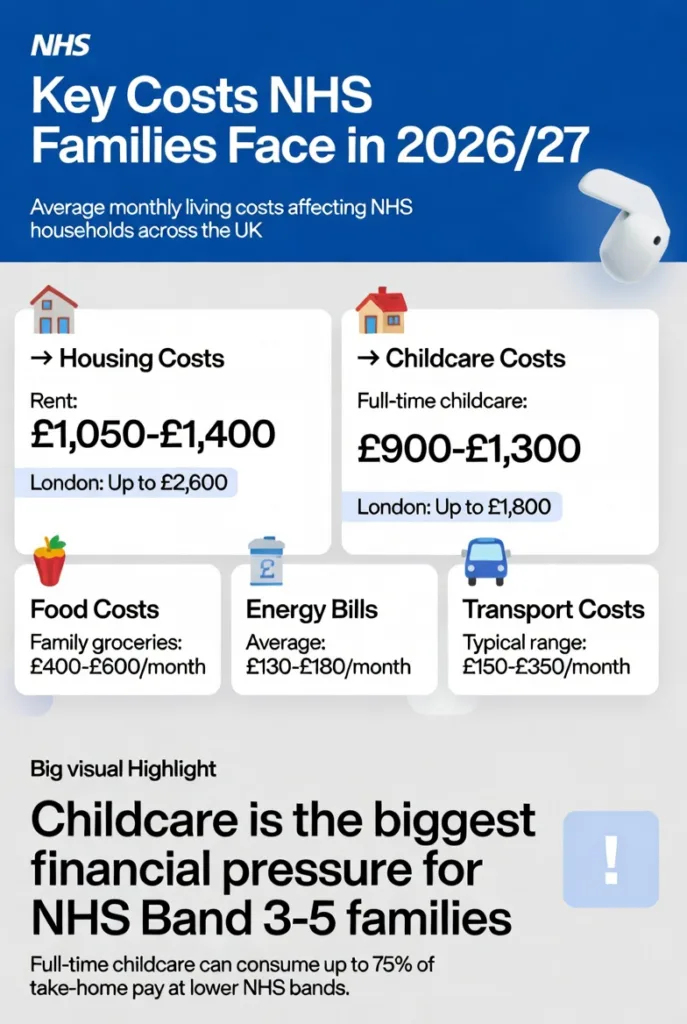
Before the band-by-band examples, these are the fixed cost anchors that shape every NHS family budget:
Average UK Monthly Costs 2026/27
| Cost Category | UK Average | London |
|---|---|---|
| Rent (2-bed) | £1,050 — £1,400 | £1,800 — £2,600 |
| Mortgage (2-bed, 90% LTV) | £900 — £1,200 | £1,400 — £2,000 |
| Childcare (1 child, full-time) | £900 — £1,300 | £1,200 — £1,800 |
| Food (family of 3–4) | £400 — £600 | £500 — £700 |
| Energy bills | £130 — £180 | £130 — £180 |
| Transport | £150 — £350 | £180 — £400 |
| Council tax (Band C–D) | £150 — £210 | £130 — £220 |
Childcare is the dominant pressure on NHS family budgets at Band 3 to Band 5. At Band 3 and 4, full-time childcare for one child can consume 50% to 75% of take-home pay — making two-income households effectively a necessity at those bands.
Band 3 Family Budget Example — £1,741/Month Take-Home
Profile: Band 3 healthcare support worker, partner working part-time (£900/month net), one child aged 3 accessing 30 free hours childcare. Renting outside London.
| Category | Monthly Cost | Notes |
|---|---|---|
| Rent (2-bed) | £950 | Shared with partner’s income |
| Council tax | £160 | Band C property |
| Energy | £145 | Average UK household |
| Food and groceries | £380 | Budget supermarket shopping |
| Transport (car + fuel) | £220 | Essential for shift patterns |
| Mobile phones (x2) | £40 | SIM-only contracts |
| Childcare top-up | £120 | Above 30 free hours |
| Clothing / household | £80 | |
| Total Outgoings | £2,095 | |
| Combined Income | £2,641 | NHS + partner |
| Monthly Surplus | £546 |
At Band 3 on a single income, this budget does not work without a partner’s contribution. The 30 free childcare hours make a critical difference — without them, childcare costs would consume the entire NHS take-home. Savings at this level require strict discretionary spending control.
Band 3 Budget Strategies:
- Maximise the 30 free childcare hours entitlement — available from age 9 months in 2026/27 for working parents
- Apply for NHS uniform tax relief (£25/year) via HMRC P87 — small but costs nothing to claim
- Use the NHS discount scheme (Health Service Discounts) for food, clothing and household costs
- Check Universal Credit eligibility — Band 3 households with children may qualify depending on partner income and hours worked
Band 4 Family Budget Example — £1,763/Month Take-Home
Profile: Band 4 senior support worker, partner not working (caring for two children aged 1 and 4). One child in funded childcare (30 hours). Renting outside London.
| Category | Monthly Cost | Notes |
|---|---|---|
| Rent (2-bed) | £950 | |
| Council tax | £165 | |
| Energy | £150 | |
| Food and groceries | £450 | Family of 4 |
| Transport | £200 | |
| Childcare (infant, part-time) | £450 | 15 hours per week |
| Mobile / broadband | £60 | |
| Clothing / household | £100 | |
| Total Outgoings | £2,525 | |
| Take-Home | £1,763 | |
| Shortfall | -£762 | Without benefits |
At Band 4 with one non-working partner and two children, this budget requires benefits to function. Universal Credit, Child Benefit and the two-child limit (where applicable) significantly affect the real household income picture.
Expected benefit additions at this profile:
- Child Benefit: £102.80/month (two children, 2026/27)
- Universal Credit (estimated): £400 — £600/month depending on childcare costs and housing
- Free school meals eligibility likely once eldest child starts school
Band 4 Budget Strategies:
- Claim all child benefit entitlements immediately — do not defer due to high income charge concerns at this salary level; Band 4 is well below the £60,000 threshold
- Explore salary sacrifice for childcare costs if trust offers it — reduces pensionable pay but saves tax and NI on childcare payments
- Consider NHS bank shifts on days when childcare is covered — even one shift per month at Band 4 (£13.62/hr basic) adds approximately £100 net
Band 5 Family Budget Example — £1,925/Month Take-Home
Profile: Newly qualified Band 5 nurse, Plan 2 student loan (take-home £1,876), partner working full-time (£1,600/month net). One child aged 2. Renting outside London.
| Category | Monthly Cost | Notes |
|---|---|---|
| Rent (2-bed) | £1,050 | |
| Council tax | £170 | |
| Energy | £150 | |
| Food and groceries | £420 | |
| Transport | £180 | |
| Childcare (full-time) | £900 | Primary pressure point |
| Mobile / broadband | £55 | |
| Student loan | £49 | Already deducted from pay |
| Clothing / household | £100 | |
| Subscriptions | £30 | |
| Total Outgoings | £3,104 | |
| Combined Income | £3,476 | NHS + partner |
| Monthly Surplus | £372 |
The student loan is already deducted before take-home — it does not appear as a separate budget line but is reflected in the lower take-home figure. The £372 monthly surplus is modest for a household with a young child and limited financial buffer.
Band 5 Budget Strategies:
- Tax-Free Childcare account — government adds £2 for every £8 you pay in, up to £500 per quarter (£2,000/year) per child. At £900/month childcare, this saves £1,800 per year
- Claim HMRC uniform tax relief — £125/year relief for nurses, saving £25 at 20% tax
- Review pension tier annually — at Band 5 mid-point, contribution rate is 12.5%; if salary drops temporarily (e.g. unpaid leave), contribution rate may fall
- Bank shifts when childcare allows — a single Band 5 bank shift at £17.10/hr for 7.5 hours adds approximately £96 net
Band 6 Family Budget Example — £2,163/Month Take-Home
Profile: Band 6 specialist nurse or AHP, mid-point, no student loan. Partner working part-time (£900/month net). Two children aged 3 and 6. Buying (mortgage).
| Category | Monthly Cost | Notes |
|---|---|---|
| Mortgage (2-bed) | £950 | 25-year term, 90% LTV |
| Council tax | £175 | |
| Energy | £155 | |
| Food and groceries | £480 | |
| Transport | £220 | |
| Childcare (one child, part-time) | £350 | Older child in school |
| Mobile / broadband | £55 | |
| Life insurance / income protection | £60 | |
| Clothing / household | £120 | |
| Subscriptions / leisure | £80 | |
| Total Outgoings | £2,645 | |
| Combined Income | £3,063 | NHS + partner |
| Monthly Surplus | £418 |
Band 6 with a partial second income allows modest homeownership outside London and a small monthly surplus. The school-age child eliminates full-time childcare — the budget position improves significantly once both children are in school, freeing approximately £350 per month.
Band 6 Budget Strategies:
- Tax-Free Childcare for the younger child — saves up to £500 per quarter on eligible childcare costs
- Salary sacrifice schemes — car lease, cycle to work or additional pension contributions reduce pensionable pay, saving 20% tax and 8% NI on the sacrificed amount
- Check Tax-Free Childcare and 30 free hours eligibility — available to working parents earning between £9,518 and £100,000 per year each
- Review life insurance and income protection annually — NHS sick pay is generous (6 months full, 6 months half after one year) but income protection fills the gap for longer absences
Band 7 Family Budget Example — £2,480/Month Take-Home
Profile: Band 7 advanced practitioner, mid-point, no student loan. Partner not working. Two children aged 4 and 8. Mortgage.
| Category | Monthly Cost | Notes |
|---|---|---|
| Mortgage (3-bed) | £1,150 | |
| Council tax | £195 | Band D property |
| Energy | £160 | |
| Food and groceries | £520 | |
| Transport | £250 | |
| Childcare / after-school clubs | £280 | Reduced — school age children |
| Mobile / broadband | £60 | |
| Life insurance / income protection | £75 | |
| Clothing / household | £150 | |
| Leisure / family activities | £120 | |
| Savings (emergency fund) | £200 | Target 3 months expenses |
| Total Outgoings | £3,160 | |
| Take-Home (single income) | £2,480 | |
| Shortfall | -£680 | Single income household |
Band 7 on a single income with a non-working partner and two children does not balance without either a partner returning to work or careful management of discretionary spending. The budget above includes £200 savings — a deliberate priority that requires cutting elsewhere.
Band 7 Budget Strategies:
- Higher rate tax planning — at Band 7 top point (£52,809), approximately £2,539 falls into the 40% tax band; additional pension contributions via salary sacrifice above the standard tier rate reduce this liability
- Child Benefit — both children qualify; combined Child Benefit at 2026/27 rates is approximately £145.80/month for two children. Band 7 salary is below the £60,000 High Income Child Benefit Charge threshold — claim in full
- Emergency fund target — three months of essential outgoings (approximately £8,400 at this budget level); £200/month reaches this in 42 months
- Partner return-to-work calculation — even part-time income of £800 to £1,000/month net transforms this budget from deficit to meaningful surplus
London NHS Family Budget — The Affordability Gap
London HCAS adds up to £8,059 per year to NHS salaries. But London housing costs create a significant affordability gap even with the supplement.
Band 6 NHS staff member in Inner London — adjusted take-home:
- Band 6 mid-point with HCAS: ~£48,604 gross
- Monthly take-home (after tax, NI, pension): ~£2,680
- Average 2-bed rent in Inner London: £2,100 — £2,600/month
Rent alone consumes 78% to 97% of a single Band 6 NHS earner’s take-home pay in Inner London. This is not a viable single-income household budget. NHS families in London almost universally require:
- Dual incomes
- NHS key worker housing schemes (where available)
- Shared ownership through NHS or trust-affiliated providers
- Living in Outer London or London Fringe zones (reducing rent to £1,400 — £1,800 with lower HCAS)
Childcare Costs — The Biggest Pressure on NHS Family Budgets
For NHS families with children under five, childcare is the dominant budget variable. The 2026/27 childcare entitlements for working parents are:
| Child Age | Free Hours Entitlement | Conditions |
|---|---|---|
| 9 months — 2 years | 15 hours/week | Both parents working, earning £9,518 — £100,000 each |
| 2 years | 15 hours/week | Same conditions |
| 3 — 4 years | 30 hours/week | Both parents working |
For a Band 5 nurse on single income with a non-working partner, the 30 hours entitlement at age 3 to 4 applies — but the 15-hour entitlements for under-3s require both parents to be working. This creates a difficult choice for NHS families where one partner is not working.
Tax-Free Childcare is available to working parents earning between £9,518 and £100,000 each. For every £8 deposited into a Tax-Free Childcare account, the government adds £2 — up to £500 per quarter per child (£2,000/year). This stacks on top of free hours entitlements.
Building Financial Resilience on an NHS Salary
Across all bands, NHS financial resilience depends on three foundations:
Emergency Fund First
Before saving for anything else, three months of essential outgoings is the target. At Band 5, that is approximately £5,775. At Band 6, approximately £7,935. A standing order of even £50 to £100 per month builds this over time without requiring large lump sums.
NHS Pension as Forced Saving
The NHS Pension Scheme contributions you make are not just a deduction — they are building guaranteed inflation-linked retirement income. A Band 6 nurse contributing 12.5% per month is effectively saving £422 per month toward a defined benefit pension. This is part of your financial resilience picture even when it does not feel like savings.
Debt Management Priority Order
For NHS staff carrying debt alongside family costs, the priority order is:
- Rent or mortgage — always first
- Council tax — priority debt with serious enforcement consequences
- Energy bills — priority debt
- High-interest unsecured debt (credit cards, overdrafts)
- Student loans — lowest priority; repayments are income-contingent and written off after 30 years (Plan 2)
Frequently Asked Questions
Can a Band 5 nurse afford to buy a house with a family?
Outside London, yes — with a partner’s income contributing. On a single Band 5 income of £29,970 to £36,483, most lenders offer 4 to 4.5 times salary — approximately £120,000 to £164,000. This is insufficient for most two-bed properties in high-cost areas without a significant deposit or shared ownership scheme.
Does Child Benefit affect NHS salary at Band 6 or 7?
At Band 6 (max £44,962) and Band 7 up to £60,000, Child Benefit is fully claimable with no High Income Child Benefit Charge. The charge only applies where either parent earns above £60,000. Claim Child Benefit in full at these bands.
What is Tax-Free Childcare and can NHS staff use it?
Tax-Free Childcare is a government scheme where HMRC adds 25% to childcare payments — effectively £2 for every £8 paid, up to £500 per quarter per child. NHS staff earning between £9,518 and £100,000 qualify. It stacks with free hours entitlements and can save NHS families up to £2,000 per child per year.
Is the NHS pension included in family budget calculations?
Pension contributions are deducted before take-home pay. They do not appear as a budget line — they are already reflected in the lower take-home figure. However, they represent significant enforced saving — between £189 and £553 per month depending on band — that builds guaranteed defined benefit retirement income.
How do NHS families in London afford housing?
Most do not on a single income. NHS key worker housing schemes, shared ownership through providers such as Peabody and L&Q, NHS trust accommodation (where available) and dual-income households are the primary mechanisms. Inner London on a single Band 6 income is not financially viable for family renting without housing support.
Summary
NHS family budgets in 2026/27 range from approximately £1,741 take-home at Band 3 to £2,480 at Band 7 mid-point in England. At Band 3 and 4, single-income family budgets do not work without partner income, benefits or both — childcare costs alone can consume the entire NHS take-home. Band 5 households with two working parents achieve a modest monthly surplus through Tax-Free Childcare and the 30 free hours entitlement. Band 6 allows sustainable homeownership outside London with a partial second income. Band 7 on a single income with a non-working partner requires careful management, with the budget only reaching surplus once both children are school-age. London HCAS adds up to £8,059 per year but does not bridge the housing affordability gap in Inner London. Tax-Free Childcare, the 30 free hours entitlement, Child Benefit, salary sacrifice and NHS expense claims are the most impactful tools for improving real household income at every band.
Take-home figures are mid-point estimates for England using 2026/27 Agenda for Change rates and standard tax codes. Budget examples are illustrative and based on average UK costs. Individual circumstances vary significantly. Benefit entitlements depend on household income, hours worked and personal circumstances — verify at gov.uk.

Daniel Carter is a senior NHS Payroll Accountant with over 10 years of experience in Agenda for Change pay structures, tax, and pensions. He created the NHS Pay Calculators platform to help NHS staff easily understand their take-home pay, sick pay, maternity pay, and pension entitlements through simple, accurate online tools.