Male vs Female NHS Salaries: Is There a Gender Pay Gap in the NHS?
The NHS is one of the UK’s largest employers and one of the most female-dominated workforces in the world. Yet despite a pay structure — Agenda for Change — specifically designed to make pay transparent and fair, a measurable gender pay gap still exists across NHS trusts.
This article explains exactly what the data shows, where the gap comes from, why it persists even within a banded pay system, and what it means for you as an NHS employee.
Does the NHS Have a Gender Pay Gap?
Yes. Most NHS trusts report a gender pay gap in their mandatory annual gender pay gap reports — typically showing men earning a higher mean hourly rate than women across the workforce as a whole.
That might seem surprising given that Agenda for Change (AfC) ties pay to band and spine point rather than to the individual. A Band 5 nurse earns the same whether they are male or female. So why does a gap exist at all?
The answer is not about unequal pay for equal work in most cases. It is about occupational and seniority segregation: who holds which jobs, at which level, and how many hours they work.
How NHS Pay Is Structured
Before analysing the gap, it helps to understand how NHS pay works.
Most non-medical NHS staff are employed under Agenda for Change, a national pay framework with nine pay bands (Band 1 through Band 9, with Band 1 largely phased out). Each band has defined minimum and maximum pay points. Progression within a band is linked to appraisal and length of service, not negotiation.
Medical and dental staff — consultants, specialty doctors, GPs — operate under separate pay contracts with different frameworks.
For a full breakdown of current band salaries, see the NHS Pay Bands 2026/27 guide.
Because AfC pay is fixed by band, there should be — and largely is — equal pay for equal work within the same band. The gender pay gap in the NHS is therefore a workforce composition gap, not a direct pay discrimination gap in most cases.
The NHS Workforce: A Predominantly Female Organisation
The NHS workforce in England is approximately 77% female. Women make up the large majority of nurses, midwives, healthcare assistants, allied health professionals, and administrative staff.
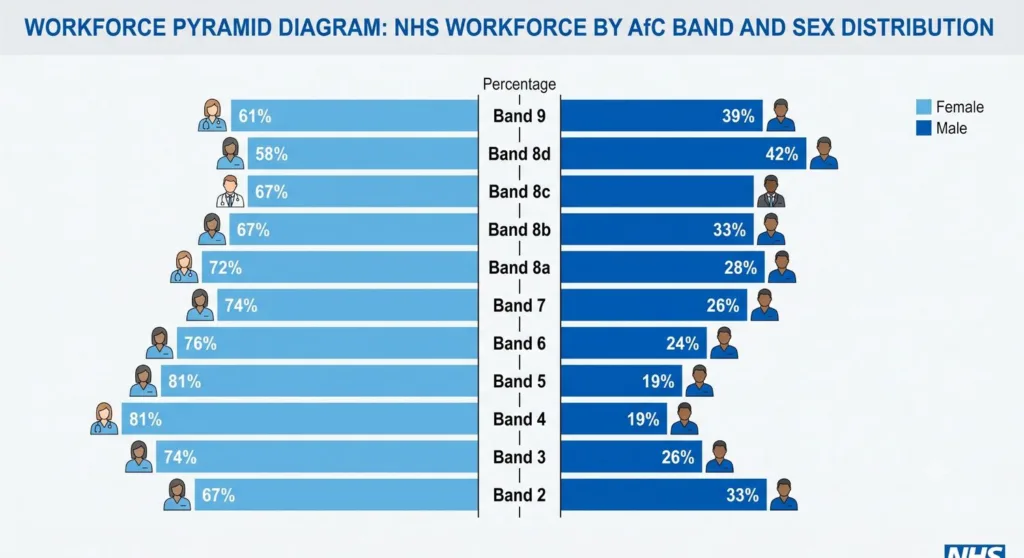
However, the distribution of men and women across the workforce is not even. Men are overrepresented in:
- Senior medical and dental roles (consultants, specialty doctors)
- Higher AfC bands (Band 8 and Band 9)
- Certain specialties (surgery, emergency medicine, radiology)
Women are overrepresented in:
- Nursing and midwifery roles
- Healthcare support worker roles (Band 2–3)
- Part-time and flexible working arrangements
- Administrative and clerical roles
This distribution directly drives the overall pay gap figure that appears in gender pay gap reports.
Where the Pay Gap Actually Shows Up
1. Seniority Gap
The higher you go in the NHS, the more male-dominated roles become. NHS consultant roles — which sit outside AfC and carry the highest clinical salaries — are disproportionately held by men. Even within AfC, men are more likely to hold Band 8 and Band 9 positions.
When the mean hourly rate is calculated across an entire trust’s workforce, men pull that average up because more of them sit in the highest-paid roles.
For context on what those senior roles pay, see our NHS Consultant Salary guide.
2. The Part-Time Penalty
This is one of the most significant — and least discussed — drivers of the NHS gender pay gap.
Women in the NHS are far more likely than men to work part-time, particularly following maternity leave or when managing caring responsibilities. Gender pay gap calculations typically compare hourly rates, which should neutralise the hours effect. But part-time workers are often:
- Concentrated in certain roles (nursing, HCA)
- Less likely to take on additional paid responsibilities or overtime
- Progressing through pay bands more slowly in some trusts
Our NHS Part-Time Pay Calculator lets you model your actual take-home based on contracted hours.
3. Occupational Segregation
Some entire job families within the NHS are heavily gendered. Healthcare assistants — predominantly female, sitting in Band 2 and 3 — represent a large share of the NHS workforce. Surgeons — predominantly male — represent a small share but with very high salaries.
Because the NHS gender pay gap is calculated across the entire workforce, a high concentration of women in lower-paid roles will always produce a reported gap, even if every individual is paid exactly the right amount for their band.
4. Progression and Promotion
Research — including from the NHS Employers organisation and NHS England — has consistently found that women in the NHS are less likely to be in senior roles, even when controlling for experience and qualification level. This points to structural barriers beyond simple occupational choice.
Women are underrepresented in shortlists and appointment panels for senior leadership roles. Unconscious bias in promotion decisions has been documented in NHS studies. The NHS People Plan has acknowledged this explicitly.
Mean vs Median: Why Both Numbers Matter
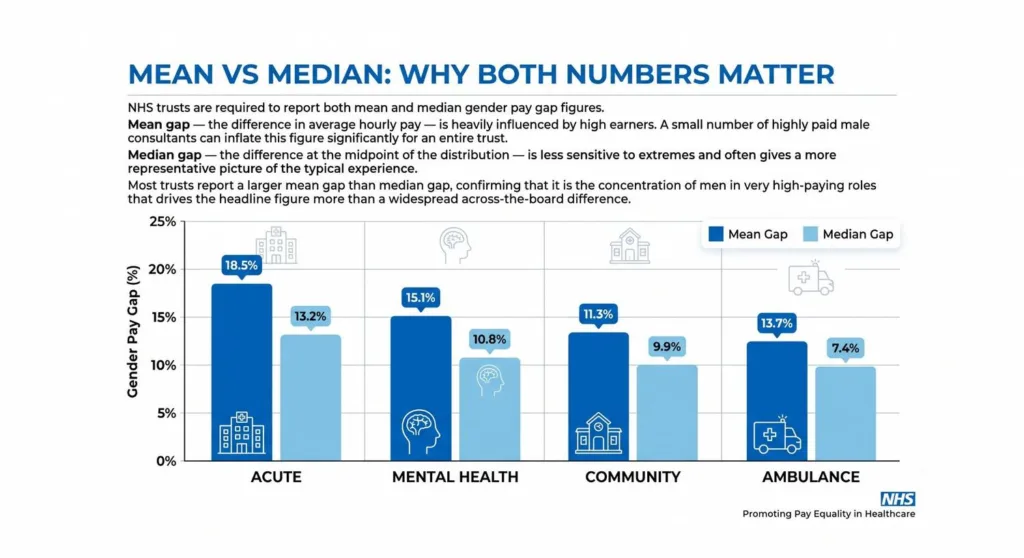
NHS trusts are required to report both mean and median gender pay gap figures.
Mean gap — the difference in average hourly pay — is heavily influenced by high earners. A small number of highly paid male consultants can inflate this figure significantly for an entire trust.
Median gap — the difference at the midpoint of the distribution — is less sensitive to extremes and often gives a more representative picture of the typical experience.
Most trusts report a larger mean gap than median gap, confirming that it is the concentration of men in very high-paying roles that drives the headline figure more than a widespread across-the-board difference.
Does the NHS Pay Gap Vary by Trust?
Yes, significantly. Each NHS trust publishes its own annual gender pay gap report (mandatory for organisations with 250+ employees under the Equality Act 2010 reporting regulations).
Trusts with more medical consultants (such as acute teaching hospitals) tend to report larger gaps because their workforce includes more high-earning male doctors. Community and mental health trusts, which have a different workforce mix, often report smaller gaps.
Ambulance trusts — which employ more men than most NHS settings — sometimes report gaps in different directions.
What About Nurses vs Doctors?
This is the comparison most people are actually curious about.
Within nursing, pay under AfC is gender-neutral. A Band 6 nurse earns the same regardless of sex. However, because men are more likely to progress to Band 7 and above — and more likely to move into management or specialist roles — the average male nurse salary across the profession tends to be slightly higher than the average female nurse salary.
For a detailed look at Band 7 nursing pay, see our NHS Band 7 Nurse Salary guide.
Among doctors, the gap is more pronounced. Female doctors are more likely to work less-than-full-time (LTFT) contracts during training and career development, which can affect progression speed through the specialty pay scales. Female consultants are underrepresented in the highest-earning specialties.
Is the Gap Illegal?
Not necessarily. There is an important distinction between:
Unequal pay — paying a man more than a woman for the same job. This is illegal under the Equality Act 2010.
A gender pay gap — men earning more on average across an organisation due to workforce composition. This is not automatically illegal, but it is a recognised indicator of systemic inequality.
The NHS uses Agenda for Change precisely to eliminate unequal pay for equal work. Equal pay claims in the NHS do exist — particularly in non-AfC contexts or where role gradings are disputed — but the reported gap is primarily a composition issue rather than a direct pay discrimination issue.
What Is Being Done About It?
NHS England and NHS Employers have introduced a range of initiatives:
NHS People Plan — includes commitments to address race and gender inequality in career progression.
Workforce Race Equality Standard (WRES) and Workforce Disability Equality Standard (WDES) — while not specifically about gender, these frameworks model transparent equality reporting that gender strategies draw on.
NHS Gender Pay Gap action plans — trusts are required not just to report their gap but to publish an action plan explaining what they will do to reduce it.
Flexible working commitments — the NHS Long Term Workforce Plan and NHS People Plan both commit to expanding flexible working options, which research consistently links to better retention of women in senior roles. For more on how flexible working affects NHS pay and contracts, see our NHS Flexible Working and Job Sharing guide.
Leadership and talent programmes — NHS England runs programmes specifically targeted at developing women into senior leadership.
Progress has been made but is slow. Structural change in large organisations takes years to materialise in the pay gap data.
What This Means for NHS Employees
If you are an NHS employee, here is the practical takeaway:
If you are on Agenda for Change: Your pay within your band is not affected by your sex. The published gap does not mean you are personally underpaid relative to a male colleague doing the same job at the same band and spine point.
If you are in a medical grade: Review your contract, specialty, and working pattern carefully. Working less-than-full-time affects your pay calculation and can slow band progression.
If you are considering career progression: The data shows women are less likely to reach Band 8+ roles or consultant level. Understanding the structural barriers — and actively seeking mentorship and sponsorship — matters.
If you are approaching retirement: Gaps in pension accrual (particularly linked to periods of part-time work or career breaks) can compound over a career. Use our NHS Pension Calculator and NHS Early Retirement Calculator to model your position.
Frequently Asked Questions
Is NHS pay the same for men and women?
Within Agenda for Change, yes — pay is fixed by band and spine point regardless of sex. The reported gender pay gap reflects workforce composition, not pay discrimination within roles.
Which NHS roles have the biggest gender pay gap?
The gap is largest in acute hospital trusts with significant medical consultant workforces, where men are overrepresented in the highest-paid positions.
Do female NHS consultants earn less than male consultants?
At the same grade and programmed activities (PAs), consultant pay should be equal. However, female consultants are more likely to work fewer PAs and are underrepresented in the highest-earning specialties, producing a pay difference at the aggregate level.
Does part-time work affect NHS pay equality?
Not in terms of hourly rate — a part-time Band 6 nurse earns the same hourly rate as a full-time Band 6 nurse. But women are far more likely to work part-time, which affects their total earnings and can affect pension accrual and career progression speed.
Where can I find my trust’s gender pay gap report?
NHS trusts publish gender pay gap reports annually on the UK Government’s gender pay gap reporting service at gender-pay-gap.service.gov.uk. Search for your trust by name.
Has the NHS gender pay gap been getting smaller?
Progress has been gradual. Some trusts have narrowed their gaps; others have seen them widen due to changes in workforce mix. The overall NHS picture shows slow improvement without a dramatic trend change.

Daniel Carter is a senior NHS Payroll Accountant with over 10 years of experience in Agenda for Change pay structures, tax, and pensions. He created the NHS Pay Calculators platform to help NHS staff easily understand their take-home pay, sick pay, maternity pay, and pension entitlements through simple, accurate online tools.