
NHS Pay Rise 2026/27: New AfC Pay Scales & Salaries
The NHS pay rise for 2026/27 is confirmed at 3.3% for all Agenda for Change staff in England, Wales, and Northern Ireland — effective 1 April 2026, with no delays or backdating. Scotland secured a better deal at 3.75% under a separate two-year agreement with the Scottish Government. This guide covers the full updated pay scales for every band and spine point, hourly rates, London weighting, pension tier changes, and your exact take-home impact — use the free NHS pay calculator below for a personalised result.

NHS Pay Rise 2026/27 – Key Facts at a Glance
Detail | Confirmed Information |
Pay rise percentage | 3.3% consolidated (England, Wales, Northern Ireland) |
Scotland | 3.75% (separate two-year deal — Scottish Government) |
Effective date | 1 April 2026 |
Payslip date | April 2026 (first on-time payment in six years) |
Who is covered | All Agenda for Change staff, Bands 2–9 (1.4 million workers) |
Who is NOT covered | Doctors, dentists (DDRB), very senior managers, GP practice nurses |
Announced by | Health Secretary Wes Streeting, 12 February 2026 |
Recommended by | NHS Pay Review Body (NHSPRB), 39th Annual Report |
HCAS (London weighting) | Also increased by 3.3% from 1 April 2026 |
Initial government offer | 2.5% (November 2025 evidence to NHSPRB) |
OBR forecast inflation | 2.2% for 2026/27 (government says award is above inflation) |
Union view | RCN called award ‘an insult’; CPI was 3.4% at announcement date |
Structural reforms | Funded AfC pay structure reform discussions underway — NHS Staff Council |
Scotland hours | 36-hour working week from 1 April 2026 (no pay cut) |

When Will the 3.3% NHS Pay Rise Be Paid?
This is the question most NHS staff are asking right now — and for once, the answer is straightforward. The 3.3% pay rise will appear in April 2026 payslips for the vast majority of NHS staff. This is the first time since 2020 that the Agenda for Change annual pay award has been paid in the correct month rather than arriving months late as a taxable lump sum.

The NHS Business Services Authority (NHS BSA) confirmed that the Electronic Staff Record (ESR) system — used by most NHS trusts in England — was updated in time to process the increase for April payroll. NHS Employers confirmed this on 12 February 2026, the same day the government accepted the NHSPRB recommendation.
Here is what to expect depending on your employer:
- NHS Trusts on ESR: ESR employers (most NHS trusts): New rate in April 2026 payslip — no action needed from you.
- Non-ESR employers: Non-ESR employers: May need an extra payroll cycle. Any delay means April backdating will be applied.
- GP practice nurses: GP practice nurses (directly employed): Not covered by Agenda for Change. Separate arrangements apply — check with your practice manager.
- Northern Ireland: Northern Ireland: Subject to budget confirmation. Historically subject to delays; arrears payment possible.
Why does it matter that it is on time? In previous years — 2022/23, 2023/24, and 2024/25 — the award arrived as a backdated lump sum, often in September or October. That lump sum was taxed entirely in the month it was received, often pushing staff into a higher tax bracket for that month and creating confusing payslips. An on-time April payment avoids all of this.
NHS Agenda for Change Pay Bands 2026/27 – Full Tables with 3.3% Rise

Below are the complete confirmed pay band tables for all Agenda for Change staff in England from 1 April 2026. All figures are sourced from the official NHS Employers 2026/27 pay circular (nhsemployers.org). Scotland figures follow in the regional section.
Band 2 – Healthcare Assistants, Receptionists, Phlebotomists, Domestic & Catering Staff
Band 2 is a single spot rate — there is no pay progression within this band. From 1 April 2026, all Band 2 staff earn the same rate regardless of years of service. Band 1 has been closed to new starters since 1 December 2018; any remaining Band 1 staff are paid at Band 2 rates. Important: From April 2026, the National Living Wage rises to £12.71 per hour, leaving Band 2 just 21p above the legal minimum at £12.92 per hour — a margin that UNISON has warned is dangerously narrow.
Pay Point | 2025/26 Annual | 2026/27 Annual | Rise (£) | Hourly (2026/27) |
Spot Rate | £24,465 | £25,272 | +£807 | £12.92 |
Band 3 – Clinical Support Workers, Therapy Assistants, Pharmacy Assistants, Administrative Staff
Pay Point | 2025/26 Annual | 2026/27 Annual | Rise (£) | Hourly (2026/27) |
Entry (0–2 yrs) | £24,937 | £25,760 | +£823 | £13.16 |
Top (2+ yrs) | £26,598 | £27,476 | +£878 | £14.03 |
Band 4 – Nursing Associates, Pharmacy Technicians, Bed Managers, Senior Clerical Staff
Pay Point | 2025/26 Annual | 2026/27 Annual | Rise (£) | Hourly (2026/27) |
Entry (0–3 yrs) | £27,485 | £28,392 | +£907 | £14.51 |
Top (3+ yrs) | £30,162 | £31,157 | +£995 | £15.92 |
Band 5 – Registered Nurses, Midwives, Paramedics, Physiotherapists, OTs, Radiographers, SLTs
Band 5 is the most searched pay band in the UK — it covers most newly registered healthcare professionals including nurses, midwives, paramedics, physiotherapists, occupational therapists, diagnostic radiographers, and speech and language therapists. A national Band 5 nursing role review is also underway (see dedicated section below).
Pay Point | 2025/26 Annual | 2026/27 Annual | Rise (£) | Hourly (2026/27) |
Entry (0–2 yrs) | £31,049 | £32,073 | +£1,024 | £16.38 |
Mid (2–4 yrs) | £33,487 | £34,592 | +£1,105 | £17.66 |
Top (4+ yrs) | £37,796 | £39,043 | +£1,247 | £19.94 |
Band 6 – Junior Sisters, Charge Nurses, Community Midwives, Band 6 Paramedics, Pharmacists, Biomedical Scientists
Pay Point | 2025/26 Annual | 2026/27 Annual | Rise (£) | Hourly (2026/27) |
Entry (0–2 yrs) | £38,682 | £39,959 | +£1,277 | £20.41 |
Mid (2–5 yrs) | £40,823 | £42,170 | +£1,347 | £21.54 |
Top (5+ yrs) | £46,580 | £48,117 | +£1,537 | £24.57 |
Band 7 – Ward Sisters, Charge Nurses, Senior Physiotherapists, Clinical Pharmacists, Senior Midwives
Pay Point | 2025/26 Annual | 2026/27 Annual | Rise (£) | Hourly (2026/27) |
Entry (0–2 yrs) | £47,810 | £49,387 | +£1,577 | £25.22 |
Mid (2–5 yrs) | £50,273 | £51,932 | +£1,659 | £26.52 |
Top (5+ yrs) | £54,710 | £56,515 | +£1,805 | £28.86 |
Band 8a – Matrons, Advanced Clinical Practitioners, Service Managers, Speciality Leads
Pay Point | 2025/26 Annual | 2026/27 Annual | Rise (£) | Hourly (2026/27) |
Entry (0–2 yrs) | £55,690 | £57,528 | +£1,838 | £29.39 |
Mid (2–5 yrs) | £58,487 | £60,417 | +£1,930 | £30.86 |
Top (5+ yrs) | £62,682 | £64,750 | +£2,068 | £33.08 |
Band 8b – Psychologists, Lead Pharmacists, Lead Clinicians, Principal Clinical Scientists
| Pay Point | 2025/26 Annual | 2026/27 Annual | Rise (£) | Hourly (2026/27) |
| Entry (0–2 yrs) | £64,455 | £66,582 | +£2,127 | £34.01 |
| Mid (2–5 yrs) | £68,631 | £70,896 | +£2,265 | £36.22 |
| Top (5+ yrs) | £74,896 | £77,368 | +£2,472 | £39.52 |
Band 8c – Heads of Clinical Service, Senior HR & Finance Managers, Tactical Response Leads
| Pay Point | 2025/26 Annual | 2026/27 Annual | Rise (£) | Hourly (2026/27) |
| Entry (0–2 yrs) | £76,965 | £79,504 | +£2,539 | £40.61 |
| Mid (2–5 yrs) | £81,652 | £84,346 | +£2,694 | £43.08 |
| Top (5+ yrs) | £88,682 | £91,609 | +£2,927 | £46.80 |
Band 8d – Deputy Directors of Clinical Services, Deputy Chief Nurses, Consultant Clinical Scientists
| Pay Point | 2025/26 Annual | 2026/27 Annual | Rise (£) | Hourly (2026/27) |
| Entry (0–2 yrs) | £91,342 | £94,356 | +£3,014 | £48.20 |
| Mid (2–5 yrs) | £96,941 | £100,140 | +£3,199 | £51.16 |
| Top (5+ yrs) | £105,337 | £108,814 | +£3,477 | £55.59 |
Band 9 – Nurse Consultants, Directors of Clinical Services, Chief Nursing Officers, Executive Leads
| Pay Point | 2025/26 Annual | 2026/27 Annual | Rise (£) | Hourly (2026/27) |
| Entry (0–2 yrs) | £109,179 | £112,782 | +£3,603 | £57.61 |
| Mid (2–5 yrs) | £115,763 | £119,583 | +£3,820 | £61.10 |
| Top (5+ yrs) | £125,637 | £129,783 | +£4,146 | £66.28 |
All figures sourced from NHS Employers 2026/27 pay circular (nhsemployers.org). Hourly rates calculated on 37.5 hours per week / 1,957.5 annual hours (England, Wales, Northern Ireland).
2025/26 vs 2026/27 Pay Bands – Side-by-Side Comparison
The table below gives you a quick reference for every band entry point across both financial years, showing the exact cash gain from the 3.3% rise. Use this to check your payslip or plan a career move.
| Band | Entry 2025/26 | Entry 2026/27 | Cash Rise | Top 2025/26 | Top 2026/27 | Cash Rise |
| Band 2 | £24,465 | £25,272 | +£807 | — | — | — |
| Band 3 | £24,937 | £25,760 | +£823 | £26,598 | £27,476 | +£878 |
| Band 4 | £27,485 | £28,392 | +£907 | £30,162 | £31,157 | +£995 |
| Band 5 | £31,049 | £32,073 | +£1,024 | £37,796 | £39,043 | +£1,247 |
| Band 6 | £38,682 | £39,959 | +£1,277 | £46,580 | £48,117 | +£1,537 |
| Band 7 | £47,810 | £49,387 | +£1,577 | £54,710 | £56,515 | +£1,805 |
| Band 8a | £55,690 | £57,528 | +£1,838 | £62,682 | £64,750 | +£2,068 |
| Band 8b | £64,455 | £66,582 | +£2,127 | £74,896 | £77,368 | +£2,472 |
| Band 8c | £76,965 | £79,504 | +£2,539 | £88,682 | £91,609 | +£2,927 |
| Band 8d | £91,342 | £94,356 | +£3,014 | £105,337 | £108,814 | +£3,477 |
| Band 9 | £109,179 | £112,782 | +£3,603 | £125,637 | £129,783 | +£4,146 |
Complete Hourly Rates 2026/27
Hourly rates are important if you work part-time, do bank shifts, or want to compare your NHS pay against agency or private sector roles. England and Wales share the same rates, calculated on 37.5 hours per week (1,957.5 annual hours). Scotland’s rates are calculated on 36 hours per week from 1 April 2026 (1,872 annual hours) — meaning Scottish staff get a hidden hourly boost of approximately 2.8% on top of the headline 3.75% salary rise.
| Band | Pay Point | England & Wales (£/hr) | Scotland (£/hr) | Difference (£/hr) |
| Band 2 | Spot | £12.92 | £13.82 | +£0.90 |
| Band 3 | Entry | £13.16 | £15.07 | +£1.91 |
| Band 3 | Top | £14.03 | £16.26 | +£2.23 |
| Band 4 | Entry | £14.51 | £15.89 | +£1.38 |
| Band 4 | Top | £15.92 | £17.51 | +£1.59 |
| Band 5 | Entry | £16.38 | £18.43 | +£2.05 |
| Band 5 | Top | £19.94 | £22.96 | +£3.02 |
| Band 6 | Entry | £20.41 | £23.05 | +£2.64 |
| Band 6 | Top | £24.57 | £28.08 | +£3.51 |
| Band 7 | Entry | £25.22 | £28.52 | +£3.30 |
| Band 7 | Top | £28.86 | £32.62 | +£3.76 |
| Band 8a | Entry | £29.39 | £33.16 | +£3.77 |
| Band 8a | Top | £33.08 | £37.52 | +£4.44 |
| Band 9 | Top | £66.28 | £74.70 | +£8.42 |
Northern Ireland uses the same annual rates as England and Wales. Hourly rate is therefore also identical. Scotland figures are based on the 3.75% deal and 36-hour week. Scottish hourly rates sourced from Scottish Government pay circular PCS(AFC)2025/8.
London Weighting & High Cost Area Supplement (HCAS) 2026/27
If your NHS base is in or around London, you receive a High Cost Area Supplement (HCAS) — commonly called London weighting — on top of your standard AfC pay. HCAS increased by 3.3% from 1 April 2026 in line with the pay award. The supplement is pensionable and taxable, but your net benefit is roughly 65–72% of the headline supplement depending on your tax position.

| Zone | Rate | 2026/27 Minimum (£/yr) | 2026/27 Maximum (£/yr) | Examples of Eligible Areas |
| Inner London | 20% of basic salary | £5,794 | £8,746 | Camden, Hackney, Islington, Lambeth, Southwark, Tower Hamlets, Westminster, Wandsworth |
| Outer London | 15% of basic salary | £4,870 | £6,137 | All remaining Greater London boroughs outside the Inner London boundary |
| Fringe | 5% of basic salary | £1,346 | £2,270 | Parts of Hertfordshire, Surrey, Berkshire, Essex bordering Greater London (e.g. Frimley, Epsom, Basildon) |
HCAS is based on your contractual base location, not your home address. If you are unsure which zone applies to you, check your employment contract or ask your payroll team. The minimum and maximum caps mean that very low-paid staff get a proportionally bigger boost, and very high-paid staff are capped. Source: NHS Employers pay circular 2026/27.
What does HCAS mean in cash terms for a Band 5 nurse?
| HCAS Zone | Band 5 Entry Gross (£32,073 base) | HCAS Added | Total Gross | Approx. Monthly Take-Home |
| No HCAS (rest of England) | £32,073 | — | £32,073 | ~£2,041/month |
| Fringe | £32,073 | +£1,604 | £33,677 | ~£2,110/month |
| Outer London | £32,073 | +£4,870 | £36,943 | ~£2,290/month |
| Inner London | £32,073 | +£6,415 | £38,488 | ~£2,408/month |
NHS Pay Rise by Nation
NHS pay is devolved. Each of the four UK nations sets its own Agenda for Change pay policy. Here is a full comparison for 2026/27 so you can see exactly where you stand.
| Nation | 2026/27 Rise | Effective Date | Working Week | Income Tax | HCAS | Key Notes |
| England | 3.3% | 1 April 2026 | 37.5 hrs | Standard UK (20%/40%/45%) | Yes (Inner/Outer/Fringe) | First on-time payment since 2020. Structural reforms via NHS Staff Council. |
| Wales | 3.3% | 1 April 2026 | 37.5 hrs | Standard UK (same as England) | No | Same AfC rates as England plus 1.5% Welsh Government premium. Band 2 living wage protection (~5.9% effective rise). |
| Scotland | 3.75% | 1 April 2026 | 36 hrs (from Apr 2026) | Scottish Income Tax (6 bands — generally higher for Band 4+) | No | Two-year deal (2025–2027). CPI+1% inflation guarantee. 36-hour week gives hidden ~2.8% hourly boost. Highest paid in UK. |
| Northern Ireland | 3.3% | 1 April 2026 (subject to budget confirmation) | 37.5 hrs | Standard UK | No | Historically subject to implementation delays. Arrears payment possible. Higher NHS pension tiers than England. |
Scotland is the clear winner for gross pay in 2026/27. A Band 7 ward manager at the top of their band earns £4,449 more per year in Scotland than in England before tax. However, Scotland’s six-band income tax system means take-home differences are smaller — and sometimes non-existent for higher earners. Use the Scotland filter in our NHS pay calculator to see your true Scottish take-home.

How the 3.3% Pay Rise Affects Your Take-Home Pay
The 3.3% is a gross rise — but what you actually take home is different. Your take-home gain is reduced by income tax, National Insurance, and potentially a higher NHS pension contribution if the rise pushes you across a tier boundary. Here is a realistic band-by-band breakdown.
| Band & Role | Gross Gain (£/yr) | Approx. Tax & NI on Rise | Pension Tier Impact | Net Take-Home Gain (£/yr) | Net Gain (£/month) |
| Band 2 – HCA | +£807 | ~£177 | None (tier unchanged) | ~£630 | ~£53 |
| Band 3 – Clinical Support Worker | +£823 | ~£183 | None (tier unchanged) | ~£640 | ~£53 |
| Band 4 – Nursing Associate | +£907 | ~£227 | Check tier boundary | ~£680 | ~£57 |
| Band 5 – Nurse (entry) | +£1,024 | ~£254 | Check tier boundary | ~£770 | ~£64 |
| Band 5 – Nurse (top) | +£1,247 | ~£324 | Likely tier crossing | ~£840 | ~£70 |
| Band 6 – Senior Nurse (top) | +£1,537 | ~£447 | Possible tier impact | ~£1,090 | ~£91 |
| Band 7 – Ward Manager (top) | +£1,805 | ~£605 | Higher rate tax zone | ~£1,200 | ~£100 |
| Band 8a – Matron (top) | +£2,068 | ~£827 | Higher rate tax zone | ~£1,241 | ~£103 |
| Band 8b – Lead Clinician (top) | +£2,472 | ~£989 | Higher rate tax zone | ~£1,483 | ~£124 |
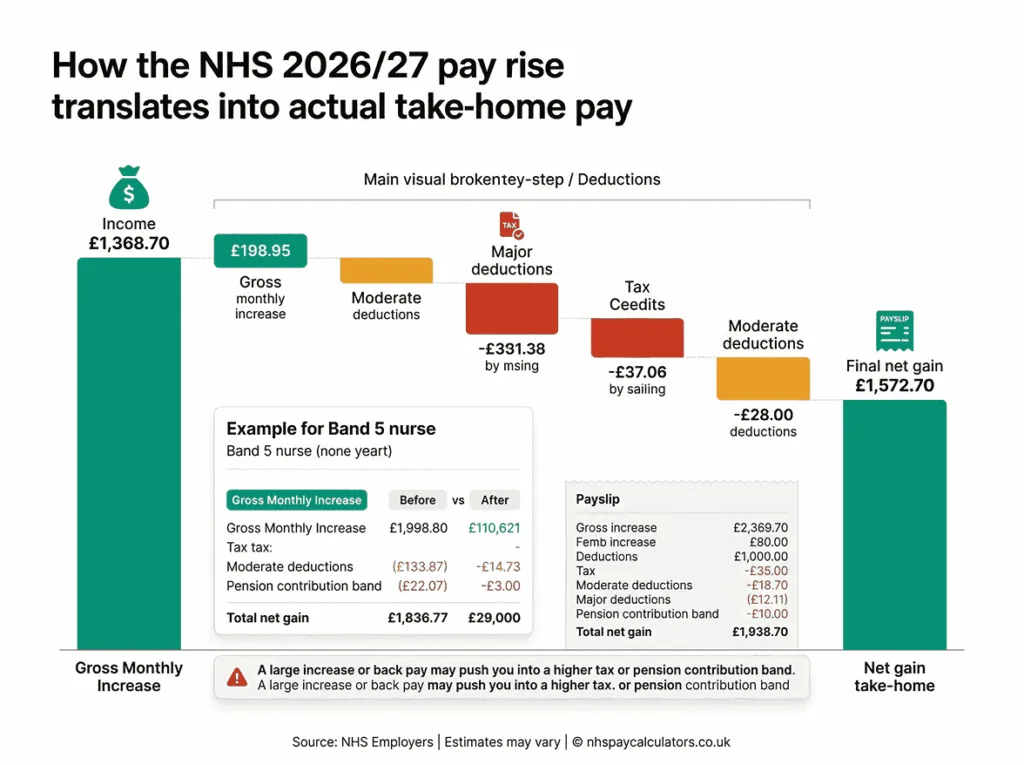
These estimates assume a standard 1257L tax code, NHS Pension 2015 Scheme, and no student loan. Your actual take-home will vary. Use the NHS pay calculator for a personalised result.
A critical point many staff miss: if your new 2026/27 salary crosses a pension tier boundary, the higher contribution rate applies to your entire salary — not just the amount above the threshold. This can quietly eat into your take-home gain from the pay rise. For example, a Band 5 nurse whose new salary crosses from the 8.3% tier to the 9.8% tier will pay an additional £49 per month in pension contributions. The NHS pay calculator applies these tier crossings automatically.
NHS Pension Contributions After the Pay Rise (2026/27 Tiers)
The NHS Pension Scheme 2015 — a Career Average Revalued Earnings (CARE) scheme administered by the NHS Business Services Authority (NHS BSA) — uses a tiered contribution structure. Your contribution rate is determined by your gross salary. As salaries rise with the 3.3% award, some staff will move into a higher tier from 1 April 2026.
| Gross Salary Range (England & Wales) | Employee Contribution Rate | Which Bands Are Typically Here? |
| Up to £13,246 | 5.2% | Very part-time only |
| £13,247 – £26,831 | 6.5% | Part-time Band 2, Band 3 (entry) |
| £26,832 – £32,690 | 8.3% | Band 3 (top), Band 4, Band 5 (entry) |
| £32,691 – £50,059 | 9.8% | Band 5 (mid/top), Band 6, Band 7 (entry) |
| £50,060 – £72,030 | 10.7% | Band 7 (mid/top), Band 8a, Band 8b (entry) |
| Above £72,030 | 12.5% | Band 8b (top), Band 8c, Band 8d, Band 9 |
Pension contributions are tax-relievable, which reduces their net cost. Northern Ireland operates higher pension contribution rates at most tiers. Scotland uses nine contribution tiers instead of six. Check nhsbsa.nhs.uk for the most current confirmed tiers.
Tier boundary alert for 2026/27: The 3.3% rise takes Band 5 entry from £31,049 to £32,073. This keeps Band 5 entry in the 8.3% tier (boundary is £32,690). However, Band 5 mid-point rises from £33,487 to £34,592 — already in the 9.8% tier. Band 5 staff at mid-point will see the pension contribution remain at 9.8% — no change. Band 4 top (£31,157) sits just below the 8.3% tier boundary of £32,690 — also no crossing. Use the NHS pay calculator to check your specific situation.
Pay Progression & Increments Explained
Alongside the annual 3.3% cost-of-living award, most Agenda for Change staff also receive a separate increment on their anniversary date — moving to the next pay point within their band. These two increases are independent. If you are due an increment in 2026/27, you benefit from both: your new starting point after the increment is also 3.3% higher than it would have been under 2025/26 rates.
| Band | Number of Pay Points | Approximate Years to Top | How Progression Works |
| Band 2 | 1 (spot rate) | No progression | Single rate — no movement within band |
| Band 3 | 2 pay points | Up to 2 years | Entry → Top after 2 years at entry point |
| Band 4 | 2 pay points | Up to 3 years | Entry → Top after 3 years at entry point |
| Band 5 | 3 pay points | Up to 4 years | Entry → Mid (yr 2) → Top (yr 4) |
| Band 6 | 3 pay points | Up to 5 years | Entry → Mid (yr 2) → Top (yr 5) |
| Band 7 | 3 pay points | Up to 5 years | Entry → Mid (yr 2) → Top (yr 5) |
| Band 8a–9 | 3 pay points | Up to 5 years | Entry → Mid (yr 2) → Top (yr 5) |
Progression is based on satisfactory performance, confirmed through your annual appraisal under the Knowledge and Skills Framework (KSF). In practice, the vast majority of staff progress automatically. If you are promoted to a higher band, Agenda for Change places you on the lowest pay point of the new band that exceeds your current salary — you cannot be placed on the same or lower point than you currently earn.
- Key tip: Your increment date may not be 1 April — check your contract or ESR record.
- New starters: If you join a new band part-way through the year, your first increment is on your anniversary date, not 1 April.
- Band 8 sub-bands: There is no automatic advancement between Band 8a, 8b, 8c, and 8d — these sub-bands require a new job application.
Band 5 Nursing Review & Upcoming Pay Structure Reforms 2026
The 2026/27 pay package included something beyond the percentage rise — a commitment to funded structural reform of the Agenda for Change pay framework. This is potentially worth thousands of pounds to some NHS staff, yet it received almost no coverage in mainstream media.
National Band 5 Nursing Role Review
Every Band 5 nurse in NHS England will have their job description reviewed by their employer. The aim is to identify nurses who are working at a level above Band 5 in practice. If your responsibilities are found to align with Band 6, you will be rebanded and receive backdated additional pay to 1 April 2026. National funding has been allocated for this process. The NHS Staff Council will set national timescales that employers must follow.
Graduate Pay Review
The Department of Health and Social Care (DHSC) and NHS Staff Council have committed to prioritising graduate pay in upcoming structural reform discussions. This affects newly qualified nurses, physiotherapists, occupational therapists, pharmacists, and other graduate health professionals who enter the NHS at Band 5. The argument — advanced strongly by the Royal College of Nursing (RCN) — is that a three or four-year degree qualification should be reflected in a higher starting salary, and that the current Band 5 entry point fails to recognise the investment graduates have made.
National Nursing Preceptorship Framework
A single national preceptorship framework for newly qualified nurses will be established. All NHS employers will be required to adhere to agreed national timescales. Further details were expected ahead of 1 April 2026. This is separate from the pay award funding and represents an additional government commitment.
Primary Care Nurses — Left Out Again
Practice nurses employed directly by GP surgeries are not on Agenda for Change contracts and are excluded from the 3.3% award. The RCN, Royal College of General Practitioners (RCGP), and nursing representative groups have criticised this exclusion, warning it damages recruitment and retention in general practice at a time when primary care is already under severe pressure. GP practice nurse pay is covered by separate NHS England guidance and is typically negotiated locally between practices and their staff.
Why This NHS Pay Rise Feels Different (On-Time Payment + Real-Terms Analysis)
On Time for the First Time in Six Years
In 2020, 2021, 2022, 2023, 2024, and 2025 — the Agenda for Change annual pay award was either delayed, paid as a late lump sum, or both. Staff often waited until September or October to see their new pay, receiving months of arrears in a single payment. That created two problems: the lump sum pushed many staff into a higher tax bracket for one month, and the uncertainty made financial planning extremely difficult.
Health Secretary Wes Streeting confirmed on 12 February 2026 that the government had deliberately accelerated the 2026/27 pay round — issuing remit letters to the NHSPRB in July 2025, months earlier than in previous years. NHS BSA confirmed ESR was updated in time for April payroll. This represents a genuine operational improvement, regardless of the views on the percentage itself.
Is the 3.3% Rise Above or Below Inflation?
This is contested, and both sides have a legitimate point.
- Government view: The government’s case: The Office for Budget Responsibility (OBR) forecast UK CPI inflation at 2.2% for the 2026/27 financial year. The 3.3% award therefore exceeds forecast inflation by 1.1 percentage points, making it a real-terms pay rise on government projections. It also exceeds the government’s own initial affordability position of 2.5% and is the third consecutive year of above-OBR-forecast increases.
- Unions’ view: The unions’ case: When the award was announced on 12 February 2026, the most recent CPI figure (January 2026) was 3.4% — above the 3.3% pay rise. RCN General Secretary Professor Nicola Ranger described the award as ‘an insult’, saying ‘Unless inflation falls, the government is forcing a very real pay cut on its NHS workers.’ UNISON noted that Band 2 staff will earn just 21p per hour above the National Living Wage from April 2026, warning the pay system risks breaching minimum wage for the lowest bands if future awards continue to lag behind NLW increases.
The OBR forecasts inflation to fall to 2.4% by mid-2026, which would make the 3.3% award a genuine real-terms gain by the second half of the financial year. But as of March 2026, that forecast remains uncertain. The NHS Staff Council structural reform talks — if they result in additional funded pay improvements backdated to 1 April 2026 — could add further value to the 2026/27 package for some staff.
Frequently Asked Questions – NHS Pay Rise 2026/27

Daniel Carter is a senior NHS Payroll Accountant with over 10 years of experience in Agenda for Change pay structures, tax, and pensions. He created the NHS Pay Calculators platform to help NHS staff easily understand their take-home pay, sick pay, maternity pay, and pension entitlements through simple, accurate online tools.

One Comment