NHS MARS Payment Calculator 2026/27– NHS Exit Settlement
NHS MARS is a voluntary exit scheme that pays eligible staff a negotiated lump sum to leave — calculated on your band, salary, and length of NHS service, capped at £95,000. No NHS employee has an automatic right to MARS; your employer decides whether to offer it, and pension strain costs frequently determine if your application gets approved. This guide covers how your payment is calculated, what pension strain deducts from your offer, tax treatment of the lump sum, and how MARS compares to voluntary redundancy.
| Notional Reference Monthly Wage | £3,208.33 |
| Calculated Months Base Compensated | 6.0 Months |
| Gross Contractual Severance Value | £19,250.00 |
| HMRC Termination Income Tax Owed | £0.00 |
| Net Net Take-Home Payment Disbursed | £19,250.00 |
Mutually Agreed Resignation Scheme (MARS) departures represent a voluntary severance track resignation, completely separate from structural redundancy or forced dismissal pathways.
Standard Payment Formula:
* 1 to 5 Years NHS Service: Triggers a locked baseline minimum layout of exactly 3 months gross base salary.
* 6 Years+ NHS Service: Increments smoothly at exactly 0.5 months basic pay per complete year of continuous continuous service up to an absolute contractual cap barrier of 12 months pay.
Cap Boundaries: Under strict 2026/27 public sector exit framework rules, an absolute notional base salary earning ceiling cap variable of £80,000 applies directly to calculations (pro-rata for part-time workers). Furthermore, the complete lump sum disbursement cannot exceed an ultimate ceiling barrier of £80,000. The first £30,000 passes completely tax-free under HMRC severance code rules.
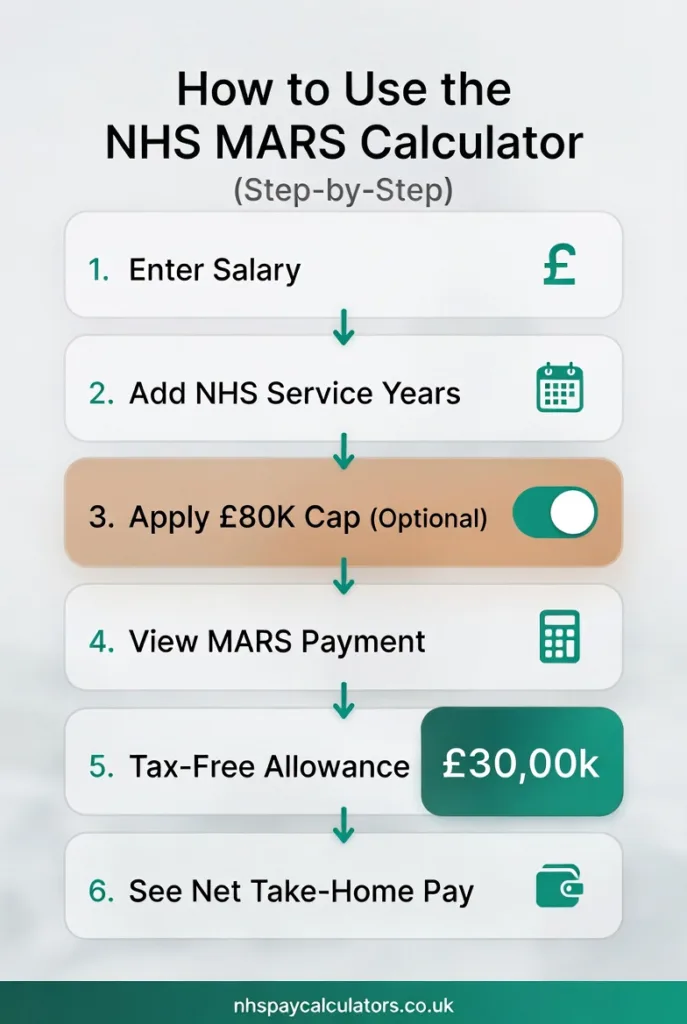
How to Use the NHS MARS Calculator (Step-by-Step)
- Enter your annual NHS salary before deductions, or use the quick preset buttons to fill it instantly.
- Input your completed years of NHS service, or adjust the slider to quickly estimate different scenarios.
- Toggle the £80,000 salary cap if your earnings exceed the NHS notional cap to keep calculations compliant.
- Instantly view your gross MARS payment, calculated based on your salary and capped service months (up to 24 months).
- The calculator automatically applies the £30,000 tax-free allowance, so you can clearly see the non-taxable portion.
- Check your estimated net payment, which shows what you may take home after applying basic tax assumptions.
- Adjust salary, service years, or cap settings to compare different outcomes and better understand your potential payout.
What Is the NHS MARS Scheme?
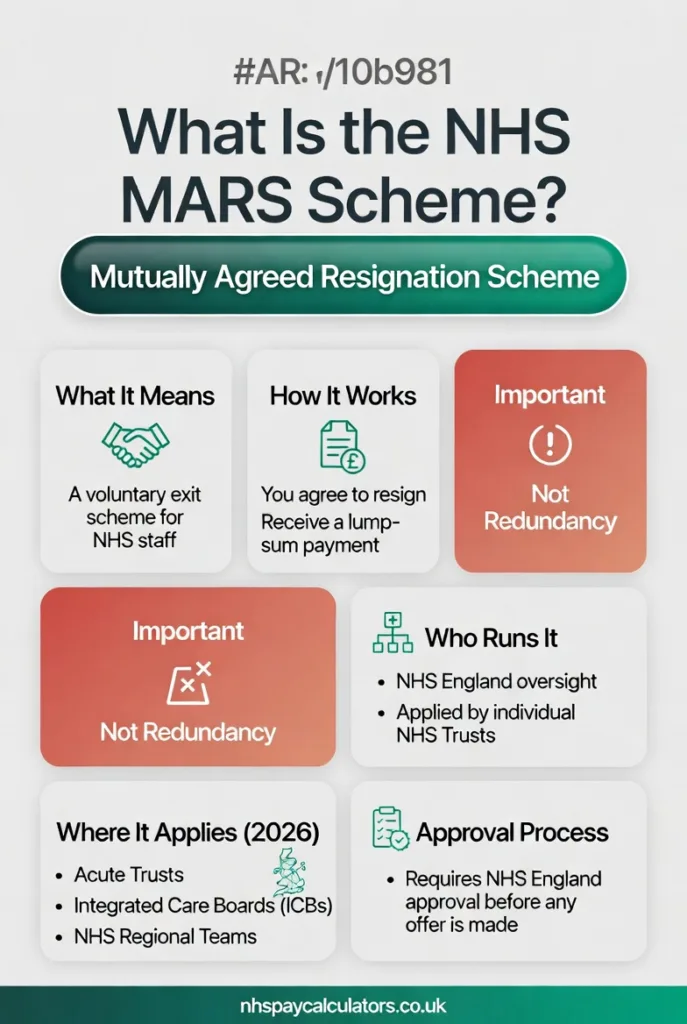
MARS stands for Mutually Agreed Resignation Scheme. It is an NHS England workforce tool that allows trusts to offer voluntary exit packages to employees whose posts are no longer needed.
It is not redundancy. Under MARS, you agree to resign in exchange for a lump-sum payment. NHS England governs the scheme, and each NHS trust applies it differently based on local workforce needs.
The NHS MARS scheme 2026 is active across acute trusts, integrated care boards (ICBs), and NHS England regional teams. Approval must come from NHS England before any offer is made. Now you can easily calculate NHS Take Home Pay 2026/27.
How the NHS MARS Calculator Works
The NHS MARS calculator estimates your exit payment based on your salary, years of service, and age. Most NHS organisations use the NHS Employers framework formula.
Key Inputs the Calculator Uses
- Current annual salary (full-time equivalent)
- Contracted hours (full-time or part-time)
- Length of NHS service in complete years
- Age at the date of exit
- NHS pension scheme membership (2015, 2008, or 1995 section)
How the Lump Sum Is Calculated
The MARS payment is based on a multiplier applied to your weekly pay. The standard formula used across NHS trusts is:
MARS Payment = Weekly Pay × Weeks Entitlement (capped at 95 weeks or £95,000)
The cap of £95,000 applies to the total exit payment under HM Treasury rules for public sector workers.
Years of Service | Weeks of Pay | Example (£40k salary) |
2 years | 4 weeks | £3,077 |
5 years | 10 weeks | £7,692 |
10 years | 20 weeks | £15,385 |
20 years | 40 weeks | £30,769 |
25+ years | Up to 95 weeks | Up to £73,077 |
Is NHS MARS Tax Free?
This is the most common question around the NHS MARS scheme. The answer depends on how the payment is structured.
The first £30,000 of a qualifying termination payment is exempt from income tax under HMRC rules (ITEPA 2003, s.403). Anything above £30,000 is taxed at your marginal income tax rate.
Payment Amount | Tax Status | Notes |
First £30,000 | Tax free | HMRC termination exemption applies |
£30,001 to £50,270 | Taxed at 20% | Basic rate band 2026/27 |
£50,271 to £125,140 | Taxed at 40% | Higher rate band 2026/27 |
Above £125,140 | Taxed at 45% | Additional rate band 2026/27 |
National Insurance contributions do not apply to qualifying MARS termination payments, which increases your net take-home figure compared to a salary equivalent.
Note: If you receive notice pay or pay in lieu of notice (PILON), this is fully taxable and is not covered by the £30,000 exemption.
NHS MARS Scheme Payments: What You Actually Receive
Once the lump-sum figure is calculated, three deductions affect your final payment.
1. Income Tax on the Taxable Portion
Your employer will deduct income tax at source via PAYE on any amount above £30,000. This is applied to the MARS payment itself, not your normal salary.
2. Pension Strain Costs
If you are a member of the NHS Pension Scheme and are taking voluntary early retirement alongside MARS, your trust may face a pension strain cost. This cost is borne by the employer, not deducted from your payment — but some trusts factor it into whether they approve an offer.
3. Repayment Conditions
The NHS MARS scheme includes a clawback clause. If you return to work in any NHS-funded organisation within a set period (usually 12 months, sometimes 24), you must repay the full MARS lump sum. This applies to NHS trusts, ICBs, NHS England, and arm’s-length bodies (ALBs).
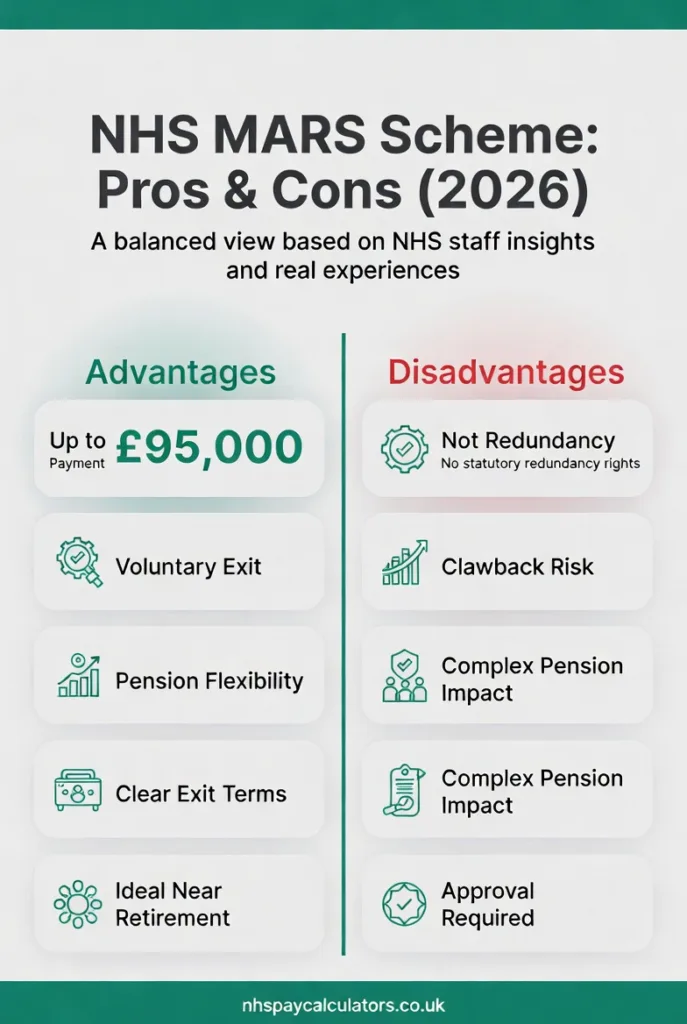
NHS MARS Scheme Pros and Cons
Staff on forums and NHS professionals blogs consistently debate the same points. Here is a balanced view.
Advantages
- Lump sum up to £95,000 with partial tax relief
- Voluntary — you are not forced out
- Can be combined with deferred NHS pension benefits
- Certainty over exit terms without conflict or grievance process
- Useful for those near retirement who want to leave cleanly
Disadvantages
- Not the same as redundancy — statutory redundancy rights do not apply
- Clawback if you return to any NHS-funded role within the restricted period
- Pension implications can be complex, especially in the 2015 scheme
- Trusts must get NHS England approval — offers can be withdrawn
- No right to appeal if your application is declined
The NHS MARS scheme pros and cons forum discussions on sites like Reddit NHS and the HSJ forums consistently flag the clawback clause as the biggest risk. Many applicants underestimate how broadly “NHS-funded role” is defined.
MARS Redundancy NHS: Key Differences
MARS and NHS redundancy are often confused. They are separate exit routes with different legal bases.
Feature | MARS | NHS Redundancy |
Legal basis | Voluntary agreement | Employment Rights Act 1996 |
Qualifying period | Set by trust / NHS England | 2 years continuous service |
Statutory rights | None | Full statutory redundancy |
Tax treatment | £30k exempt | £30k exempt |
Return to NHS | Clawback clause applies | No clawback in statute |
Pension impact | Complex — depends on scheme section | Complex — depends on scheme section |
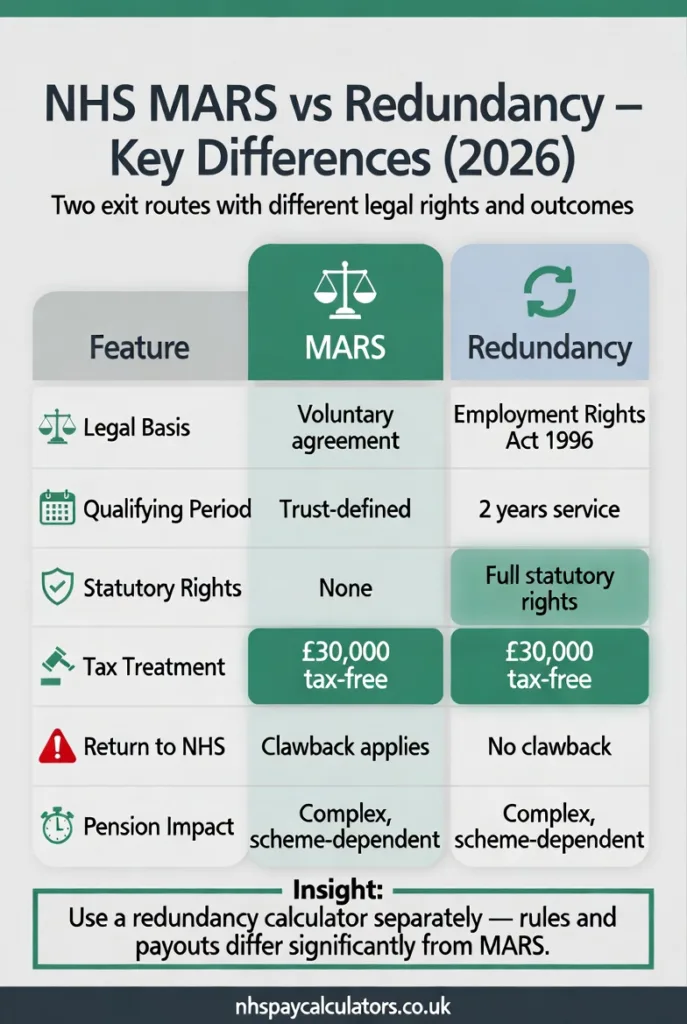
Use the NHS severance pay calculator separately if your exit is redundancy-based. The formula and rights differ materially from MARS.
NHS MARS Calculator Free PDF and Official Tools
Many staff search for an NHS MARS calculator free PDF or the NHS MARS calculator gov uk version. Here is what is publicly available.
Official Sources
- NHS Employers publish the MARS policy framework (nhsemployers.org)
- Individual NHS trusts publish their own MARS policies on their staff intranet or public website
- HM Treasury publishes the public sector exit payment cap guidance (gov.uk)
- HMRC publishes tax treatment of termination payments at gov.uk/hmrc
There is no single centralised NHS MARS calculator gov.uk tool. Each trust uses its own spreadsheet model or HR system. You should request an indicative calculation from your trust’s HR or workforce team when an offer is made.
Some financial advisers who specialise in NHS pay — including those on the Society of Pension Professionals (SPP) register — offer NHS MARS calculator free PDF outputs as part of a consultation. Always verify figures with your trust and an independent financial adviser (IFA).
NHS Pension Scheme and MARS: What You Need to Know
Your NHS pension is separate from your MARS lump sum. Leaving under MARS does not automatically trigger pension payment — that depends on your age and scheme section.
Scheme Section | Normal Pension Age | Early Access Options |
1995 Section | 60 | From age 55 with reduction |
2008 Section | 65 | From age 55 with reduction |
2015 Section | State Pension Age | From age 55 with reduction |
If you are leaving before your Normal Pension Age, your pension will be reduced by an actuarial factor for each year you draw it early. This reduction can be significant — typically 5% per year in the 2015 scheme.
Some trusts offer to cover early retirement pension strain costs as part of a MARS package. This must be negotiated before you sign any agreement.
How to Apply for NHS MARS in 2026
The MARS process follows a defined set of steps. Not all trusts run MARS schemes at all times — availability depends on local workforce strategy.
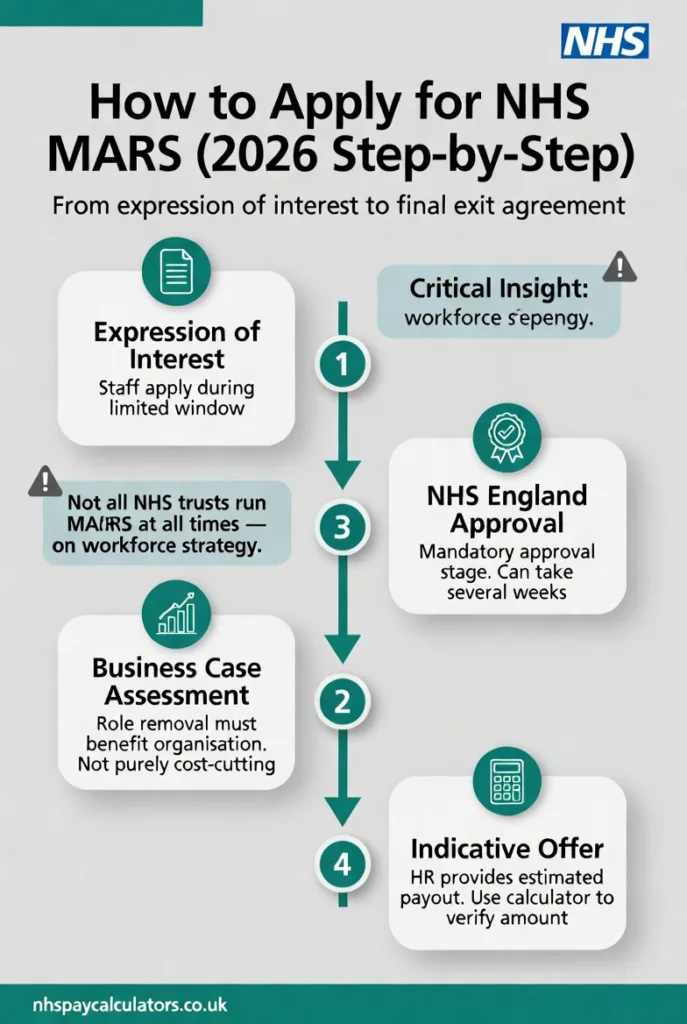
Step 1: Expression of Interest
Your trust will invite expressions of interest, usually during a specific window. You submit a form indicating you want to be considered for a voluntary exit.
Step 2: Business Case Assessment
HR and your line manager assess whether releasing your post creates a genuine business benefit. MARS cannot be used simply to cut costs without a workforce rationale.
Step 3: NHS England Approval
The trust submits the proposed package to NHS England for approval. Offers above certain thresholds require additional sign-off. This step can take weeks.
Step 4: Indicative Offer and Financial Modelling
If approved, HR provides an indicative MARS calculation. This is where you should run your own numbers using the mutually agreed resignation scheme calculator logic above and seek independent advice.
Step 5: Acceptance and Notice Period
You sign a settlement agreement. Your notice period begins. Once signed, you cannot usually reverse the decision.
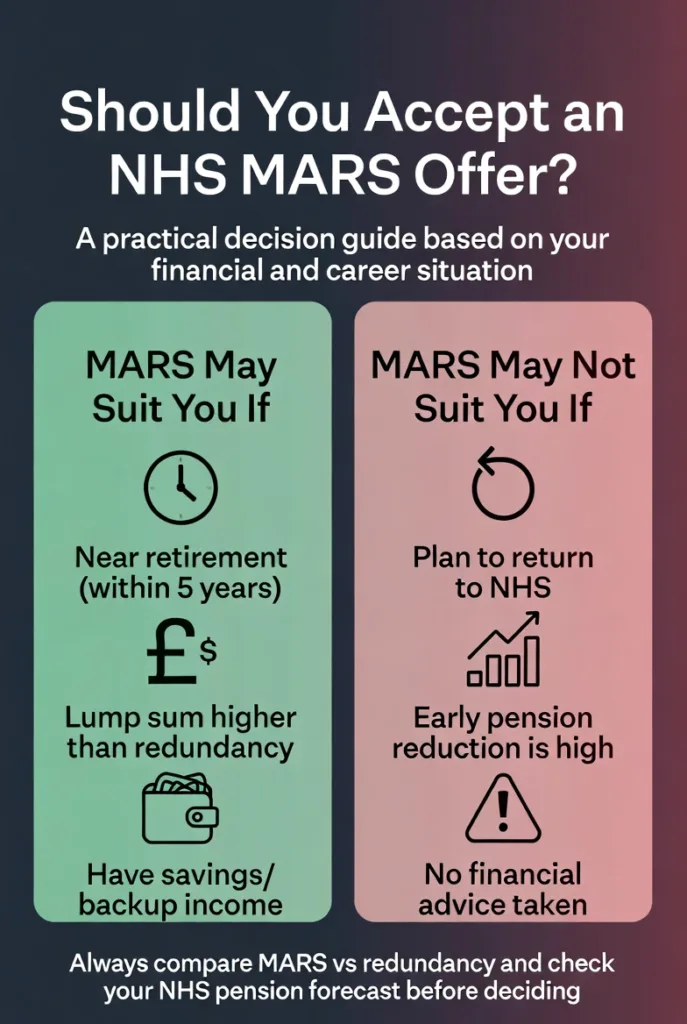
Should You Accept a MARS Offer?
Whether MARS is right for you depends on your financial position, career plans, and pension status.
MARS May Suit You If:
- You are within 5 years of your pension Normal Pension Age
- Your MARS lump sum exceeds what you would receive from statutory redundancy
- You do not plan to return to NHS-funded employment
- You have alternative income or savings to bridge any gap before pension access
MARS May Not Suit You If:
- You plan to return to NHS or public sector work within 12 to 24 months
- Your pension reduction for early access is very high (check your NHS pension forecast at nhsbsa.nhs.uk)
- You have not taken independent financial advice
- Your trust’s offer is below what you could negotiate under redundancy terms
Frequently Asked Questions
Summary
The NHS MARS calculator helps you estimate your voluntary exit lump sum, tax position, and pension implications under the Mutually Agreed Resignation Scheme.
Key facts for 2026: the payment cap is £95,000, the first £30,000 is tax free, and the clawback clause applies if you return to NHS-funded work within the restricted period.
Always request a formal indicative calculation from your trust’s HR team. Take independent financial advice — ideally from an IFA who specialises in NHS pay and pensions — before signing any settlement agreement.

Daniel Carter is a senior NHS Payroll Accountant with over 10 years of experience in Agenda for Change pay structures, tax, and pensions. He created the NHS Pay Calculators platform to help NHS staff easily understand their take-home pay, sick pay, maternity pay, and pension entitlements through simple, accurate online tools.