NHS Junior Sister Salary 2026: Band, Hourly Pay & Take Home
An NHS junior sister is paid at Band 6 under the Agenda for Change framework, with a 2026/27 salary range of £37,338 to £44,962 in England. The hourly rate runs from £19.15 to £23.06 based on a standard 37.5-hour week. After income tax, National Insurance and NHS pension contributions, monthly take-home at the mid-point of £40,545 is approximately £2,163. London adds up to £8,059 per year through the High Cost Area Supplement. This guide covers every pay point, real take-home figures, hourly pay, unsocial hours rates, and how the junior sister role sits within the NHS nursing pay structure.
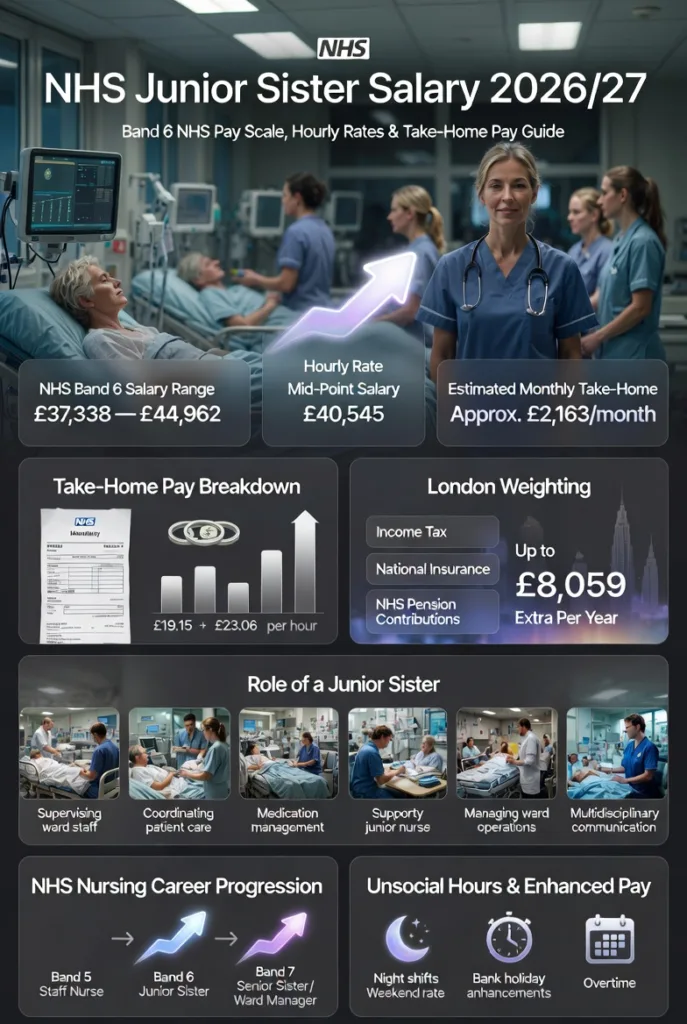
Table of Contents
What Band Is an NHS Junior Sister?
An NHS junior sister is graded at Band 6 under the Agenda for Change pay system. The title “junior sister” is used interchangeably with senior staff nurse or charge nurse in many trusts — the grade is consistent even when the job title differs. Band 6 is the first supervisory nursing grade above Band 5 staff nurse level. It carries autonomous clinical responsibility, caseload leadership and supervisory accountability for junior staff. Some trusts use “junior sister” specifically to distinguish a Band 6 with ward coordination responsibilities from a Band 6 in a purely clinical specialist role.
NHS Junior Sister Salary 2026/27 — Every Pay Point
England Band 6 Range: £37,338 — £44,962
The Band 6 spine has five pay points. You enter at Point 1 on appointment and increment annually, subject to satisfactory performance. The difference between entry and the top of the band is £7,624 gross per year — approximately £380 to £420 more per month in take-home pay across the full spine. Check the NHS Band 7 Nurse Salary in 2026.
Band 6 Pay Points — England 2026/27
| Pay Point | Annual Salary | Monthly Gross |
|---|---|---|
| Point 1 | £37,338 | £3,112 |
| Point 2 | £38,890 | £3,241 |
| Point 3 | £40,545 | £3,379 |
| Point 4 | £42,328 | £3,527 |
| Point 5 | £44,962 | £3,747 |
Most nurses appointed to a junior sister post enter at Point 1 unless their trust applies a matching policy for existing Band 6 experience. Progression through the spine is not accelerated by performance — annual increment is the standard route.
NHS Junior Sister Take-Home Pay 2026 — After All Deductions
Gross salary and take-home pay differ significantly at Band 6. Income tax at 20%, Class 1 National Insurance and NHS pension contributions at 12.5% all apply at this salary level. The table below shows estimated monthly take-home at each pay point in England with no student loan and standard tax code.
Band 6 Monthly Take-Home — All Pay Points (England 2026/27)
| Pay Point | Annual | Gross/Month | Tax | NI | Pension (12.5%) | Take-Home |
|---|---|---|---|---|---|---|
| Point 1 | £37,338 | £3,112 | £484 | £234 | £389 | £2,005 |
| Point 2 | £38,890 | £3,241 | £513 | £245 | £405 | £2,078 |
| Point 3 | £40,545 | £3,379 | £541 | £253 | £422 | £2,163 |
| Point 4 | £42,328 | £3,527 | £572 | £267 | £441 | £2,247 |
| Point 5 | £44,962 | £3,747 | £616 | £286 | £468 | £2,377 |
These are estimates using 2026/27 tax thresholds. Your actual take-home will vary depending on your tax code, student loan plan and any salary sacrifice arrangements such as car lease or cycle to work schemes.
NHS Junior Sister Hourly Pay 2026
NHS junior sister hourly pay is calculated on a standard working week of 37.5 hours. The basic hourly rate at each pay point is as follows:
Band 6 Hourly Rate — England 2026/27
| Pay Point | Annual Salary | Basic Hourly Rate |
|---|---|---|
| Point 1 | £37,338 | £19.15 |
| Point 2 | £38,890 | £19.94 |
| Point 3 | £40,545 | £20.79 |
| Point 4 | £42,328 | £21.71 |
| Point 5 | £44,962 | £23.06 |
These are basic contracted rates. They do not include unsocial hours enhancements, which apply on top for evening, night, weekend and bank holiday shifts — and which meaningfully increase actual hourly earnings for junior sisters working those patterns.
NHS Junior Sister Unsocial Hours Pay 2026
Junior sisters working outside standard Monday to Friday daytime hours receive AfC unsocial hours enhancements on top of their basic hourly rate. These are contractual, not discretionary.
AfC Unsocial Hours Enhancement Rates
| Shift Period | Enhancement |
|---|---|
| Saturday (all day) | Basic + 47% |
| Sunday / Bank Holiday | Basic + 94% |
| Weekday 8pm — 11pm | Basic + 44% |
| Weekday 11pm — 6am | Basic + 83% |
A junior sister at Point 3 (£20.79 basic hourly rate) working a Sunday shift earns approximately £40.33 per hour on that day. A full Saturday shift at the same pay point pays approximately £30.56 per hour. For junior sisters on rotation patterns covering nights and weekends regularly, annual earnings can exceed the basic Band 6 top point by several thousand pounds.
NHS Junior Sister Salary in Scotland, Wales and Northern Ireland
Band 6 nursing pay differs across the four UK nations. Scotland consistently pays the highest AfC rates. Wales sits marginally above England. Northern Ireland mirrors England exactly.
Band 6 Junior Sister Salary by Nation — 2026/27
| Nation | Entry Point | Top of Band |
|---|---|---|
| England | £37,338 | £44,962 |
| Scotland | £38,750 | £46,244 |
| Wales | £37,898 | £45,637 |
| Northern Ireland | £37,338 | £44,962 |
A junior sister at the top of Band 6 in Scotland earns £1,282 more gross per year than the equivalent post in England. After Scotland’s marginally higher income tax rates are applied, the real net difference is approximately £770 per year — meaningful but not transformative for most career decisions.
Junior Sister Salary in London — HCAS Applied
NHS junior sisters working in London receive the High Cost Area Supplement on top of Band 6 basic pay. This is a contractual entitlement under AfC.
London HCAS Rates — Band 6 Junior Sister
| Zone | Supplement | Band 6 Mid-Point With HCAS |
|---|---|---|
| Inner London | 20% (max £8,059) | ~£48,604 |
| Outer London | 15% (max £5,736) | ~£46,281 |
| London Fringe | 5% (max £2,122) | ~£42,667 |
A junior sister at the Band 6 mid-point in Inner London earns approximately £48,604 gross — above the Band 7 entry point for England. However, London living costs — particularly housing — absorb a significant share of that premium in practice.
What Does an NHS Junior Sister Do?
A junior sister holds the first layer of ward or unit leadership in NHS nursing. Core responsibilities include coordinating shifts and patient flow, supervising Band 5 staff nurses and healthcare assistants, acting as ward manager in the absence of the senior sister or ward manager, conducting clinical assessments for complex patients, contributing to governance and audit processes, and managing patient safety incidents at ward level. The role requires autonomous clinical judgment and the ability to lead a team under pressure — it is not a purely clinical role but a hybrid of clinical and operational leadership.
Junior Sister vs Senior Sister vs Ward Manager — Pay Comparison
Understanding where junior sister sits in the NHS nursing hierarchy clarifies both the pay and the progression path.
| Role | Typical Band | England Salary Range |
|---|---|---|
| Staff Nurse | Band 5 | £29,970 — £36,483 |
| Junior Sister / Charge Nurse | Band 6 | £37,338 — £44,962 |
| Senior Sister / Ward Manager | Band 7 | £46,148 — £52,809 |
| Matron | Band 8a | £53,755 — £60,504 |
The gap between Band 5 top and Band 6 entry is £855 gross — approximately £50 to £60 per month net. The real financial case for moving to junior sister is the Band 6 trajectory: top of band pays approximately £400 more per month net than Band 5 top. If you are considering the move, the NHS Band 6 pay guide on nhspaycalculatorss.co.uk covers the full take-home breakdown in detail.
How the NHS Pension Affects Junior Sister Take-Home Pay
At Band 6, the employee pension contribution rate is 12.5% of pensionable pay. This is the primary reason why gross-to-net conversion at this salary level is steep. Your employer contributes a further 23.7% of your pensionable pay — for a junior sister at £40,545, that is approximately £9,609 per year in employer pension funding working on your behalf, accruing as guaranteed defined benefit pension income in retirement.
The 2015 NHS Pension Scheme builds your pension based on a fraction of your pensionable pay each year, revalued with inflation. For nurses planning long NHS careers, this scheme represents significant financial value that gross salary comparisons with private sector roles consistently understate.
Student Loan Deductions on a Junior Sister Salary
Many nurses qualifying after 2012 carry a Plan 2 student loan. Repayments are 9% of earnings above £27,295 per year.
Plan 2 Student Loan Deductions — Band 6 Junior Sister
| Pay Point | Annual Salary | Annual Repayment | Monthly Deduction |
|---|---|---|---|
| Point 1 | £37,338 | £906 | £76 |
| Point 3 | £40,545 | £1,195 | £100 |
| Point 5 | £44,962 | £1,592 | £133 |
At Band 6 mid-point with a Plan 2 loan, take-home reduces from approximately £2,163 to around £2,063 per month. If you qualified in Scotland or Wales under a different loan plan, the threshold and rate differ — use the specific plan rules for your situation.
Salary Sacrifice and Its Effect on Junior Sister Pay
Many NHS trusts offer salary sacrifice schemes — childcare, car leasing, cycle to work, and additional pension contributions. These reduce your pensionable pay, which lowers your income tax and NI liabilities. For a junior sister at Band 6 mid-point contributing to a car lease salary sacrifice of £300 per month, pensionable pay reduces to approximately £36,945 — saving roughly £60 to £80 per month in tax and NI, partially offsetting the sacrifice cost.
How to Progress From Junior Sister to Ward Manager
Progression from Band 6 junior sister to Band 7 ward manager or senior sister requires a substantive role change — a Band 7 vacancy must exist and you must be formally appointed. You cannot be promoted within the same post. Most junior sisters who progress to Band 7 do so after three to five years at Band 6, combining clinical expertise with demonstrated leadership, governance contribution and often a formal management qualification or leadership programme completion. The Band 7 entry salary in England is £46,148 — a gross increase of £1,186 over Band 6 top, translating to approximately £65 to £80 more per month net at the crossover point, growing substantially as you progress through the Band 7 spine.
FAQs: NHS junior sister salary 2026/27
What band is an NHS junior sister?
An NHS junior sister is paid at Band 6 under the Agenda for Change pay framework. The 2026/27 salary range in England is £37,338 to £44,962. The title may vary by trust — charge nurse and senior staff nurse are equivalent grades at Band 6.
What is the NHS junior sister hourly pay in 2026?
The basic hourly rate for an NHS junior sister ranges from £19.15 at Band 6 entry to £23.06 at the top of the band, based on a 37.5-hour working week. Unsocial hours enhancements add significantly to this for evening, night, weekend and bank holiday shifts.
How much does an NHS junior sister take home per month?
At Band 6 mid-point (£40,545) in England, a junior sister takes home approximately £2,163 per month after income tax, National Insurance and 12.5% NHS pension contributions, with no student loan. With a Plan 2 student loan, take-home reduces to approximately £2,063 per month.
What is the junior sister hourly rate on Sundays?
At Band 6 mid-point (£20.79 basic hourly), the Sunday and bank holiday enhanced rate is basic plus 94%, giving approximately £40.33 per hour. Saturday rate at the same pay point is approximately £30.56 per hour.
Is junior sister the same as charge nurse?
Yes. Junior sister and charge nurse are equivalent roles — both sit at Band 6. The title used depends on the trust and sometimes the gender convention of the ward, though both terms are used for all staff regardless of gender in modern NHS practice.
What is the junior sister salary in London?
A Band 6 junior sister at the mid-point in Inner London earns approximately £48,604 gross with the 20% HCAS applied. Outer London adds 15% (up to £5,736), and London Fringe adds 5% (up to £2,122).
How does junior sister salary compare to staff nurse?
The entry gap between Band 5 top (£36,483) and Band 6 entry (£37,338) is £855 gross — roughly £50 to £60 more per month net. The real pay gain comes through Band 6 progression: Band 6 top pays approximately £400 more per month net than Band 5 top.
Summary
An NHS junior sister is paid at Band 6, with a 2026/27 salary range of £37,338 to £44,962 in England. Basic hourly pay runs from £19.15 to £23.06, rising to approximately £40.33 per hour on Sundays with AfC unsocial hours enhancements applied. Monthly take-home at the mid-point is approximately £2,163 after tax, NI and 12.5% pension — dropping to around £2,063 with a Plan 2 student loan. Scotland pays up to £1,282 more gross per year than England.
Inner London adds up to £8,059 through the HCAS, bringing mid-point gross to approximately £48,604. The role sits at the first supervisory layer of NHS nursing — above Band 5 staff nurse and below Band 7 ward manager — carrying ward coordination, staff supervision and clinical leadership responsibilities. Pension contributions at 12.5% are a significant deduction, but the employer’s 23.7% contribution represents substantial long-term defined benefit value that gross salary figures alone do not capture.
All figures reflect 2026/27 Agenda for Change pay rates for England. Take-home estimates are illustrative mid-point calculations using standard tax codes. Individual figures vary by personal tax code, student loan plan, pension tier and trust-specific allowances. Verify current rates at NHS Employers.

Daniel Carter is a senior NHS Payroll Accountant with over 10 years of experience in Agenda for Change pay structures, tax, and pensions. He created the NHS Pay Calculators platform to help NHS staff easily understand their take-home pay, sick pay, maternity pay, and pension entitlements through simple, accurate online tools.