NHS Band 2 Take Home Pay 2026: What You Actually Pocket
| Basic Contract Pay (Gross) | £0.00 |
| Night / Saturday Enhancements (+41%) | +£0.00 |
| Sunday / Bank Holiday Enhancements (+83%) | +£0.00 |
| Cumulative Total Gross Income | £0.00 |
| PAYE Income Tax Assessment | -£0.00 |
| National Insurance Contributions | -£0.00 |
| NHS Pension Scheme Contribution | -£0.00 |
| Student Loan Repayment Deduction | -£0.00 |
| Contractual Salary Sacrifice Scheme | -£0.00 |
| Net Calculated Take-Home Payout | £0.00 |
Unsocial Hours Scaling Rules: Under Agenda for Change Section 2 rules, Band 2 receives exceptional unsocial shift premium compensation ratios:
* Nights (8pm-6am) & Saturdays: Paid at basic hourly base + **41% premium**.
* Sundays & Public Bank Holidays: Paid at basic hourly base + **83% premium**.
Pension & Tax Shields: Basic Personal Allowance stands locked at **£12,570**. Class 1 Employee National Insurance logs at **8%**. Pension tier deductions trace gross parameters safely at **6.5%**.
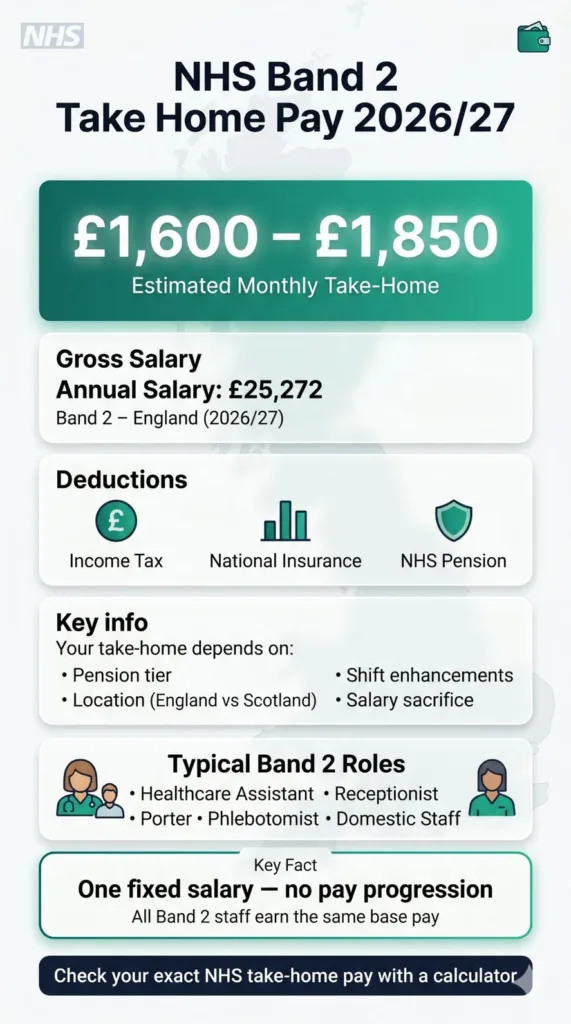
Your NHS Band 2 take home pay in 2026/27 is £25,272 per year in England. After income tax, National Insurance, and your NHS pension contribution come out, most Band 2 staff take home somewhere between £1,600 and £1,850 per month. The exact figure depends on your pension tier, whether you’re in Scotland or England, and any extras like shift enhancements or salary sacrifice. Use the NHS Take Home Pay Calculator to get your precise number in under a minute.
What Is Band 2 and Who Is It For
Band 2 is the entry point for most support roles in the NHS under the Agenda for Change pay framework. Healthcare assistants, receptionists, phlebotomists, porters, domestic staff, and catering workers all typically sit at Band 2. It is a flat-rate band in England — there is one pay point, no progression, and everyone at Band 2 earns the same basic salary regardless of how long they have been in post. Scotland works differently on this, which is covered below.
Band 2 Take Home Pay Change in 2026/27
The confirmed Band 2 from 1 April 2026 is £25,272 per year in England, following the 3.3% Agenda for Change pay award accepted by the government on 12 February 2026. That works out to £2,106 gross per month, or roughly £12.91 per hour based on a 37.5-hour full-time week. This is the number on paper — what hits your bank account after deductions is lower, and the sections below break down exactly why.
| 2025/26 | 2026/27 | Change | |
|---|---|---|---|
| Band 2 Annual (England) | £24,465 | £25,272 | +£807 |
| Monthly Gross | £2,039 | £2,106 | +£67 |
| Hourly Rate | £12.51 | £12.91 | +£0.40 |

How Deductions impact NHS Band 2 Take Home Pay 2026
Three things come out of your pay before you see it — and none of them are optional. Income tax takes a slice of everything you earn above your personal allowance. National Insurance is a separate charge on top of that. Then your NHS pension contribution comes out too. The good news is that your pension contribution reduces the amount of income tax you pay, because it comes off your gross before tax is calculated. At Band 2 earnings, you will not get near the higher rate tax band, so all your taxable pay is charged at the basic 20% rate.
Income Tax on Band 2 Pay
Your personal allowance for 2026/27 is £12,570. This is the amount you earn completely tax-free, every year. On a Band 2 salary of £25,272, only £12,702 of your earnings are actually taxable. That portion is charged at 20%, giving you a tax bill of around £2,540 per year, or roughly £212 per month. Because Band 2 sits well below the higher rate threshold of £50,270, you will never pay 40% tax on this salary alone.
National Insurance on Band 2 Pay
National Insurance in 2026/27 is charged at 8% on earnings between £12,570 and £50,270 per year. On a Band 2 salary of £25,272, you pay NI on £12,702. That works out to approximately £1,016 per year, or £85 per month. NI is calculated on your gross pay before pension is deducted — unlike income tax, your pension contribution does not reduce your NI bill.
NHS Pension Contribution at Band 2
Your pension contribution rate is set by which tier your salary falls into. At £25,272, Band 2 staff in England fall into the 6.5% pension contribution tier. On a gross annual salary of £25,272, that is £1,643 per year going into your pension, or roughly £137 per month. This comes out before tax is applied, so it reduces your taxable income — meaning you are effectively getting a 20% government top-up on every pound you put in. The pension itself is a defined benefit scheme, which means your retirement income is guaranteed based on your salary and years of service, not on how stock markets perform.
NHS Pension Contribution Tiers 2026/27:
Annual Pensionable Pay | Contribution Rate |
|---|---|
Up to £13,259 | 5.2% |
£13,260 – £26,831 | 6.5% |
£26,832 – £111,376 | 9.8% |
Band 2 at £25,272 sits in the 6.5% tier. A pay rise that pushed you above £26,831 would move you into the 9.8% tier — meaning a larger pension deduction, which can actually reduce your take-home slightly even though your gross pay went up.
NHS Band 2 Take Home Pay 2026 England
Here is how the full-time Band 2 Take Home Pay payslip stacks up in England for 2026/27:
| Item | Annual | Monthly |
|---|---|---|
| Gross Pay | £25,272 | £2,106 |
| Pension (6.5%) | -£1,643 | -£137 |
| Taxable Pay | £23,629 | — |
| Income Tax (20%) | -£2,212 | -£184 |
| National Insurance (8%) | -£1,016 | -£85 |
| Estimated Take-Home | ~£20,401 | ~£1,700 |
These figures are estimates for a standard Band 2 employee with no student loan, no salary sacrifice, and no additional deductions. Your actual take home pay may differ by £20–£50 per month due to rounding and your trust’s payroll schedule. You can also calculate NHS Band 7 Take Home Pay on our website.
England vs Scotland: Band 2 Take Home Pay Compared
Scotland runs a separate Agenda for Change deal. For 2026/27, Scottish NHS staff received a 3.75% pay rise under a two-year agreement. Scotland is also the only UK nation where Band 2 has two pay points — meaning Scottish Band 2 staff can earn more after two years of service, unlike England where the rate is flat throughout. Scottish staff also work a 36-hour standard week from April 2026 instead of 37.5 hours — so the same annual salary divided over fewer hours gives a higher hourly rate.
Scotland also uses a different income tax structure set by the Scottish Parliament, with six bands instead of four. For Band 2 earnings, the practical impact is modest but real — Scottish basic rate taxpayers face a 20% rate on income up to £26,561, but the starter rate of 19% applies to earnings between £12,571 and £15,397. This actually means some Scottish Band 2 workers pay slightly less income tax than equivalent English colleagues on the same gross, depending on exactly where their earnings land.
England | Scotland | |
|---|---|---|
Band 2 Gross 2026/27 | £25,272 | Higher (3.75% rise) |
Pay Progression | No | Yes (2 pay points) |
Standard Hours/Week | 37.5 | 36 |
Income Tax Structure | 4 bands | 6 bands |
Band 2 Pay Take Home Pay with Unsocial Hours Enhancements
The £25,272 base salary is just the floor. If you work evenings, nights, weekends, or bank holidays, your total earnings can be meaningfully higher. Bands 2 and 3 receive some of the highest enhancement rates in the AfC framework — 41% extra for evening, Saturday, and weekday night shifts, and 83% extra for Sundays and bank holidays.
On a Band 2 hourly rate of £12.91, those enhancements add real money:
- Evening or Saturday shift (8 hours): +£42.38 on top of basic
- Sunday or bank holiday shift (8 hours): +£85.21 on top of basic
A Band 2 healthcare assistant regularly working two Sunday shifts per month could earn an extra £2,000+ per year above their basic salary. These enhancements are pensionable, which means they count towards your pension too.
London Weighting and HCAS
If you work in London or the surrounding fringe areas, you receive a High Cost Area Supplement on top of your Band 2 salary. The fringe rate is 5% of basic salary, with a minimum of £1,346 and a maximum of £2,270. Inner London rates are significantly higher. This supplement is there because the cost of living in London is much higher than the rest of England, and without it, NHS employers in the capital would struggle to recruit and retain staff at Band 2 rates. HCAS only applies in England — Scotland, Wales, and Northern Ireland do not have an equivalent.
Case Study: Maria, Healthcare Assistant, Manchester
Maria is a Band 2 HCA working full-time at a trust in Manchester. Her gross annual salary in 2026/27 is £25,272. She falls into the 6.5% pension tier and has no student loan. Her estimated monthly take-home is around £1,700. She also works two Sunday shifts per month, each eight hours. Those Sundays add roughly £213 per month to her gross pay, which after tax and NI deductions lands her approximately £165 extra in her bank account each month. Her real monthly take-home including Sundays is therefore closer to £1,865.
Maria had originally calculated her monthly pay by simply dividing £25,272 by 12 and assumed she’d receive around £2,106 per month. Understanding the deductions — and how her enhancements actually stack up after tax — helped her budget properly for rent and bills from the moment she started.
Case Study: David, Receptionist, Edinburgh
David works as a Band 2 NHS receptionist in Edinburgh. Under Scotland’s 3.75% rise, his gross salary is slightly higher than an equivalent role in England. He works a 36-hour standard week. Because Scotland has a starter income tax rate of 19% on earnings up to £15,397, David’s income tax bill is marginally lower than a Band 2 colleague in England with identical gross pay — though the difference is small, around £30–£50 per year. The bigger practical benefit for David is the shorter working week: he works 90 fewer hours per year than an equivalent Band 2 worker in England for the same annual salary, giving him a noticeably higher effective hourly rate.
Student Loans and Band 2 Pay
If you’re repaying a student loan, whether any money comes off your payslip depends entirely on which plan you’re on and how much you earn. For Plan 2 loans (most university graduates from 2012 onwards), the repayment threshold in 2026/27 is £27,295. Since Band 2 gross pay is £25,272, you are below this threshold. No student loan repayment is deducted — your balance still exists and interest still accrues, but nothing comes off your payslip until your earnings exceed the threshold. Plan 1 graduates have a lower threshold of £24,990, which means some Band 2 staff on Plan 1 will see a small deduction — 9% on earnings above £24,990, so roughly £25 per year at current Band 2 pay levels.
Salary Sacrifice at Band 2: Is It Worth It
Salary sacrifice lets you take a portion of your gross pay as a benefit — like a car lease or cycle-to-work scheme — instead of cash. Because this reduces your gross pay on paper, you pay less tax and NI. At Band 2 earnings, the savings are modest but genuine. A £500 annual cycle-to-work arrangement would save you approximately £100 in income tax and £40 in NI per year. The net cost of a £500 bike is effectively £360. Your employer’s HR or payroll team can tell you which schemes your trust offers — not all trusts run the same programmes.
FAQs: NHS Band 2 take home pay
What is the NHS Band 2 take home pay per month in England for 2026/27?
Approximately £1,700 per month after income tax, NI, and NHS pension at the 6.5% rate. Shift enhancements and salary sacrifice will change this figure up or down.
Does Band 2 have a pay rise in 2026/27?
Yes. The 3.3% Agenda for Change pay award applies from 1 April 2026, taking Band 2 from £24,465 to £25,272 in England. Scotland received 3.75% under a separate two-year deal.
Why is my Band 2 take home pay lower than I expected?
Because your gross salary is not what you receive. Income tax (20% on earnings above £12,570), National Insurance (8% on earnings above £12,570), and your NHS pension (6.5% on your full salary) all come out before the money reaches your account. Together these three deductions remove around £3,700–£3,900 per year from a full-time Band 2 salary.
Is Band 2 NHS pay the same in Scotland as England?
No. Scotland’s 2026/27 pay rise is 3.75%, slightly higher than England’s 3.3%. Scotland also has two pay points at Band 2 — meaning you can progress to a higher rate after two years — whereas England has a flat single rate. Scottish staff also work a 36-hour standard week instead of 37.5 hours.
If I work part-time at Band 2, what do I take home?
Your gross pay scales with your hours. A 0.6 WTE Band 2 worker in England earns £15,163 gross per year. At that level, most of your income falls below the personal allowance, so your tax bill is small. NI and pension still apply on the portion above £12,570. Your estimated take-home would be around £1,210–£1,240 per month. Use the calculator for the exact figure based on your contracted hours.

Daniel Carter is a senior NHS Payroll Accountant with over 10 years of experience in Agenda for Change pay structures, tax, and pensions. He created the NHS Pay Calculators platform to help NHS staff easily understand their take-home pay, sick pay, maternity pay, and pension entitlements through simple, accurate online tools.