NHS Band 4 Salary and Take Home Pay Calculator 2026/27
| Basic Contract Pay (Gross) | £0.00 |
| High Cost Area Supplement (HCAS) | +£0.00 |
| Cumulative Total Gross Income | £0.00 |
| PAYE Income Tax Assessment | -£0.00 |
| National Insurance Contributions | -£0.00 |
| NHS Pension Contribution (Auto Tiered) | -£0.00 |
| Student Loan Repayment Deduction | -£0.00 |
| Contractual Salary Sacrifice Scheme | -£0.00 |
| Net Calculated Take-Home Payout | £0.00 |
* Pension Contribution Tiers: Pension bands are structured automatically using annual gross bounds. Standard baseline entries under £27,154 fall into the **8.3% pension contribution rate**. However, moving up to the Top Step Point or applying a London HCAS multiplier pushes gross earnings over the tier limit, smoothly stepping up into the **8.7% contribution tier**.
* Pre-Tax Income Protections: Contractual pension allocations run under *Net Pay Arrangements*. This saves you money immediately by reducing your gross taxable profile before HMRC calculates PAYE income tax.
Band 4 sits just below the professional registration threshold in the NHS Agenda for Change framework. It covers experienced support workers, senior technicians, and associate-level practitioners who carry real clinical or operational responsibility without holding a full professional registration.
In 2026/27, the Band 4 salary range in England runs from approximately £26,530 to £29,114 per year. These are gross figures. After income tax, National Insurance, and NHS pension contributions, your actual monthly take-home is considerably lower — and understanding that gap is exactly what this guide covers.
Whether you are a senior healthcare assistant, an assistant practitioner, a pharmacy technician, or an administrative team leader, Band 4 pay follows the same AfC rules. The deductions are the same. The progression is the same. But the net outcome depends on your pay point, contracted hours, location, and personal tax circumstances.
NHS Band 4 Take Home Pay Points 2026/27: Breakdown
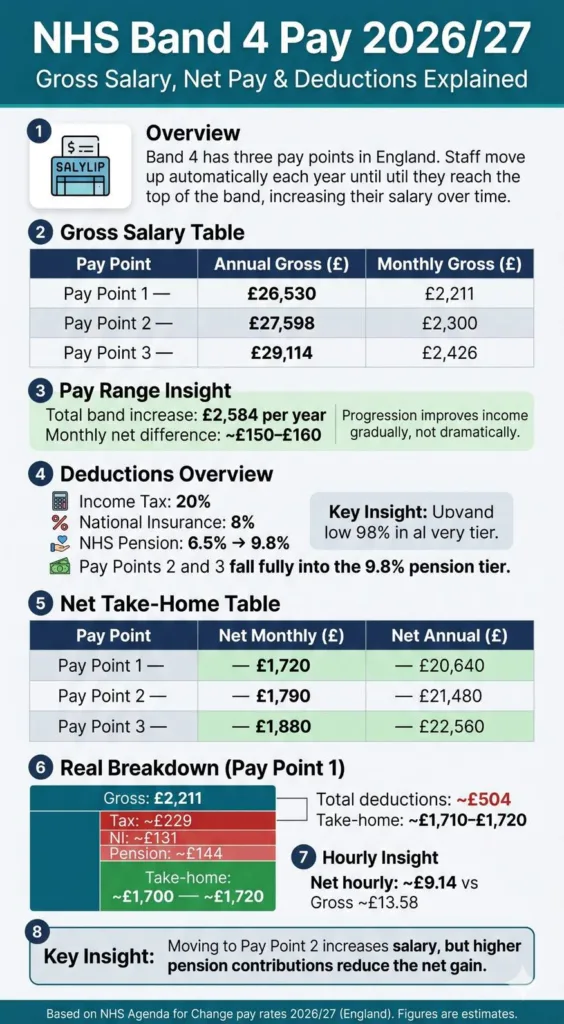
Band 4 has three pay points in England. Progression moves automatically each year on your incremental date until you reach the top of the band.
Pay Point | Annual Gross | Monthly Gross |
|---|---|---|
Pay Point 1 | £26,530 | £2,211 |
Pay Point 2 | £27,598 | £2,300 |
Pay Point 3 | £29,114 | £2,426 |
The range across the full band is approximately £2,584 gross per year. In net terms, that difference between Pay Point 1 and Pay Point 3 is around £150–£160 per month — meaningful for household budgeting but not transformative.
Band 4 Take Home Pay After Deductions: England 2026/27
At Band 4, the three standard deductions are income tax at 20% (basic rate), National Insurance at 8% on earnings between £12,570 and £50,270, and NHS pension contributions.
The pension rate for Band 4 is the key variable. Pay Point 1 (£26,530) falls partially in the 6.5% tier (up to £26,831) and partially — if you include any enhancements or overtime — in the 9.8% tier. Pay Points 2 and 3 sit fully in the 9.8% tier.
Estimated Monthly Take Home — Band 4 England 2026/27
Pay Point | Gross Monthly | Est. Net Monthly | Est. Net Annual |
|---|---|---|---|
Pay Point 1 | £2,211 | £1,720 | £20,640 |
Pay Point 2 | £2,300 | £1,790 | £21,480 |
Pay Point 3 | £2,426 | £1,880 | £22,560 |
These figures assume a standard 1257L tax code, no student loan, no London weighting, and full-time 37.5 hours per week. Use the NHS Pay Calculator to generate a personalised figure based on your exact circumstances.
Breaking Down Band 4 Deductions at Pay Point 1
For a Band 4 employee starting on £26,530, here is exactly where each pound goes every month:
Monthly gross: £2,211
- Income tax (20% on earnings above £12,570 personal allowance): approximately £229
- National Insurance (8% on earnings between £12,570 and £50,270): approximately £131
- NHS pension (6.5% on pay up to £26,831): approximately £144
Total monthly deductions: approximately £504 Net monthly take home: approximately £1,707–£1,720
That works out to approximately £396 per week, or roughly £9.14 per hour net for a standard 37.5-hour week — compared to the gross hourly rate of £13.58.
At Pay Point 2, pension contributions jump to 9.8% because the full salary sits above the £26,831 threshold. This slightly reduces the net gain from moving to Pay Point 2 compared to what the gross difference suggests.
Band 4 Hourly Rate 2026/27
The standard AfC hourly rate formula is: annual salary ÷ 52.14 ÷ 37.5.
Pay Point | Annual Salary | Gross Hourly Rate |
|---|---|---|
Pay Point 1 | £26,530 | £13.58 |
Pay Point 2 | £27,598 | £14.12 |
Pay Point 3 | £29,114 | £14.90 |
Net effective hourly rate after all deductions sits between approximately £8.80 and £9.63 per hour depending on pay point. This is the figure that matters when comparing NHS bank shift pay to private sector alternatives or agency work.
Who Works at NHS Band 4?
Band 4 covers a remarkably wide range of roles across clinical, scientific, technical, and administrative functions. It is the standard level for experienced support staff and associate practitioners who have developed beyond the Band 3 scope but have not yet completed full professional registration.
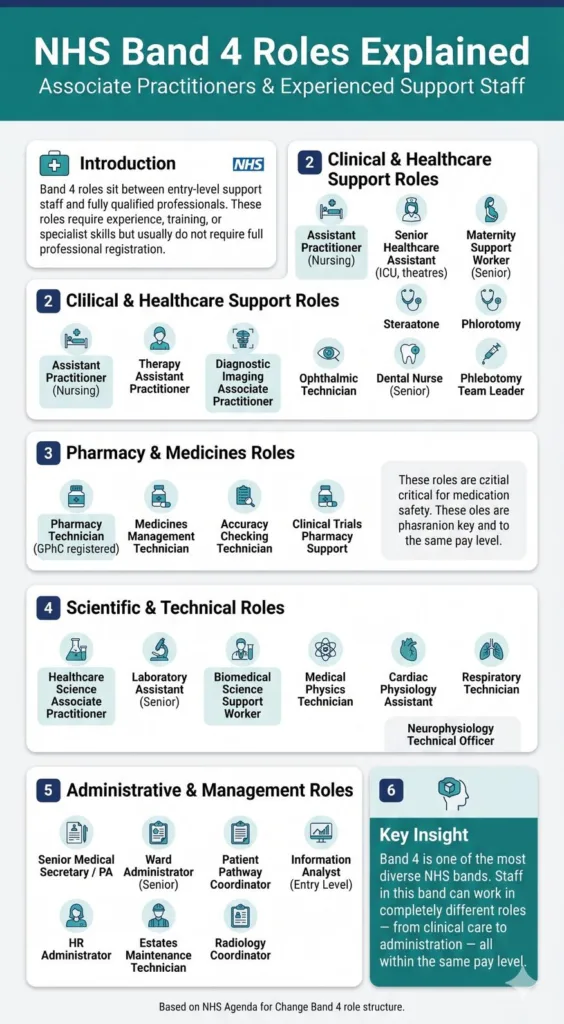
Clinical and Healthcare Support Roles at Band 4
- Assistant practitioner (nursing — completing or having completed a Foundation Degree)
- Senior healthcare assistant in specialist settings (ICU, theatres, endoscopy)
- Maternity support worker (senior/specialist grade)
- Therapy assistant practitioner (physiotherapy, occupational therapy)
- Associate practitioner in diagnostic imaging
- Ophthalmic technician and orthoptic assistant
- Dental nurse (senior or specialist grade)
- Phlebotomy team leader
Pharmacy and Medicines Roles at Band 4
- Pharmacy technician (GPHC registered — this is a Band 4 or Band 5 role depending on trust)
- Medicines management technician
- Accuracy checking technician
- Clinical trials pharmacy support
Scientific and Technical Roles at Band 4
- Healthcare science associate practitioner (pathology, audiology, physiology)
- Laboratory assistant (senior grade, IBMS-recognised)
- Biomedical science support worker (senior)
- Medical physics technician
- Cardiac physiologist (assistant practitioner level)
- Respiratory physiology technician (assistant level)
- Neurophysiology technical officer
Administrative, Managerial, and Other Roles at Band 4
- Senior medical secretary or PA to consultant
- Ward or departmental administrator (senior)
- Patient pathway coordinator
- Information analyst (entry level)
- HR administrator (senior)
- Estates maintenance technician (skilled trades)
- Radiology booking and scheduling coordinator
Band 4 is one of the most varied bands in the entire AfC structure. Two Band 4 employees in the same trust could be doing entirely different jobs — one managing a consultant’s diary, another performing phlebotomy in ICU.
Case Study: Band 4 Assistant Practitioner in Physiotherapy
Diane is an assistant practitioner in a physiotherapy department at an NHS acute trust in the East Midlands. She holds a Foundation Degree in Health and Social Care and has been in her Band 4 post for two years. She is at Pay Point 2, earning £27,598 per year.
Monthly gross: £2,300 Income tax: approximately £246 National Insurance: approximately £139 NHS pension at 9.8%: approximately £225
Net monthly take home: approximately £1,690
Diane also does occasional Saturday morning clinics — six per year, each four hours long.
Saturday gross rate: £14.12 × 1.30 = £18.36/hr Four hours: £73.44 gross per Saturday × 6 = £440.64 gross annually Net addition after tax and NI: approximately £300/year, or £25/month average
Her effective annual net income with Saturday clinics: approximately £20,580 — a modest but real supplement to her base pay.
Case Study: Band 4 Pharmacy Technician — Pay Point 3
Marcus is a GPhC-registered pharmacy technician at a large teaching hospital in Leeds. He completed his NVQ Level 3 and registration several years ago and has progressed to the top of Band 4, earning £29,114 per year.
Monthly gross: £2,426 Income tax: approximately £270 National Insurance: approximately £149 NHS pension at 9.8%: approximately £238
Net monthly take home: approximately £1,769
Marcus is exploring whether to pursue a Band 5 accuracy checking technician or clinical pharmacy technician post. The Band 5 starting salary of £29,970 would add approximately £93 per month net — a small initial gain that grows significantly by Pay Point 3–4 of Band 5. His pension accrual would also increase.
He is also weighing up whether to pursue the NHS MARS Calculator figures for a potential voluntary exit as his trust restructures dispensing services. Understanding both options requires accurate net pay modelling.
Case Study: Senior Medical Secretary — Band 4 Pay Point 1, London
Priya works as a senior medical secretary at a central London NHS trust. She is newly appointed to Band 4 at Pay Point 1 (£26,530) but receives Inner London HCAS of 20% (£5,306, below the cap).
Total gross pay: £26,530 + £5,306 = £31,836 Monthly gross: £2,653 Income tax: approximately £340 National Insurance: approximately £170 NHS pension at 9.8% (on full pensionable pay): approximately £260
Net monthly take home: approximately £1,883
Without London weighting, Priya’s net would be approximately £1,720. The HCAS adds approximately £163 per month net — a genuine but partial offset against the significantly higher cost of living in central London.
Band 4 Pay Across All Four UK Nations
NHS pay is devolved. Each nation sets its own AfC rates independently.
Nation | Band 4 Min (Approx) | Band 4 Max (Approx) |
|---|---|---|
England | £26,530 | £29,114 |
Scotland | £27,598 | £30,019 |
Wales | £26,928 | £29,551 |
Northern Ireland | £26,530 | £29,114 |
Scotland’s Band 4 starting salary is approximately £1,068 more than England — equivalent to about £680 extra per year in net terms after tax and pension. Wales offers a smaller premium. Northern Ireland mirrors England’s rates.
The Scottish premium is meaningful for Band 4 staff given the salary level — £680 net per year is around £57 per month, which is proportionally more impactful at this income level than at higher bands.
Unsocial Hours Pay at Band 4
Band 4 staff in clinical, ward-based, or service delivery roles frequently work shifts that attract unsocial hours enhancements under Agenda for Change Section 2.
AfC enhancement rates at Band 4:
- Monday–Friday, 8pm–6am: base rate + 37%
- Saturday (all hours): base rate + 30%
- Sunday and bank holidays: base rate + 60%
At Pay Point 1 (£13.58/hr gross):
- Night rate: £13.58 × 1.37 = £18.60/hr
- Saturday rate: £13.58 × 1.30 = £17.65/hr
- Sunday/bank holiday rate: £13.58 × 1.60 = £21.73/hr
A Band 4 senior HCA working regular nights and one weekend day per week can add £3,500–£5,500 to their gross annual earnings through enhancements alone. At Pay Point 1, that can push effective gross earnings to £30,000–£32,000 — significantly above the headline AfC salary figure.
This is one of the most important aspects of Band 4 pay that gross salary tables fail to show.
Part-Time Band 4 Take Home Pay
Many Band 4 employees work part-time — particularly those with caring responsibilities, health conditions, or portfolio roles. Part-time pay is pro-rated by WTE (Whole Time Equivalent) but the hourly rate remains the same.
Example: Band 4 Pay Point 2 at 0.6 WTE (22.5 hours/week)
- Pro-rated annual salary: £27,598 × 0.6 = £16,559
- Monthly gross: £1,380
- Income tax: approximately £50 (most income sheltered by personal allowance)
- National Insurance: approximately £32
- NHS pension at 6.5% (pro-rated salary falls back into lower tier): approximately £90
Net monthly take home: approximately £1,208
At 0.6 WTE, the salary drops below the £26,831 pension threshold, reducing the pension contribution rate from 9.8% back to 6.5%. This partially compensates for the reduced hours in terms of net retention rate — you keep a higher proportion of each pound earned.
For any WTE fraction, the NHS Part-Time Pay Calculator generates an accurate net figure instantly.
NHS Pension at Band 4: What You Contribute and What You Build
The NHS pension contribution for Band 4 staff depends on which tier your salary falls into:
Annual Pay | Pension Rate |
|---|---|
£13,260–£26,831 | 6.5% |
£26,832–£60,318 | 9.8% |
Pay Point 1 (£26,530) sits just below the upper threshold — in the 6.5% tier. Pay Points 2 and 3 are both in the 9.8% tier. This creates a notable jump in pension deduction between Pay Points 1 and 2 — approximately £91 more per month — that reduces the net gain from progression.
In the 2015 NHS CARE scheme, you build up 1/54th of your pensionable pay each year. At Pay Point 2 (£27,598), that is approximately £511 of guaranteed annual pension built per year. Over 20 years at Band 4, you could accumulate over £10,000 of annual pension entitlement — index-linked and payable from pension age.
The employer contributes 23.7% on top of your salary. On a £27,598 salary, that is approximately £6,541 per year of employer pension funding — more than double your own contribution.
Band 4 Sick Pay Entitlement
NHS sick pay under Agenda for Change is significantly more generous than statutory sick pay, but it tapers over time and does reduce your take-home pay during illness.
Sick pay entitlement by length of service:
- Year 1: 1 month full pay, 2 months half pay
- After 1 year: 2 months full pay, 2 months half pay
- After 2 years: 4 months full pay, 4 months half pay
- After 3 years: 5 months full pay, 5 months half pay
- After 5 years: 6 months full pay, 6 months half pay
Half pay at Band 4 Pay Point 2 means a monthly gross of approximately £1,150 — well below the standard living costs in most UK areas. After tax and pension, net half-pay sits around £960–£990 per month.
Understanding your exact sick pay entitlement based on your current pay point and service length is essential for financial planning. The NHS Sick Pay Calculator models both full-pay and half-pay periods accurately for any AfC band.
Student Loan Repayments at Band 4
Band 4 staff who completed healthcare assistant practitioner degrees, Foundation Degrees, or other qualifications after 2012 may carry Plan 2 student loan balances.
Plan 2 repayment at Band 4 Pay Point 3 (£29,114):
- Threshold: £27,295
- Earnings above threshold: £1,819
- Annual repayment: £1,819 × 9% = £164
- Monthly deduction: approximately £14
At Band 4, Plan 2 repayments are very small — only around £14/month at Pay Point 3, and zero at Pay Points 1 and 2 where earnings sit below the £27,295 threshold. This means Band 4 is one of the few AfC levels where student loan has minimal impact on take-home pay.
Postgraduate loan repayments (threshold £21,000, rate 6%) would add approximately £42/month at Pay Point 3 — still modest in the context of total deductions.
Band 4 vs Band 3 and Band 5: Understanding the Pay Steps
Many Band 4 staff are progressing from Band 3 or working toward Band 5. Understanding the net pay difference at each transition is essential for making informed career decisions.
Band | Gross Range | Est. Net Monthly (Entry) |
|---|---|---|
Band 3 | £24,071–£25,674 | £1,580 |
Band 4 | £26,530–£29,114 | £1,720 |
Band 5 | £29,970–£36,483 | £1,876 |
The step from Band 3 top to Band 4 bottom adds approximately £140/month net. The step from Band 4 top to Band 5 bottom adds approximately £156/month net — comparable to the Band 3→4 step despite a larger gross gap, because the Band 5 entry point sits fully in the 9.8% pension tier from day one.
For many experienced Band 4 assistant practitioners and senior technicians, the financial case for pursuing a Band 5 role is clear over a 3–4 year horizon, particularly when pension accrual is factored in.
Band 4 and MARS: What a Voluntary Exit Might Be Worth
Some Band 4 employees facing service redesign or wishing to leave the NHS may be offered access to a MARS (Mutually Agreed Resignation Scheme) package. This is a one-off lump sum calculated on salary and length of service, offered in exchange for voluntary resignation.
At Band 4 Pay Point 2 (£27,598) with six years of service, a MARS calculation might yield:
- Weekly pay: £27,598 ÷ 52.14 = £529.33
- MARS multiplier: trust-determined, typically 1–3 weeks per year of service
- Potential gross payment range: £3,176–£9,528
Payments up to £30,000 are tax-free. Band 4 MARS payments almost always fall below this threshold, meaning most or all of the payment would be received tax-free. However, the exact calculation depends on trust policy, service length, and negotiation.
Use the NHS MARS Calculator to model your potential MARS payment before accepting or declining any offer.
Band 4 London Weighting: The Full Picture
High Cost Area Supplement rates for Band 4 in 2026/27:
- Inner London HCAS: 20% of salary (min £4,857, max £8,065)
- Outer London HCAS: 15% of salary (min £4,218, max £5,332)
- Fringe HCAS: 5% of salary (min £1,136, max £2,079)
For a Band 4 Pay Point 1 employee in outer London:
- 15% HCAS on £26,530 = £3,980 — but the minimum of £4,218 applies
- Total gross: £30,748
- This pushes pensionable pay into the 9.8% tier despite the base salary being in the 6.5% band
- Net monthly take home with HCAS: approximately £1,995
Outer London HCAS adds approximately £275/month net for a Band 4 Pay Point 1 worker — the most proportionally impactful HCAS tier for this band level given the minimum floor.
Band 4 Agency vs Substantive NHS: Is Agency Worth It?
Band 4 equivalent agency roles — particularly for healthcare assistants, phlebotomists, and pharmacy technicians — typically offer:
- Standard shifts: £14–£20/hr gross
- Weekend rates: £18–£28/hr gross
Against the NHS substantive rate of £13.58–£14.90/hr, agency appears attractive. But the true comparison must account for:
- No NHS pension (losing 23.7% employer contribution)
- No paid annual leave (28 days minimum for NHS staff — worth approximately £2,765/year at Pay Point 1)
- No occupational sick pay (statutory only)
- No incremental pay progression
- No AfC contractual protections
For a Band 4 professional with five or more years of NHS service and a growing pension pot, the break-even agency premium — the additional hourly rate needed to genuinely match total NHS compensation — is approximately £4–£6/hr above the AfC rate. Many agency roles for Band 4 equivalent work do not consistently reach that premium.
Band 4 Take Home Pay: Quick Reference
For anyone who needs headline net figures quickly:
- Pay Point 1 (£26,530 gross): approximately £1,720/month net
- Pay Point 2 (£27,598 gross): approximately £1,790/month net
- Pay Point 3 (£29,114 gross): approximately £1,880/month net
All figures are for England, standard 1257L tax code, no student loan, no London weighting, full-time 37.5 hours per week.
For a personalised figure — including your specific WTE, tax code, location, and loan plan — the NHS Pay Calculator covers all four UK nations and all pay points for 2026/27.
FAQs
What is the NHS Band 4 take home pay per month in 2026/27?
Approximately £1,720 at Pay Point 1, £1,790 at Pay Point 2, and £1,880 at Pay Point 3 — England, standard tax code, no student loan, full-time hours.
What pension rate applies to Band 4 in 2026/27?
6.5% at Pay Point 1 (salary below £26,831) and 9.8% at Pay Points 2 and 3 (salary above £26,832). This pension tier jump reduces the net gain from Pay Point 1 to Pay Point 2 progression.
What is the Band 4 hourly rate in 2026?
£13.58/hr gross at Pay Point 1, £14.12 at Pay Point 2, and £14.90 at Pay Point 3. Net effective rate after all deductions is approximately £8.80–£9.63/hr.
Does Band 4 pay differ in Scotland?
Yes. Scotland’s Band 4 range starts at approximately £27,598 — around £1,068 more than England’s entry point, worth approximately £57/month net.
How does part-time working affect Band 4 take home pay?
Salary is pro-rated by WTE. Working 0.6 WTE on Pay Point 2 gives approximately £16,559 gross — which also drops pension contributions back to 6.5%, improving the effective net retention rate.
What happens to Band 4 pay during sick leave?
You receive full pay for a period determined by your length of service, then half pay. Half pay at Pay Point 2 is approximately £960–£990/month net — significantly below normal take-home.
Is Band 4 eligible for London weighting?
Yes. Inner London HCAS adds approximately £163–£275/month net depending on pay point. Outer London and fringe supplements apply their respective minimum floors, which are proportionally significant at Band 4 salary levels.

Daniel Carter is a senior NHS Payroll Accountant with over 10 years of experience in Agenda for Change pay structures, tax, and pensions. He created the NHS Pay Calculators platform to help NHS staff easily understand their take-home pay, sick pay, maternity pay, and pension entitlements through simple, accurate online tools.