NHS Occupational Therapist Salary 2026 | Real Take Home Pay
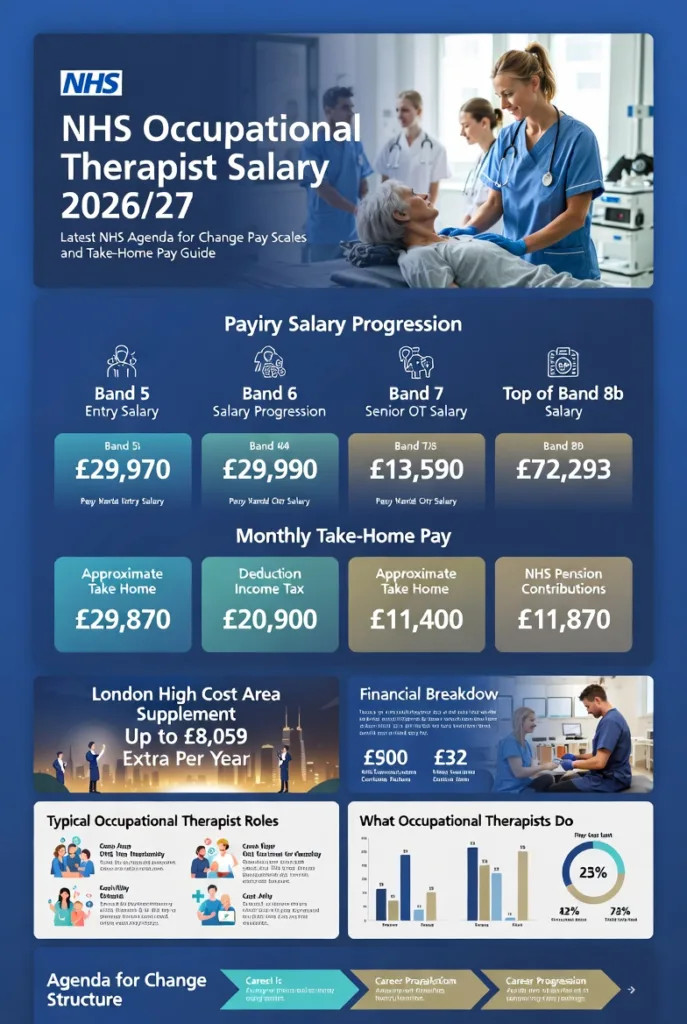
NHS occupational therapist salaries in 2026/27 are set under Agenda for Change and range from £29,970 at Band 5 entry to £72,293 at the top of Band 8b in England. After income tax, National Insurance and NHS pension deductions, a Band 5 OT takes home approximately £1,925 per month, a Band 6 OT around £2,163, and a Band 7 OT around £2,480. London adds up to £8,059 per year through the High Cost Area Supplement.
Scotland pays the highest rates of any UK nation. This guide covers every band, take-home estimates, unsocial hours pay, and what each grade requires in practice.
What Framework Governs NHS OT Pay in 2026?
All NHS occupational therapists are paid under the Agenda for Change pay framework, regardless of specialty or setting. Your salary is fixed by your band and pay point — there is no individual negotiation. Pay points increment annually subject to satisfactory performance. Scotland, Wales and Northern Ireland each run separate AfC agreements with slightly different rates; England figures are used throughout this article unless stated otherwise.
Table of Contents
Band 5 Occupational Therapist Salary 2026
Band 5 is the mandatory entry grade for all HCPC-registered occupational therapists in the NHS. The 2026/27 salary range is £29,970 to £36,483. At the mid-point of £33,344, monthly take-home after tax, NI and 12.5% pension is approximately £1,925. A Plan 2 student loan adds a further £49 deduction, bringing net pay to around £1,876. Most OTs spend three to four years at Band 5 before progressing to Band 6.
Calculate NHS Band 7 nurse take home salary and calculate your redundancy at NHS.
Band 5 Pay Points — England 2026/27
| Pay Point | Annual | Monthly Gross |
|---|---|---|
| Point 1 | £29,970 | £2,498 |
| Point 2 | £31,534 | £2,628 |
| Point 3 | £33,344 | £2,779 |
| Point 4 | £34,969 | £2,914 |
| Point 5 | £36,483 | £3,040 |
What Does a Band 5 NHS OT Actually Do?
A Band 5 occupational therapist holds an autonomous caseload from day one. You assess functional ability, design treatment programmes, contribute to discharge planning and maintain HCPC-standard clinical records. You work under clinical supervision from Band 6 and 7 colleagues — but the clinical decisions on your caseload are yours. Band 5 is a qualified clinician grade, not a trainee position.
Band 6 Occupational Therapist Salary 2026 — Specialist Grad
The Band 6 OT salary in 2026/27 runs from £37,338 to £44,962 in England. At the mid-point of £40,545, take-home is approximately £2,163 per month after tax, NI and 12.5% pension. The entry-to-top spread is £7,624 gross — around £380 to £420 more per month net across the band. Band 6 is the largest OT grade cohort in the NHS and represents the core of most OTs’ clinical careers.
Band 6 Pay Points — England 2026/27
| Pay Point | Annual | Monthly Gross |
|---|---|---|
| Point 1 | £37,338 | £3,112 |
| Point 2 | £38,890 | £3,241 |
| Point 3 | £40,545 | £3,379 |
| Point 4 | £42,328 | £3,527 |
| Point 5 | £44,962 | £3,747 |
What Does a Band 6 NHS OT Do?
A Band 6 OT manages a complex, autonomous caseload without routine supervision. You hold specialist knowledge in at least one clinical area — for example, neurological rehabilitation, hand therapy, paediatrics or mental health. You supervise Band 5 OTs and student placements, contribute to service development, and are expected to demonstrate leadership within your team. Extended scope practice begins to develop at Band 6 in many specialties.
How Long Does It Take to Go From Band 5 to Band 6?
Most NHS OTs progress from Band 5 to Band 6 after three to four years of post-registration experience. Progression is not automatic — a Band 6 vacancy must exist and you must demonstrate competency for the higher-banded role. In high-density urban areas with large OT workforces, Band 6 competition is significant. In specialist or rural services with fewer OTs, the pathway can be shorter.
Band 5 vs Band 6 OT Salary — Is the Jump Worth It?
The gap between Band 5 top (£36,483) and Band 6 entry (£37,338) is just £855 per year gross — roughly £50 to £60 more per month net. The financial case is not the immediate step but the trajectory: Band 6 top (£44,962) pays approximately £700 more per month net than Band 5 top. The sooner you progress, the more of that Band 6 spine you access across your career.
Band 7 Occupational Therapist Salary 2026 — Advanced Practitioner
The Band 7 NHS OT salary for 2026/27 runs from £46,148 to £52,809 in England. At the mid-point of £49,178, take-home is approximately £2,480 per month after tax, NI and 13.5% pension. At the top point of £52,809, the higher rate tax threshold (£50,270) is breached — around £2,539 is taxed at 40%, which reduces net pay efficiency at the upper end of this band.
Band 7 Pay Points — England 2026/27
| Pay Point | Annual | Monthly Gross |
|---|---|---|
| Point 1 | £46,148 | £3,846 |
| Point 2 | £47,820 | £3,985 |
| Point 3 | £49,178 | £4,098 |
| Point 4 | £50,952 | £4,246 |
| Point 5 | £52,809 | £4,401 |
What Does a Band 7 NHS OT Do?
Band 7 OTs function as advanced practitioners, clinical specialists or team leaders. Common titles include Advanced Occupational Therapist, Clinical Specialist OT, and Community OT Lead. You carry autonomous clinical authority, manage team members at Band 5 and 6, and contribute to service strategy. Many Band 7 OTs hold or are working toward postgraduate qualifications — MSc Advanced Practice, independent prescribing or specialist certifications — to support progression to Band 8a.
Band 6 vs Band 7 OT Salary — What the Pay Difference Looks Like
The gap between Band 6 top (£44,962) and Band 7 entry (£46,148) is £1,186 gross — around £65 to £75 more per month net. Once you reach Band 7 mid-point, the net monthly difference from Band 6 mid-point is approximately £317. At Band 7 top versus Band 6 top, the net monthly difference is around £400. The return on moving to Band 7 grows substantially with time in grade.
Band 8a Occupational Therapist Salary 2026 — Clinical Lead
Band 8a OT salary in England for 2026/27 runs from £53,755 to £60,504. At the mid-point of £57,129, take-home is approximately £2,722 per month after tax (including 40% higher rate on the portion above £50,270), NI and 13.5% pension. Band 8a roles involve service management, workforce accountability and budget responsibility — this is the point at which clinical leadership formally becomes operational leadership.
Band 8a Pay Points — England 2026/27
| Pay Point | Annual | Monthly Gross |
|---|---|---|
| Point 1 | £53,755 | £4,480 |
| Point 2 | £57,129 | £4,761 |
| Point 3 | £60,504 | £5,042 |
Band 8b Occupational Therapist Salary 2026 — Head of OT
Band 8b runs from £62,215 to £72,293 in England for 2026/27. At the mid-point of £67,254, take-home is approximately £2,975 per month — a relatively modest net gain over Band 8a given the significant gross difference, because 40% tax applies to the majority of earnings above £50,270. Band 8b OTs are typically Heads of Occupational Therapy or Associate AHP Directors with trust-wide or system-level strategic responsibility.
Consultant Occupational Therapist Salary 2026
Consultant OT posts are rare and banded at the Consultant Practitioner grade: £74,290 to £85,601 in England for 2026/27. These roles require an established track record in advanced clinical practice, service transformation or research contribution. At this salary level, approximately £24,000 to £35,000 of annual earnings fall into the 40% tax bracket. Take-home at the mid-point is approximately £3,500 per month after all deductions.
NHS OT Salary — All Bands at a Glance (England 2026/27)
| Band | Role | Gross Range | ~Monthly Take-Home |
|---|---|---|---|
| Band 4 | Senior OT Support Worker | £26,530 — £29,114 | ~£1,763 |
| Band 5 | Newly Qualified OT | £29,970 — £36,483 | ~£1,925 |
| Band 6 | Specialist / Senior OT | £37,338 — £44,962 | ~£2,163 |
| Band 7 | Advanced OT / Team Lead | £46,148 — £52,809 | ~£2,480 |
| Band 8a | Clinical Lead / Manager | £53,755 — £60,504 | ~£2,722 |
| Band 8b | Head of OT / AHP Director | £62,215 — £72,293 | ~£2,975 |
| Consultant OT | Consultant Practitioner | £74,290 — £85,601 | ~£3,500 |
Take-home figures are mid-point estimates for England, including NHS pension and standard tax. No student loan assumed.
NHS OT Salary in London 2026 — High Cost Area Supplement
NHS OTs in London receive the High Cost Area Supplement on top of AfC pay. Inner London adds 20% of basic salary, capped at £8,059 per year. Outer London adds 15%, capped at £5,736. London Fringe adds 5%, capped at £2,122. A Band 6 OT at mid-point in Inner London earns approximately £48,604 gross — above the Band 7 entry point — though London living costs absorb a significant share of that premium.
NHS OT Salary in Scotland, Wales and Northern Ireland 2026
Scotland pays the highest AfC rates in the UK. A Band 6 OT at the top of the spine in Scotland earns £46,244 versus £44,962 in England — approximately £770 more per year net after Scotland’s slightly higher income tax rates are applied. Wales sits marginally above England; Northern Ireland mirrors England exactly. For OTs considering a move between nations, the net pay difference is real but modest — career opportunity and cost of living typically matter more.
How Unsocial Hours Pay Affects NHS OT Earnings
OTs in services operating outside standard Monday-to-Friday hours receive AfC enhancements on top of basic pay. Saturday working attracts time plus 47%. Sunday and bank holidays attract time plus 94%. Evening working (8pm to 11pm weekdays) adds 44%. A Band 6 OT earning £40,545 who works every Saturday adds approximately £3,200 to £4,500 per year gross. This is most relevant to OTs in crisis teams, community mental health, and seven-day rehabilitation services.
The NHS Pension — What It’s Worth at Each OT Band
Employee pension contribution rates rise with salary — from 9.8% for Band 5 and 6 OTs up to 13.5% for Band 8a and above. Your employer contributes 23.7% of your pensionable pay on top. For a Band 6 OT at £40,545, employer contributions total approximately £9,609 per year — money accruing toward your defined benefit pension that does not appear in your pay slip. The 2015 NHS scheme guarantees a Career Average Revalued Earnings pension indexed to inflation in retirement.
NHS OT Salary vs Independent Sector 2026
Independent sector OT roles at Band 6 and 7 equivalent levels often advertise gross salaries of £35,000 to £60,000, sometimes exceeding NHS rates at senior levels. However, independent sector employers rarely offer a defined benefit pension. The NHS employer pension contribution of 23.7% represents significant additional value — for a Band 7 OT, that equates to approximately £11,000 per year in employer pension funding. This figure is almost never matched by defined contribution workplace pensions in the private sector.
OT Apprenticeship Salary During NHS Training
The Occupational Therapist Degree Apprenticeship is a Level 6 route to HCPC registration. During the three-year programme, apprentices are employed by an NHS trust — typically at Band 3 (£24,071) or Band 4 (up to £29,114) — and paid a salary throughout. Tuition fees are covered by the apprenticeship levy; no student loan is required. On qualifying, apprentices move to Band 5. This route eliminates the £45,000 to £55,000 student debt typical of the traditional university pathway.
What Determines Your NHS OT Salary Progression?
Within a band, progression is annual and linked to performance. Moving to a higher band requires a substantive change in job role — a Band 6 OT cannot be elevated to Band 7 without a Band 7 post existing and being formally appointed to it. Specialism matters: OTs in neurological rehabilitation, spinal cord injury, hand therapy and paediatrics tend to reach Band 7 more readily because specialist vacancies in these areas are harder to fill. Postgraduate qualifications support but do not guarantee band progression.
FAQs: NHS occupational therapist salary
What is the NHS occupational therapist salary in 2026?
NHS OT salaries in 2026/27 range from £29,970 (Band 5 entry, England) to £72,293 (Band 8b top). Consultant OT posts reach £85,601. After pension, tax and NI, mid-band take-home ranges from approximately £1,925 (Band 5) to £2,975 (Band 8b) per month.
What band does a newly qualified OT start at in the NHS?
All newly qualified HCPC-registered OTs begin at Band 5, regardless of prior NHS support worker experience. Band 5 entry salary is £29,970 in England for 2026/27.
How much does a Band 6 OT take home per month?
At the Band 6 mid-point of £40,545 in England, take-home is approximately £2,163 per month after income tax, NI and 12.5% NHS pension contributions.
What is the Band 7 OT take-home pay in 2026?
At the Band 7 mid-point of £49,178, take-home is approximately £2,480 per month. At the top point of £52,809, the 40% tax threshold is breached, reducing net pay efficiency at that pay point.
Do NHS OTs receive London weighting?
Yes. Inner London OTs receive 20% of basic salary up to a cap of £8,059 per year. Outer London receives 15% (max £5,736) and London Fringe receives 5% (max £2,122). It is a contractual entitlement.
Is the NHS OT apprenticeship a paid route?
Yes. OT degree apprentices are employed and paid throughout their three-year training — typically at Band 3 or 4. Tuition fees are fully funded. No student loan is required.
How does NHS OT pay compare to the private sector?
Private sector gross salaries at Band 6 to 7 equivalent are often comparable or slightly above NHS rates. However, NHS employer pension contributions (23.7%) represent substantial additional value rarely matched in the independent sector.
Summary
NHS occupational therapist salaries for 2026/27 run from £29,970 at Band 5 entry to £72,293 at Band 8b top in England, with Consultant OT posts reaching £85,601. Monthly take-home after income tax, National Insurance and NHS pension ranges from around £1,925 at Band 5 mid-point to £2,975 at Band 8b mid-point. London adds up to £8,059 per year through the HCAS. Scotland pays marginally more than England across all bands. The NHS Pension — with a 23.7% employer contribution — adds substantial long-term value beyond gross salary. Progression between bands requires a substantive role change, not just tenure. The OT degree apprenticeship offers a fully paid, debt-free qualification route for those entering or already working in NHS support roles.
All figures reflect 2026/27 Agenda for Change rates. Take-home estimates are illustrative mid-point calculations for England using standard tax codes. Individual figures vary by personal tax code, student loan plan, pension tier and trust-specific allowances. Verify current rates at NHS Employers.

Daniel Carter is a senior NHS Payroll Accountant with over 10 years of experience in Agenda for Change pay structures, tax, and pensions. He created the NHS Pay Calculators platform to help NHS staff easily understand their take-home pay, sick pay, maternity pay, and pension entitlements through simple, accurate online tools.