Burnout and Retention: Does Pay Influence NHS Staff Leaving?
NHS staff turnover costs the health service an estimated £2.4 billion per year. Burnout rates among NHS nurses, AHPs and doctors have risen consistently since 2019. The 2026 NHS Staff Survey shows that one in four NHS employees considered leaving their role in the past year. Pay dissatisfaction is cited as a primary reason by 43% of leavers — but the evidence shows pay alone neither causes nor prevents burnout. This article examines what the data says about the relationship between NHS pay, burnout and retention, what actually keeps staff, and what the workforce crisis costs when retention fails.
What the Data Says About NHS Staff Leaving in 2026
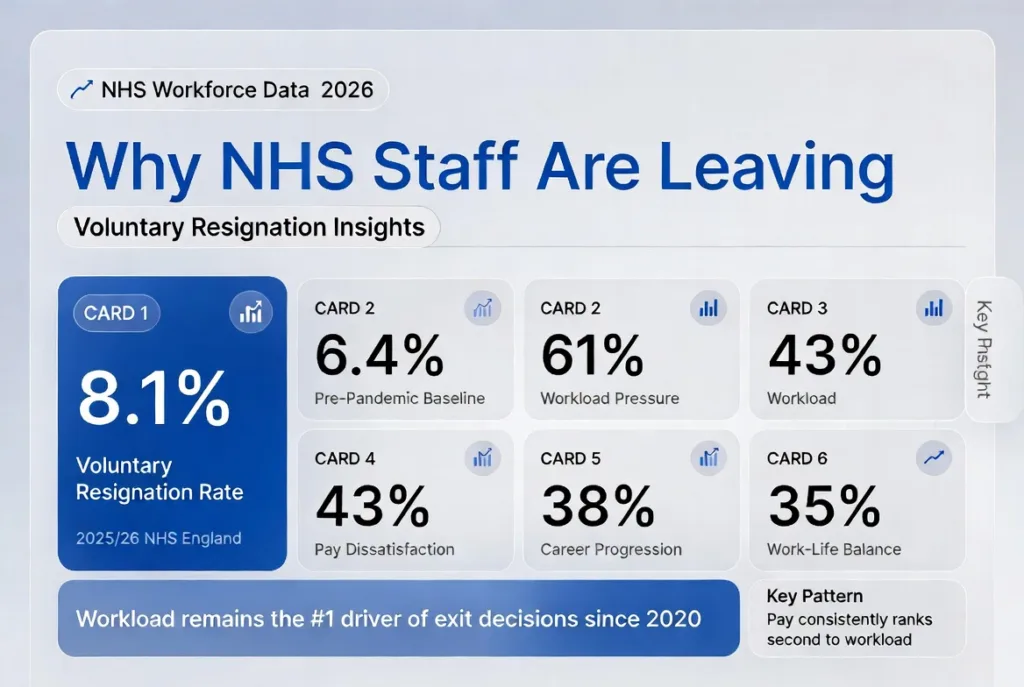
NHS England reported a voluntary resignation rate of approximately 8.1% across all staff groups in 2025/26 — higher than the pre-pandemic baseline of 6.4%. Nursing and midwifery have the highest voluntary leaver rates of any clinical group. Allied health professions follow closely. The most commonly cited reasons in exit surveys are:
- Workload and staffing levels (cited by 61% of leavers)
- Pay dissatisfaction (43%)
- Lack of career progression (38%)
- Poor work-life balance (35%)
- Management culture (29%)
Pay is a significant driver — but it consistently sits second to workload in every major NHS workforce survey conducted since 2020.
What Is Burnout in the NHS Context?
Burnout is a clinical syndrome recognised by the WHO characterised by three dimensions: emotional exhaustion, depersonalisation and reduced sense of personal accomplishment. In NHS settings, burnout is measured through tools including the Maslach Burnout Inventory and the NHS Staff Survey’s work pressure and wellbeing indices.
Key 2026 figures from the NHS Staff Survey:
- 44% of NHS staff report feeling unwell due to work-related stress in the past year
- 38% report working unpaid overtime regularly
- 27% meet criteria for high emotional exhaustion
- Burnout prevalence is highest in emergency medicine, intensive care, mental health nursing and community health
Burnout and intent to leave are strongly correlated — but the pathway from burnout to resignation runs through multiple variables, of which pay is one.
Does Pay Cause Burnout?
Pay does not directly cause burnout. The evidence consistently shows that burnout is driven primarily by workload volume, lack of control over working conditions, poor team relationships and values mismatch — not salary level alone.
However, pay influences burnout indirectly through three mechanisms:
1. Pay inequity perception — staff who feel underpaid relative to their workload experience higher emotional exhaustion. NHS nurses earning Band 5 salaries of £29,970 while managing acute ward caseloads that have grown significantly since 2019 report strong pay-workload inequity.
2. Financial stress — inadequate pay creates financial strain that extends occupational stress into home life, accelerating burnout progression. The Royal College of Nursing reported in 2025 that 1 in 8 NHS nurses used food banks at least once in the previous year.
3. Reduced recovery capacity — staff who cannot afford adequate housing, childcare or leisure due to pay levels have diminished recovery between shifts, reducing resilience to occupational stress over time.
Does Pay Drive NHS Staff to Leave?
Pay is a necessary but not sufficient condition for retention. The evidence shows a threshold effect — below a certain pay level, dissatisfaction becomes a primary driver of resignation. Above that threshold, other factors dominate.
NHS PCAF (Pay, Conditions and Affordability Framework) analysis, 2025:
| Pay Satisfaction Level | Probability of Leaving Within 12 Months |
|---|---|
| Highly satisfied | 6% |
| Moderately satisfied | 11% |
| Dissatisfied | 24% |
| Highly dissatisfied | 39% |
Staff who are highly dissatisfied with pay are more than six times more likely to leave within 12 months than those who are highly satisfied. But among dissatisfied leavers, 68% cite workload as a co-factor — meaning pay dissatisfaction rarely operates in isolation.
Which NHS Staff Groups Are Most at Risk of Leaving?
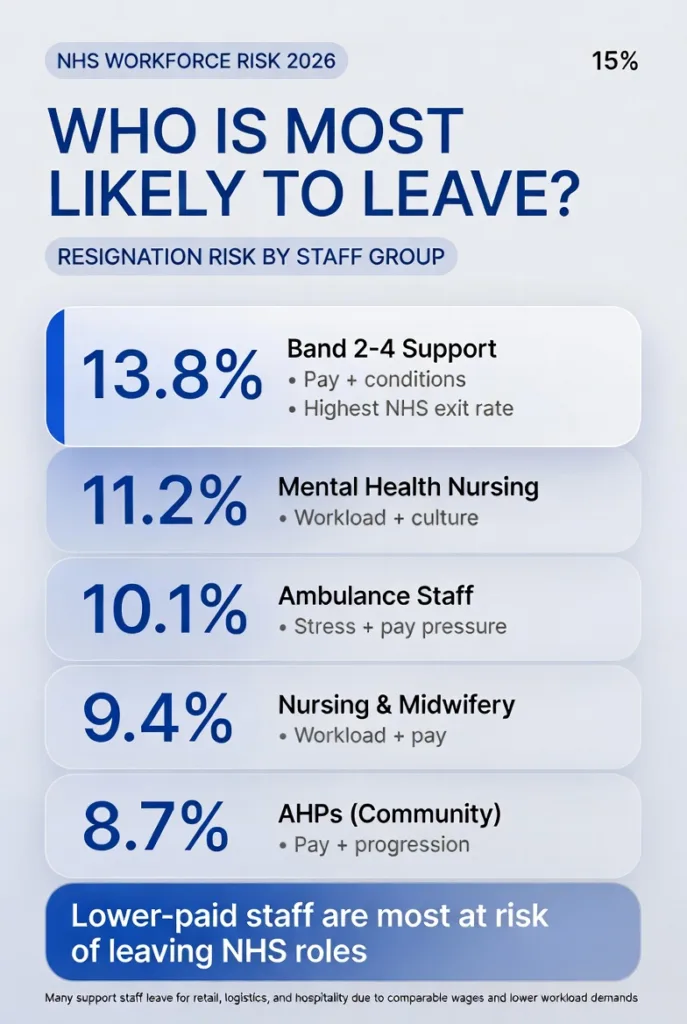
Resignation risk is not evenly distributed across the NHS workforce. The highest-risk groups in 2026 are:
| Staff Group | Annual Voluntary Leaver Rate | Primary Cited Reason |
|---|---|---|
| Nursing and Midwifery | 9.4% | Workload and pay |
| Mental Health Nursing | 11.2% | Workload and culture |
| AHPs (community) | 8.7% | Pay and progression |
| Ambulance staff | 10.1% | Stress and pay |
| Band 2–4 support workers | 13.8% | Pay and conditions |
Band 2 to 4 support workers have the highest leaver rate in the NHS. At salaries of £23,615 to £29,114, many are leaving for retail, logistics and hospitality roles that have increased wages following the National Living Wage uplifts. The NHS is losing its lowest-paid workforce to sectors that now pay comparably, without the physical and emotional demands of healthcare work.
The Real Cost of NHS Staff Turnover
Turnover is not just a workforce problem — it is a financial one. The cost of replacing a single NHS nurse is estimated at £8,500 to £16,000 when recruitment advertising, agency cover, induction and productivity loss during onboarding are combined.
Estimated Annual Turnover Cost by Role (NHS England)
| Role | Estimated Replacement Cost | Annual Leavers | Total Annual Cost |
|---|---|---|---|
| Band 5 Nurse | £10,500 | ~18,400 | ~£193 million |
| Band 6 Nurse | £14,200 | ~9,800 | ~£139 million |
| AHP (Band 6) | £12,800 | ~6,200 | ~£79 million |
| Support Worker | £5,600 | ~31,000 | ~£174 million |
These are conservative estimates. They do not include the cost of increased clinical risk during understaffing, delayed discharges or deteriorating patient outcomes attributable to workforce gaps.
What Actually Retains NHS Staff?
The evidence base on NHS retention is consistent. Pay matters — but it is one component of a retention bundle. Studies from the King’s Fund, NHS Employers and the Health Foundation identify the following as the strongest independent predictors of NHS staff retention:
Top retention drivers by evidence strength:
- Manageable workload — the single strongest predictor of intent to stay across all NHS staff surveys
- Flexible working — access to flexible hours, part-time and hybrid arrangements reduces resignation intent by up to 34% in community health roles
- Feeling valued by management — staff who report feeling recognised are 2.8 times more likely to stay than those who do not
- Pay adequacy — not maximum pay, but pay perceived as fair relative to workload and cost of living
- Career development — clear progression pathways and funded CPD reduce Band 6 leaver rates meaningfully
- Psychological safety — teams where staff feel safe raising concerns have significantly lower burnout and resignation rates
Pay features at position four — important, but consistently outranked by workload and culture factors in predictive models.
The Pay-Workload Ratio — Why It Matters More Than Pay Alone
The concept that best explains NHS retention behaviour is not absolute pay but the perceived pay-workload ratio — whether staff feel their compensation is proportionate to what is asked of them.
A Band 5 nurse earning £33,344 managing a safe caseload on a well-staffed ward may feel adequately compensated. The same nurse managing an unsafe caseload due to chronic vacancies, earning the same take home salary, experiences a fundamentally different pay-workload ratio — and is significantly more likely to leave.
This explains why NHS pay rises have not fully resolved retention problems. The 2023 and 2024 pay awards increased Band 5 nursing entry by approximately 8.5% over two years, yet resignation rates remained elevated. Workload increased in parallel — the pay improvement was absorbed by worsening conditions rather than experienced as a genuine improvement in working life.
International Comparisons — Are NHS Staff Paid Enough to Stay?
The UK competes internationally for clinical staff, particularly nurses, AHPs and doctors. Pay competitiveness relative to comparable health systems matters for retention.
Band 6 Nurse Equivalent Salary — International Comparison (2026)
| Country | Equivalent Annual Gross | NHS England Band 6 Equivalent |
|---|---|---|
| Australia | £52,000 — £58,000 | £37,338 — £44,962 |
| Canada | £48,000 — £54,000 | £37,338 — £44,962 |
| Ireland | £43,000 — £50,000 | £37,338 — £44,962 |
| UAE | £55,000 — £70,000 (tax-free) | £37,338 — £44,962 |
| Germany | £38,000 — £45,000 | £37,338 — £44,962 |
Australia, Canada and the UAE continue to actively recruit NHS-trained nurses. The pay differential — particularly the tax-free status of UAE earnings — makes international migration financially rational for many mid-career NHS nurses at Band 6 and 7, even accounting for the value of the NHS pension scheme.
What Would Make a Meaningful Difference to NHS Retention?
Evidence-based interventions with demonstrated impact on NHS retention include:
- Banding review for high-pressure roles — roles where job content has expanded significantly since initial banding evaluation, particularly Band 5 nursing in acute settings
- Cost of living supplements — beyond London HCAS, extending geographic supplements to other high-cost areas where housing affordability is a driver of departure
- Guaranteed flexible working rights — removing flexibility as a negotiation and making it a contractual baseline, particularly for Band 2–5 support workers
- Funded CPD hours within contracted time — not additional unpaid self-development but ring-fenced paid learning time, directly linked to Band 6 and 7 progression
- Workload safety limits — nurse-to-patient ratio legislation, as introduced in Scotland and piloted in Wales, showing early evidence of reduced burnout in participating wards
Pay increases are necessary but not sufficient. The evidence consistently shows that without parallel workload management, pay rises are absorbed by deteriorating conditions and do not translate into sustained retention improvements.
Frequently Asked Questions
Does NHS pay directly cause staff to leave?
Pay dissatisfaction is cited by 43% of NHS leavers but consistently ranks second to workload as a primary reason. Pay operates as a retention threshold — below a certain level it becomes a primary driver of resignation, but above that level workload, culture and flexibility dominate intent to leave.
What is the NHS staff turnover rate in 2026?
The voluntary resignation rate across NHS England is approximately 8.1% in 2025/26 — above the pre-pandemic baseline of 6.4%. Mental health nursing (11.2%) and Band 2–4 support workers (13.8%) have the highest leaver rates of any staff group.
How much does NHS staff turnover cost per year?
Replacing a Band 5 nurse costs an estimated £10,500 to £16,000 including recruitment, agency cover and onboarding. Total annual NHS turnover costs are estimated at approximately £2.4 billion across all staff groups.
Which NHS staff are most likely to leave in 2026?
Band 2 to 4 support workers have the highest voluntary leaver rate at 13.8%. Mental health nurses follow at 11.2%. Ambulance staff and community AHPs also show elevated resignation rates driven by workload and pay dissatisfaction.
Do NHS pay rises improve retention?
Pay rises improve retention when they restore the perceived pay-workload ratio — but if workload increases in parallel, the improvement is absorbed and resignation rates remain elevated. The 2023/24 pay awards raised Band 5 nursing pay by approximately 8.5% but did not produce a corresponding reduction in leaver rates because staffing pressures worsened simultaneously.
Why are NHS staff leaving for Australia and the UAE?
An equivalent Band 6 nurse in Australia earns £52,000 to £58,000 gross — up to £13,000 more per year than the England equivalent. UAE roles offer £55,000 to £70,000 tax-free. The financial case for international migration is significant, particularly for mid-career NHS nurses carrying student loan debt in high cost-of-living areas.
Summary
NHS burnout and staff retention in 2026 are shaped by pay but not determined by it. Pay dissatisfaction is cited by 43% of NHS leavers and is a genuine driver — particularly for Band 2 to 4 support workers now competing with a higher-wage hospitality and retail sector, and for mid-career Band 6 and 7 clinicians facing international salary differentials of £10,000 to £30,000 per year. But workload consistently outranks pay in predictive models of resignation intent.
The evidence points to a pay-workload ratio effect — staff leave not when pay is low in absolute terms but when it feels disproportionate to what is being asked of them. Effective retention requires simultaneous action on pay adequacy, workload safety, flexible working and career progression. Pay rises alone, without workload management, have not historically translated into sustained improvements in NHS staff retention.
Data references include NHS Staff Survey 2026, NHS Digital Workforce Statistics 2025/26, Health Foundation workforce analysis, King’s Fund retention research and Royal College of Nursing employment surveys. Individual trust figures vary. All salary figures reflect 2026/27 Agenda for Change rates.

Daniel Carter is a senior NHS Payroll Accountant with over 10 years of experience in Agenda for Change pay structures, tax, and pensions. He created the NHS Pay Calculators platform to help NHS staff easily understand their take-home pay, sick pay, maternity pay, and pension entitlements through simple, accurate online tools.