Opting Out of NHS Pension: Real Costs vs Short-Term Gains
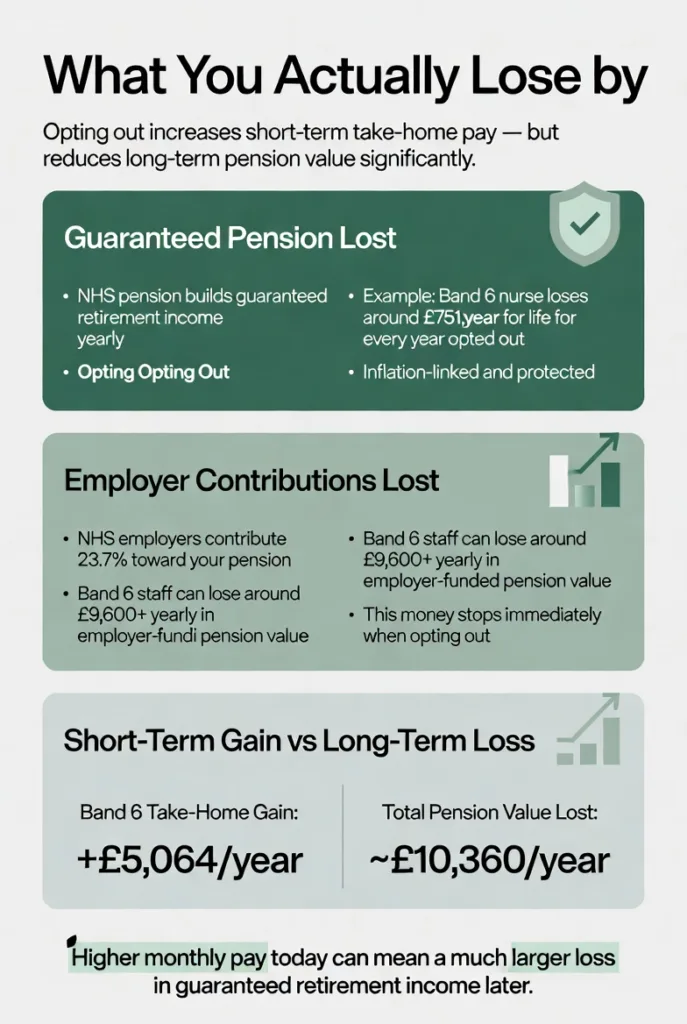
Opting out of the NHS Pension Scheme increases monthly take-home pay by £189 to £757 depending on band — but permanently stops defined benefit pension accrual worth significantly more than the contributions saved. A Band 6 nurse opting out gains approximately £422 per month in take-home but loses £751 in annual pension accrual for every year out of the scheme. The employer contribution of 23.7% — worth £9,609 per year at Band 6 mid-point — is also forfeited entirely.
This guide covers exactly what opting out costs at each band, what you gain, the break-even calculation, and the limited circumstances where opting out may be financially rational.
How the NHS Pension Scheme Works in 2026/27
The 2015 NHS Pension Scheme is a Career Average Revalued Earnings (CARE) defined benefit scheme. Each year you remain in the scheme, you build up a guaranteed pension of 1/54th of your pensionable pay for that year. That amount is revalued annually in line with the Consumer Prices Index (CPI) until you retire.
The scheme has two cost components:
- Employee contribution — deducted from your pay, tier-based on salary
- Employer contribution — 23.7% of your pensionable pay, paid by your trust on top of your salary
When you opt out, both stop. You lose the accrual and the employer contribution — the most expensive element — entirely.
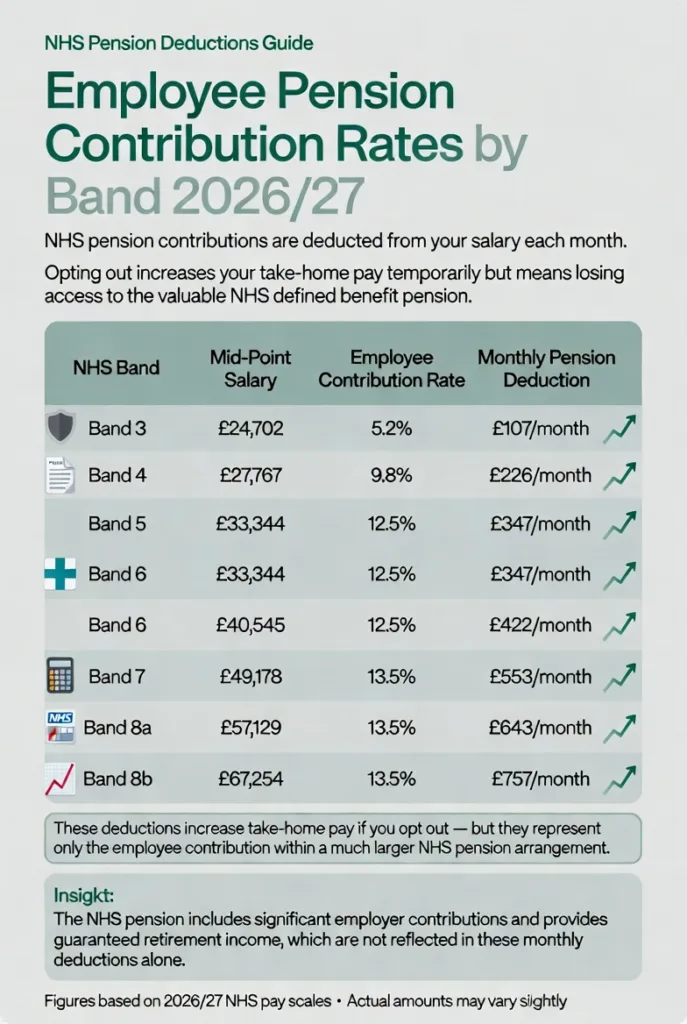
Employee Pension Contribution Rates by Band 2026/27
Your pension deduction is the take-home gain from opting out. These are the current employee contribution tiers:
| Band | Mid-Point Salary | Contribution Rate | Monthly Deduction |
|---|---|---|---|
| Band 3 | £24,702 | 5.2% | £107 |
| Band 4 | £27,767 | 9.8% | £226 |
| Band 5 | £33,344 | 12.5% | £347 |
| Band 6 | £40,545 | 12.5% | £422 |
| Band 7 | £49,178 | 13.5% | £553 |
| Band 8a | £57,129 | 13.5% | £643 |
| Band 8b | £67,254 | 13.5% | £757 |
These are the exact monthly amounts added to take-home pay if you opt out. They look significant — but they represent only the employee side of a much larger arrangement.
What You Actually Lose by Opting Out
The employee contribution is the smaller part of the pension equation. The true cost of opting out has three components:
1. Annual pension accrual lost
Each year in the scheme builds 1/54th of pensionable pay as guaranteed retirement income.
| Band | Mid-Point Salary | Annual Pension Accrued | Monthly Equivalent in Retirement |
|---|---|---|---|
| Band 3 | £24,702 | £457 | £38 |
| Band 5 | £33,344 | £617 | £51 |
| Band 6 | £40,545 | £751 | £63 |
| Band 7 | £49,178 | £910 | £76 |
| Band 8a | £57,129 | £1,058 | £88 |
For every year a Band 6 nurse opts out, they permanently lose £751 in annual retirement income — guaranteed, index-linked, for life.
2. Employer contribution forfeited
Your trust pays 23.7% of your pensionable pay into the scheme on your behalf. This does not appear on your payslip but is real money funding your pension.
| Band | Mid-Point Salary | Annual Employer Contribution Lost |
|---|---|---|
| Band 3 | £24,702 | £5,854 |
| Band 5 | £33,344 | £7,903 |
| Band 6 | £40,545 | £9,609 |
| Band 7 | £49,178 | £11,655 |
| Band 8a | £57,129 | £13,540 |
A Band 6 nurse opting out does not just lose their own £422/month contribution — they also forfeit £800 per month in employer funding that immediately stops.
3. CPI revaluation lost
Pension already accrued before opting out retains its value and continues to be revalued with CPI until retirement. But no new accrual means no new revaluation benefit on future earnings.
The Real Cost vs Gain Calculation — Band by Band
This is the critical comparison — what you gain in take-home versus what you permanently lose in pension value.
Annual Comparison — Opting Out for One Year
| Band | Monthly Take-Home Gain | Annual Take-Home Gain | Annual Pension Accrual Lost | Employer Contribution Lost | Total Annual Cost of Opting Out |
|---|---|---|---|---|---|
| Band 5 | £347 | £4,164 | £617 | £7,903 | £8,520 |
| Band 6 | £422 | £5,064 | £751 | £9,609 | £10,360 |
| Band 7 | £553 | £6,636 | £910 | £11,655 | £12,565 |
| Band 8a | £643 | £7,716 | £1,058 | £13,540 | £14,598 |
For every year a Band 6 nurse opts out, they gain £5,064 in take-home but give up £10,360 in total pension value — a net loss of £5,296 per year even before accounting for the lifetime value of lost retirement income.
The Break-Even Problem
For opting out to make financial sense, the money gained in take-home would need to generate returns exceeding the value of lost pension accrual and employer contributions.
Band 6 — Can You Replicate the NHS Pension Privately?
The NHS employer contributes £9,609 per year at Band 6 mid-point. To replicate this in a private pension, you would need to:
- Invest the £422/month take-home gain plus find an additional £379/month from elsewhere
- Achieve investment returns that match inflation-linked guaranteed income
- Accept investment risk that the NHS defined benefit scheme eliminates entirely
In practice, replicating the value of the NHS Pension Scheme through private savings is not achievable on the amounts freed up by opting out. The defined benefit guarantee — no investment risk, inflation linking, survivor benefits — has a value that defined contribution alternatives cannot match at equivalent contribution rates.
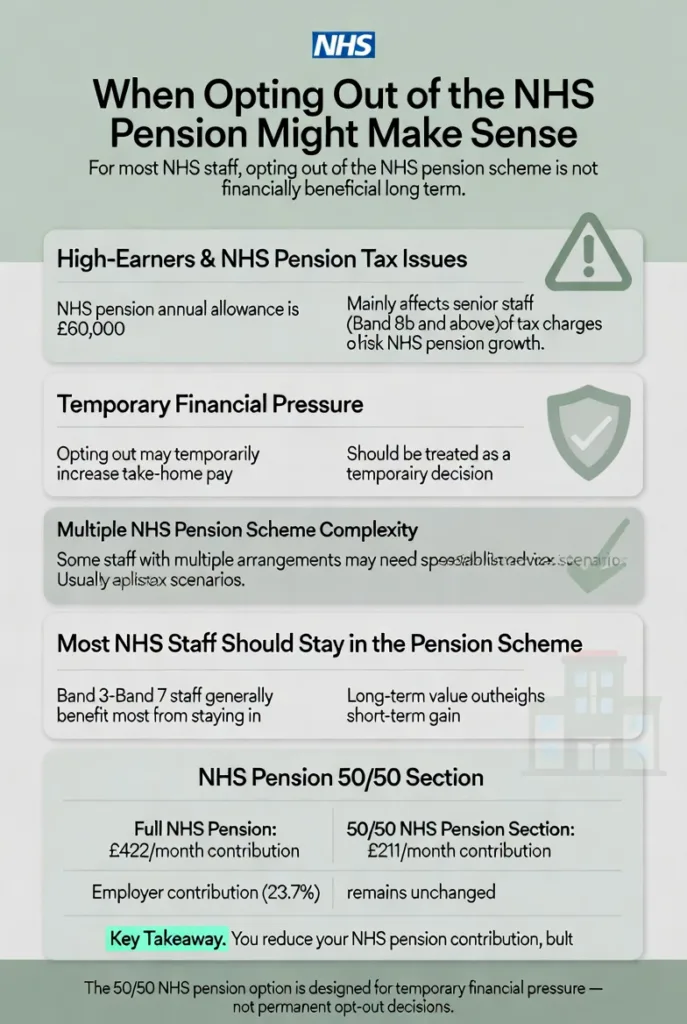
When Opting Out Might Be Considered
There are specific and limited circumstances where opting out could be financially rational:
1. Annual Allowance breach risk
The pension annual allowance is £60,000 per tax year. High earners at Band 8b and above, or those receiving large pay rises, may see their pension input exceed this — triggering a tax charge that can exceed the pension value gained. If your pension growth plus contributions is approaching £60,000, opting out or reducing accrual temporarily avoids this charge.
2. Lifetime Allowance — post-2023 changes
The Lifetime Allowance was abolished in April 2024. This previously discouraged senior NHS staff from continued pension accrual. Its removal has reduced the case for opting out significantly at senior levels.
3. Severe short-term financial crisis
If you face genuine financial hardship — mortgage arrears, priority debt accumulation — the additional take-home from opting out can provide temporary relief. This should always be a short-term measure with a plan to re-enrol.
4. Dual employment and pension complications
NHS staff with multiple pension schemes approaching complex tax positions sometimes opt out of one scheme temporarily on advice from a qualified financial adviser.
None of these apply to the majority of NHS staff. For Band 3 to Band 7 employees not approaching tax threshold issues, opting out is almost never financially beneficial.
The 50/50 Section — A Middle Option
Before opting out entirely, the 50/50 section of the NHS Pension Scheme offers a middle ground. You pay half your normal contribution rate and accrue half the normal pension — while your employer continues to contribute at the full 23.7% rate.
50/50 Section — Band 6 Example
| Item | Full Scheme | 50/50 Section | Opted Out |
|---|---|---|---|
| Employee contribution | £422/month | £211/month | £0 |
| Employer contribution | £801/month | £801/month | £0 |
| Annual pension accrued | £751 | £376 | £0 |
| Take-home vs full scheme | — | +£211/month | +£422/month |
The 50/50 section retains the full employer contribution — the most valuable part — while reducing your personal contribution by 50%. It is specifically designed for staff facing temporary financial pressure. You can move between full and 50/50 membership with each pay period.
For anyone considering opting out purely to ease short-term cash flow, the 50/50 section is almost always preferable.
Re-Enrolling After Opting Out
Your employer is required to automatically re-enrol you into the NHS Pension Scheme every three years from your opt-out date. You can opt out again immediately, but the re-enrolment trigger is automatic and requires active action to reverse.
You can also voluntarily re-join at any time by notifying your employer. Re-joining does not recover pension accrual lost during the opt-out period — those years are permanently gone.
There is no backdating of pension accrual. Every month opted out is a month of pension permanently forfeited.
Tax Relief on NHS Pension Contributions
One aspect of NHS pension contributions that makes opting out less attractive than raw take-home figures suggest is tax relief. Your pension contributions are deducted before income tax — they reduce your taxable pay.
Tax Relief Value of Pension Contributions — Band 6 (£422/month)
| Tax Rate | Monthly Tax Relief | Annual Tax Relief |
|---|---|---|
| 20% (basic) | £84 | £1,013 |
| 40% (higher) | £169 | £2,027 |
At Band 7 and above where some earnings fall in the 40% band, pension contributions attract 40% tax relief on the relevant portion — making the effective cost of contributing lower than the gross deduction figure suggests. Opting out removes this tax relief benefit.
NHS Pension Death and Ill-Health Benefits — What You Also Lose
The NHS Pension Scheme includes protection benefits beyond retirement income. Opting out forfeits these too.
Benefits lost on opting out:
| Benefit | Value |
|---|---|
| Death in service lump sum | 2× annual pensionable pay |
| Survivor pension (spouse/partner) | 37.5% of your pension for life |
| Ill-health retirement (Tier 1) | Immediate pension if unable to do own job |
| Ill-health retirement (Tier 2) | Enhanced pension if unable to do any work |
A Band 6 nurse at £40,545 who opts out loses a death in service lump sum of approximately £81,090 and their family’s survivor pension entitlement. These protections are not replicated by any standard workplace or private arrangement at equivalent cost.
Frequently Asked Questions
How much more take-home pay do I get if I opt out of the NHS pension?
Take-home increases by your employee contribution amount — £347/month at Band 5 mid-point, £422/month at Band 6, £553/month at Band 7 and £643/month at Band 8a. These figures reflect the pension deduction removed from your payslip.
What do I lose by opting out of the NHS pension?
You lose annual pension accrual of 1/54th of your salary per year, the employer contribution of 23.7% of pensionable pay, tax relief on contributions, death in service benefits of 2× annual salary, survivor pension for dependants, and ill-health retirement protection.
Is the 50/50 NHS pension option better than opting out?
In almost all cases, yes. The 50/50 section halves your contribution and halves your accrual but retains the full 23.7% employer contribution — the most valuable component. It is specifically designed for temporary financial pressure and is superior to full opt-out for most staff.
Can I re-join the NHS pension after opting out?
Yes, at any time by notifying your employer. You cannot backdate accrual for the period you were opted out — those years are permanently lost. Your employer must also automatically re-enrol you every three years.
Does opting out affect my death in service benefits?
Yes. Death in service lump sum (2× pensionable pay) and survivor pensions for your spouse or partner are only available to active scheme members. Opting out removes these protections immediately.
Is opting out ever sensible for NHS staff?
For most Band 3 to Band 7 staff, no. The employer contribution alone exceeds the employee saving. Limited exceptions include staff approaching the annual allowance tax charge threshold (relevant mainly at Band 8b and above with large pay increases), or those facing severe short-term financial hardship where the 50/50 section has already been considered.
Summary
Opting out of the NHS pension adds £107 to £757 per month to take-home depending on band. But the true annual cost ranges from £8,520 at Band 5 to £14,598 at Band 8a — driven primarily by the forfeited employer contribution of 23.7% that stops immediately on opt-out. For every year a Band 6 nurse opts out, they permanently lose £751 in annual retirement income and £9,609 in employer pension funding.
The 50/50 section is a better option for short-term cash flow pressure — it halves contributions while retaining the full employer contribution. Re-joining after opting out does not recover lost accrual. Death in service and ill-health benefits are also forfeited on opt-out. For the majority of NHS staff below Band 8b, opting out is not financially rational.
All figures reflect 2026/27 Agenda for Change pay rates, NHS Pension Scheme contribution tiers and 2015 CARE scheme accrual rules for England. Pension projections are illustrative. Individual pension values depend on full career history, revaluation rates and retirement age. For personalised pension advice, contact NHS Pensions at nhsbsa.nhs.uk or consult a regulated financial adviser.

Daniel Carter is a senior NHS Payroll Accountant with over 10 years of experience in Agenda for Change pay structures, tax, and pensions. He created the NHS Pay Calculators platform to help NHS staff easily understand their take-home pay, sick pay, maternity pay, and pension entitlements through simple, accurate online tools.