NHS vs Private Healthcare Salaries for Nurses and AHPs
The private healthcare often advertises £3,000–£8,000 more in base salary than NHS roles at the same experience level. A Band 5 nurse in England now earns between £32,073 and £39,043 following the 2026/27 pay award. A comparable private hospital role typically advertises £33,000–£41,000. But once you factor in the NHS pension — where your employer contributes 23.7% of your salary on top — that private pay gap closes very quickly. This guide walks through both sectors side by side so you can make an informed decision, not just chase the bigger number.
Table of Contents
How NHS Pay Is Structured in 2026/27
The NHS uses a national pay system called Agenda for Change (AfC). It covers the vast majority of NHS staff in England, Wales, and Northern Ireland. Scotland has its own version — Scotland negotiated a 3.75% pay rise for 2026/27, slightly higher than England’s 3.3%, though higher Scottish tax rates mean take-home pay is often similar.
Your salary sits within a numbered pay band — Band 1 through Band 9. As a nurse or allied health professional (AHP), you’ll almost certainly fall between Band 5 and Band 8. You move up through pay increments annually until you reach the top of your band.
NHS Agenda for Change Pay Bands 2026/27 (England)
| Band | Role Examples | Salary Range |
|---|---|---|
| Band 5 | Staff Nurse, NQ Physio, NQ OT | £32,072–£39,041 |
| Band 6 | Senior Nurse, Radiographer, Paramedic | £39,958–£48,117 |
| Band 7 | Advanced Practitioner, Ward Manager | £49,247–£55,653 |
| Band 8a | Specialist Lead, Consultant AHP | £57,527–£65,000+ |
These are gross figures before tax, National Insurance, and pension deductions.
If you work in or near London, you also receive a High Cost Area Supplement (HCAS). Inner London adds 20% of your basic salary, with a minimum of £5,794 and a maximum of £8,746 per year for 2026/27. Outer London adds 15%, and the Fringe zone adds 5%.
What Private Healthcare Employers Actually Pay
Private hospitals — Spire Healthcare, Nuffield Health, HCA Healthcare UK, and Circle Health Group — do not follow Agenda for Change. They set their own pay rates, and salaries are often negotiable, particularly at senior levels.
Typical Private Sector Salaries for Nurses and AHPs (2026)
| Role | NHS Equivalent | Private Salary Range |
|---|---|---|
| Staff Nurse | Band 5 | £33,000–£41,000 |
| Senior Physiotherapist | Band 6 | £38,000–£47,000 |
| Theatre / Scrub Nurse | Band 6–7 | £43,000–£56,000 |
| Advanced Practitioner | Band 7–8a | £50,000–£65,000 |
These figures vary based on location, employer, and speciality. London private hospitals consistently sit at the top of these ranges. Theatre and intensive care nursing command the highest premiums in the private sector.

NHS vs Private Pay: The Full Picture
At face value, private sector salaries often look more attractive. But looking only at the basic wage misses a big chunk of what you’re actually earning.
Let’s compare a Band 6 nurse in both sectors:
| Factor | NHS Band 6 | Private Hospital |
|---|---|---|
| Basic Salary | £39,958 | £44,000 |
| Employer Pension | 23.7% (≈£9,470/yr) | 5–8% (≈£2,200–£3,520/yr) |
| Annual Leave | 27–33 days + bank holidays | 25–28 days typically |
The employer pension contribution gap alone is roughly £6,000–£7,000 per year. Over a 20-year career, that’s well over £120,000 in retirement savings that the NHS is adding on your behalf — money that doesn’t show up in your pay slip but absolutely shows up in your retirement.
The NHS Pension: Why It Changes Everything
The NHS Pension Scheme is a defined benefit pension. That means your retirement income is based on your salary and how many years you worked — and it is guaranteed. It doesn’t depend on stock market performance.
Most private sector pensions are defined contribution. Your pot grows based on what you and your employer pay in, plus investment returns. A bad run of markets near retirement can hit your income hard.
A Simple Example
A Band 6 nurse who works 30 years in the NHS could retire with a guaranteed annual pension of around £13,000–£18,000 per year, inflation-linked and for life.
In the private sector, with 6–8% employer contributions over 30 years, you could build a similar pot — but it is not guaranteed. The income in retirement depends on how investments perform.
For the majority of nurses and AHPs, the NHS pension is the single biggest financial reason to stay in the public sector — even when private salaries look better on the job board.
Other Benefits Worth Comparing
Sick Pay
NHS occupational sick pay gives you up to 6 months at full pay followed by 6 months at half pay, depending on your length of service. Private employers vary widely. Some match NHS terms, but many only offer statutory sick pay, which is significantly less.
Unsocial Hours Pay
Under Agenda for Change you receive:
- Nights: 37% enhancement
- Saturdays: 30% enhancement
- Sundays and bank holidays: 60% enhancement
Some private employers offer flat enhanced rates, but rarely match the full AfC structure.
Bank and Extra Shifts
Private hospitals often pay higher hourly rates for bank or additional shifts. This is one area where private employment can be more rewarding for staff looking to top up their income on flexible terms.
Career Progression
The NHS has a clear, nationally agreed structure. You know exactly which band you’re working toward and what’s required to get there. Private progression can be faster in some organisations — or completely undefined in others. It depends entirely on the employer.
When Private Healthcare Pay Actually Wins
There are real situations where a move to the private sector results in higher overall earnings.
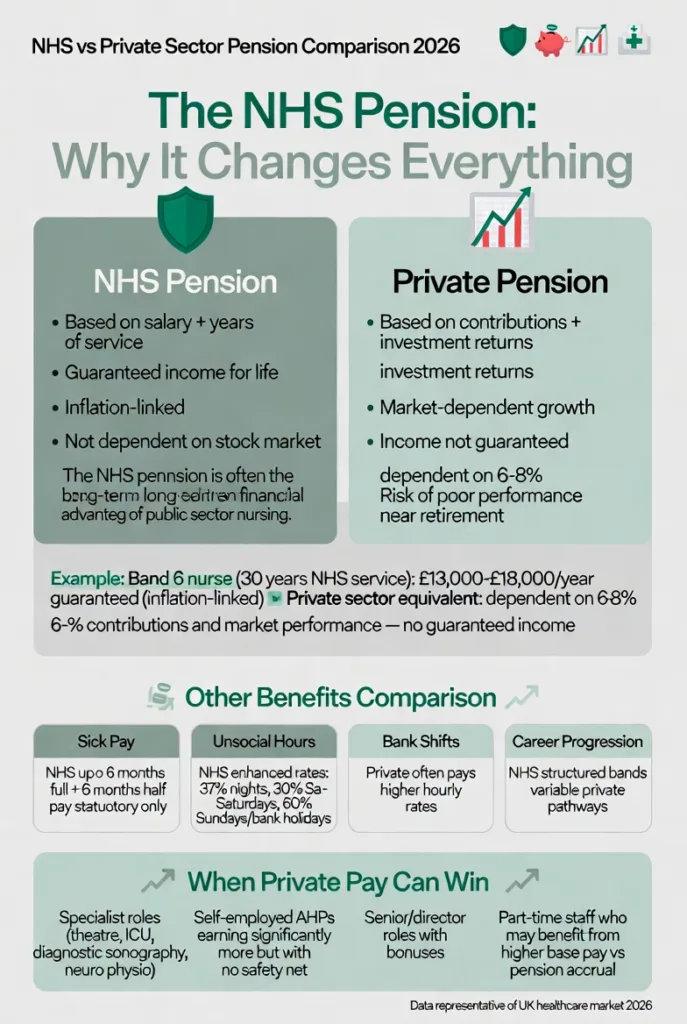
Specialist clinical roles — Theatre nurses, critical care nurses, and specialist AHPs such as neurological physiotherapists or diagnostic sonographers regularly command salaries above Band 7 equivalents in the private sector.
Self-employed AHPs — Physiotherapists, podiatrists, and occupational therapists running their own practices can earn £55,000–£95,000+, though they carry business costs including indemnity insurance, accountancy, and no sick pay safety net.
Senior and director-level positions — Band 8b and above equivalents in large private hospital groups sometimes offer total packages including bonuses that exceed NHS rates.
Part-time workers — If you’re working reduced hours and won’t build a full NHS pension over a long career, the higher private base pay can genuinely be worth more.
Real Career Scenarios
Scenario 1 — Newly Qualified Nurse
Tom qualifies as a Band 5 nurse on £32,073. A private hospital offers £35,500. The private offer looks £3,427 better. But Tom’s NHS employer contributes 23.7% to his pension — that’s £7,601 per year. The private employer contributes 6%, which is £2,130. The NHS is worth more overall, especially early in a career when pension years matter most.
Scenario 2 — Experienced Physiotherapist
Sarah is a Band 7 physio on £49,247. A private group offers £57,000 — a jump of £7,753. Even after accounting for the pension contribution gap, the private salary here is meaningfully higher in take-home terms. For Sarah, especially if she’s not planning a 30-year NHS career, the switch makes financial sense.
Scenario 3 — Senior AHP
James is a Band 8a occupational therapist at £57,527. A private hospital group offers £66,000 plus a performance bonus. This exceeds the top of his NHS band. At this level, private pay can genuinely outperform the NHS on almost every measure.
Things to Think About Before Making the Move
- Job security — NHS contracts are protected and redundancy situations are rare compared to the private sector
- CPD and revalidation — NHS trusts tend to fund and support continuing professional development and NMC/HCPC revalidation more consistently
- Clinical complexity — The NHS offers broader, more complex caseloads and multi-disciplinary team working that many AHPs value for development
- Location — Most private hospitals are in cities and commuter belts, limiting options for those outside urban areas
- Maternity and family leave — NHS occupational maternity pay is among the most generous available, typically far above what private employers offer
Frequently Asked Questions
Do private hospital nurses earn more than NHS nurses in 2026/27?
Usually yes in base salary — often £3,000 to £8,000 more at similar experience levels. But once the NHS pension (23.7% employer contribution), sick pay, and enhanced unsocial hours payments are included, the NHS total package is frequently competitive or superior, especially for Band 5 and Band 6 staff.
Do private hospital nurses earn more than NHS nurses in 2026/27?
Usually yes in base salary — often £3,000 to £8,000 more at similar experience levels. But once the NHS pension (23.7% employer contribution), sick pay, and enhanced unsocial hours payments are included, the NHS total package is frequently competitive or superior, especially for Band 5 and Band 6 staff.
Is the NHS pension still worth staying for in 2026?
Yes, for most healthcare professionals. It is a defined benefit scheme with guaranteed income in retirement. Most private sector pensions offer 5–8% employer contributions with no income guarantee. The NHS pension is one of the best workplace pensions available in the UK.
What do AHPs earn in private healthcare vs the NHS in 2026/27?
A Band 6 AHP earns £39,958–£48,117 in the NHS. Private equivalents typically range from £38,000–£47,000, with specialist roles in areas like sonography and neurology reaching higher. At Band 7 and above, private salaries increasingly edge ahead.
Can I work in both NHS and private healthcare?
Yes. Many nurses and AHPs maintain their NHS post as the primary role and take private bank or agency shifts to supplement income. This remains one of the most popular ways to benefit from both sectors without giving up NHS terms and conditions.
Pay figures reflect confirmed 2026/27 NHS Agenda for Change rates for England, effective 1 April 2026, following the 3.3% pay award announced February 2026. Private salary ranges are illustrative based on advertised roles across major UK private healthcare employers. Individual salaries will vary by employer, location, and speciality.

Daniel Carter is a senior NHS Payroll Accountant with over 10 years of experience in Agenda for Change pay structures, tax, and pensions. He created the NHS Pay Calculators platform to help NHS staff easily understand their take-home pay, sick pay, maternity pay, and pension entitlements through simple, accurate online tools.