NHS 12 Month Rolling Sickness Calculator 2026/27
NHS sick pay does not reset on a fixed date — it runs on a 12-month rolling window, meaning every day of absence in the past year counts against your current full and half pay entitlement. Your total allowance depends on your length of continuous NHS service, ranging from one month full and one month half pay in year one, up to six months full and six months half pay after four years. As old absences drop out of the rolling window, your entitlement gradually recovers — but most staff do not realise how little they have left until they are already off sick. This calculator shows exactly what remains in your sick pay pot right now based on your service length and absence history.
| Absence Start Date | Calendar Days | Action |
|---|---|---|
| Calculated Daily Base Wage Factor | £94.64 |
| Consumed Pool Days Extracted (Look-back) | 20 Calendar Days |
| Net Starting Pools Available | 162 Full / 182 Half |
| New Proposed Days at Full Pay | 45 Days Paid |
| New Proposed Days at Half Pay | 0 Days Paid |
| New Proposed Days at Nil Pay | 0 Days |
| Total Gross Yield For This Illness | £4,258.85 |
| Closing Pool Balance Remaining | 117 Full / 182 Half |
When an employee reports sick, the payroll engine looks backward exactly **365 days** from the *first day of the current absence block*. Every single calendar day of sickness logged within that specific look-back window is calculated and deducted from the employee’s global maximum tier allowance pool.
As time moves forward, historic sickness events “roll off” the back of the 12-month window, dynamically restoring days back to the available entitlement pools.
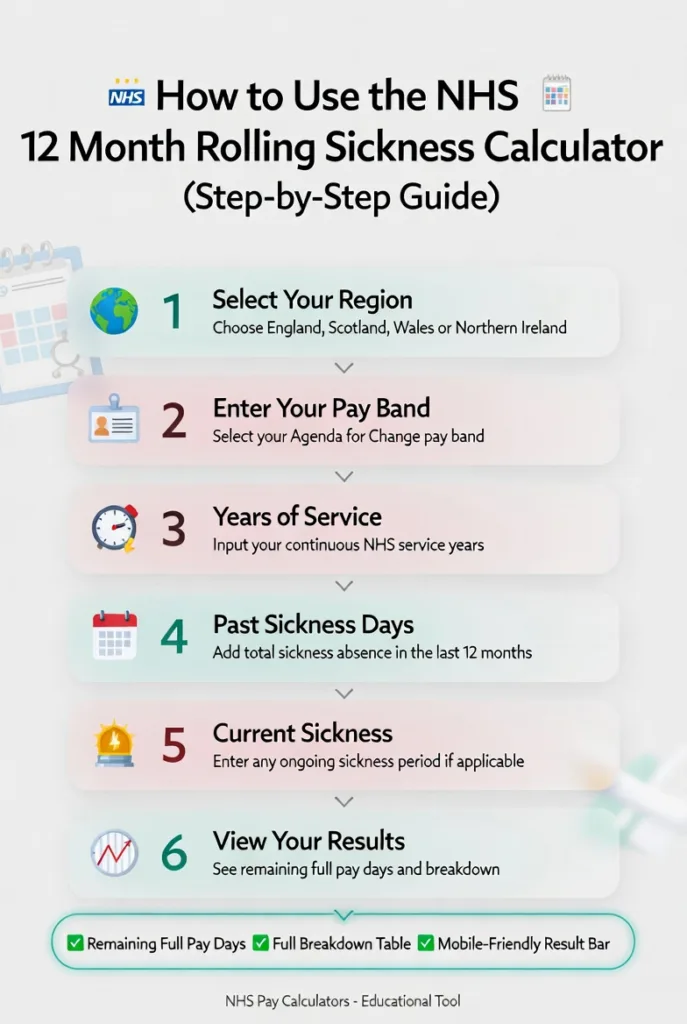
How to Use the NHS 12 Month Rolling Sickness Calculator
- Select Your Region: Choose England,
- , Wales, or Northern Ireland. Sick pay rules can vary slightly between regions.
- Pick Your Pay Band: Select your NHS Agenda for Change pay band (Band 2–9) to personalise the calculation.
- Enter Your Years of NHS Service: Input your total continuous NHS service. Less than 1 year means lower entitlement, while 5+ years gives maximum full pay (up to 6 months).
- Add Past 12-Month Sickness Days: Enter the total number of sick days taken in the last 12 months, including all previous absence spells.
- Input Current Ongoing Sickness: Add the number of days from your current sickness episode to update your remaining full pay in real time.
- View Your Results: Instantly see your remaining full pay days, detailed breakdown table, and mobile-friendly result summary.
What Is the NHS 12 Month Rolling Sickness Calculator?
The NHS 12 month rolling sickness calculator is a tool that tracks your sick days over any continuous 12-month window — not a fixed calendar year. It helps NHS managers and staff check whether an employee has hit Bradford Factor or trigger point thresholds that could trigger a formal review.
Unlike a fixed April-to-April calculation, a rolling 12-month period moves forward daily. So if today is 13 April 2026, the window covers 13 April 2025 to 13 April 2026.
This distinction matters. Days that fall outside the rolling window drop off automatically, which can change your absence record overnight.
What Does 12 Month Rolling Period Sickness Mean?
The 12 month rolling period sickness meaning is simple: your absence record is assessed against the most recent 12 months, not a fixed tax year or contract year.
Each new day added to the front of the window removes a day from the back. If you had a long absence in April 2025, it disappears from your record by April 2026.
Example:
- You had 10 sick days in May 2025
- Today is May 2026
- Those 10 days have now rolled off your record
- Your current rolling total resets to reflect only the last 12 months
This is why timing matters when NHS managers run formal reviews.
NHS Trigger Points: What Sets Off a Review?
Most NHS trusts use the following trigger thresholds:
Trigger | Threshold |
|---|---|
Number of absences | 3 or more in 12 months |
Total sick days | 8 or more in 12 months |
Bradford Factor score | 50+ points |
Hitting any one of these can prompt a Return to Work interview or a formal Attendance Review meeting.
The NHS 12 month rolling sickness calculator helps you stay ahead of these thresholds before HR flags your record.
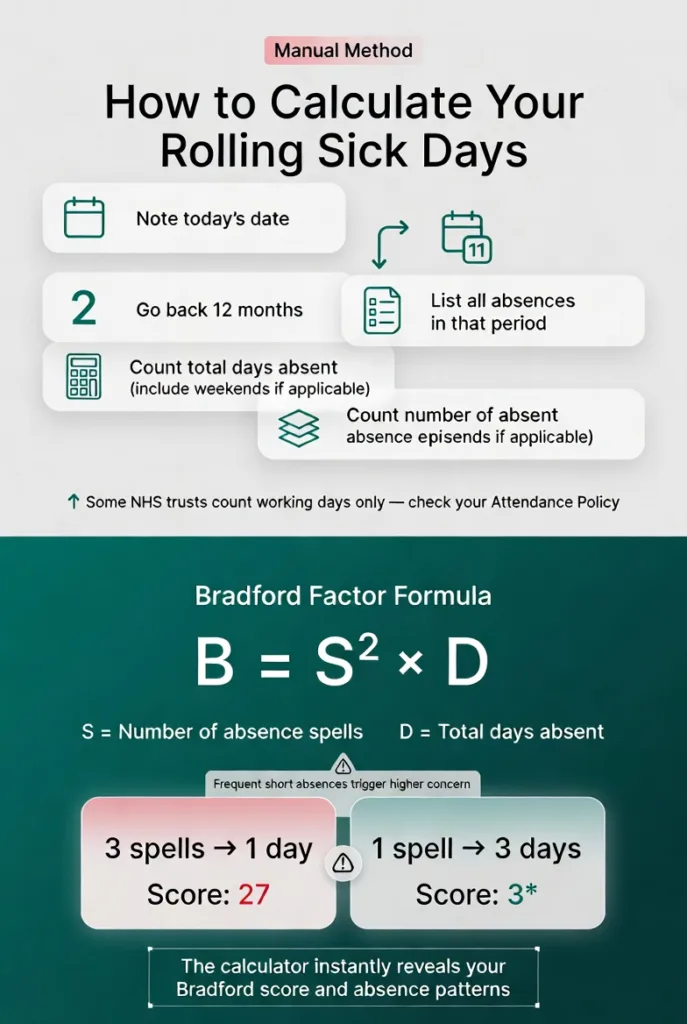
How to Calculate Your Rolling Sick Days
Manual Method
- Note today’s date
- Go back exactly 12 months
- List every absence that started within that window
- Count the total calendar days absent (including weekends for some trusts)
- Count the number of separate absence episodes
Some trusts count working days only. Check your trust’s Attendance Management Policy to confirm.
Using the Bradford Factor Formula
The Bradford Factor scores frequent short absences more heavily than long ones.
Formula: B = S² × D
- S = number of separate absence spells in 12 months
- D = total days absent in 12 months
Spells (S) | Days (D) | Bradford Score |
|---|---|---|
1 | 10 | 10 |
3 | 10 | 90 |
5 | 10 | 250 |
Three spells of one day each (score: 27) triggers more concern than one block of three days (score: 3). The calculator reveals this quickly.
NHS 12 Month Rolling Sickness Calculator England
In England, NHS trusts follow the NHS Terms and Conditions of Service Handbook (the “NHS TCS”). Under Agenda for Change (AfC), sick pay entitlements and absence triggers are standardised across England, though individual trusts can set stricter local policies.
The NHS 12 month rolling sickness calculator England context means:
- Sick pay entitlements are based on your continuous NHS service, not just your current trust
- Rolling absence is assessed against AfC Section 14 thresholds
- Managers must follow a staged process before any disciplinary action
If you work for an NHS trust in England and your rolling absence triggers a review, your entitlement to NHS sick pay depends on how many months of service you have completed.
NHS Sick Pay: How the Rolling Period Affects Your Pay
NHS Sick Pay After 12 Months
Your NHS sick pay after 12 months of employment is protected under AfC. Here’s the standard entitlement:
Service Length | Full Pay | Half Pay |
|---|---|---|
During first year | 1 month | 2 months |
After 1 year | 2 months | 2 months |
After 2 years | 4 months | 4 months |
After 3 years | 4 months | 8 months |
After 5 years | 6 months | 6 months |
After exhausting both full and half pay, you receive Statutory Sick Pay (SSP) at £116.75 per week (2026/27 rate) if eligible.
The rolling 12 months also determines when your sick pay “clock” resets. Once you’ve been back at work for 12 continuous months without any absence, your sick pay entitlement resets to its full level.
NHS Sick Pay 6 Months Calculator
The NHS sick pay 6 months calculator question comes up often. If you’ve used up your full sick pay and are entering half pay, you need to know the exact dates.
Use the NHS sick pay calculator to input your service start date, current absence start date, and any previous absences — it calculates your full pay end date an half pay end date automatically.
12 Month Rolling Sickness Calculator Excel
Many NHS managers and HR teams use a 12 month rolling sickness calculator Excel spreadsheet to track team absence. A basic setup includes:
Columns to include:
- Employee name or ID
- Absence start date
- Absence end date
- Total days absent
- Number of spells
- Bradford Factor score
- 12-month window start (auto-calculated as TODAY()-365)
You can use Excel’s COUNTIFS formula to pull absence spells within the rolling window automatically.
Example formula: =COUNTIFS(B2:B100,">="&TODAY()-365,B2:B100,"<="&TODAY())
This counts all absence start dates within the last 365 days.

For a ready-built tool without spreadsheet maintenance, the NHS pay calculators suite covers pay, sick pay, and MARS calculations in one place.
NHS 12 Month Rolling Sickness Calculator Gov
There is no single official NHS 12 month rolling sickness calculator gov tool on NHS.uk or GOV.UK. Absence monitoring is managed at trust level.
However, the NHS TCS Handbook, published by NHS Employers, sets the national framework. You can find the current version at nhsemployers.org. Individual trusts then build their own calculators, HR systems, or Excel tools aligned to this framework.
If you’ve been told your trust uses “the gov calculator,” they’re most likely referring to their internal HR system (such as ESR — the Electronic Staff Record) which uses rolling 12-month logic built to AfC standards.
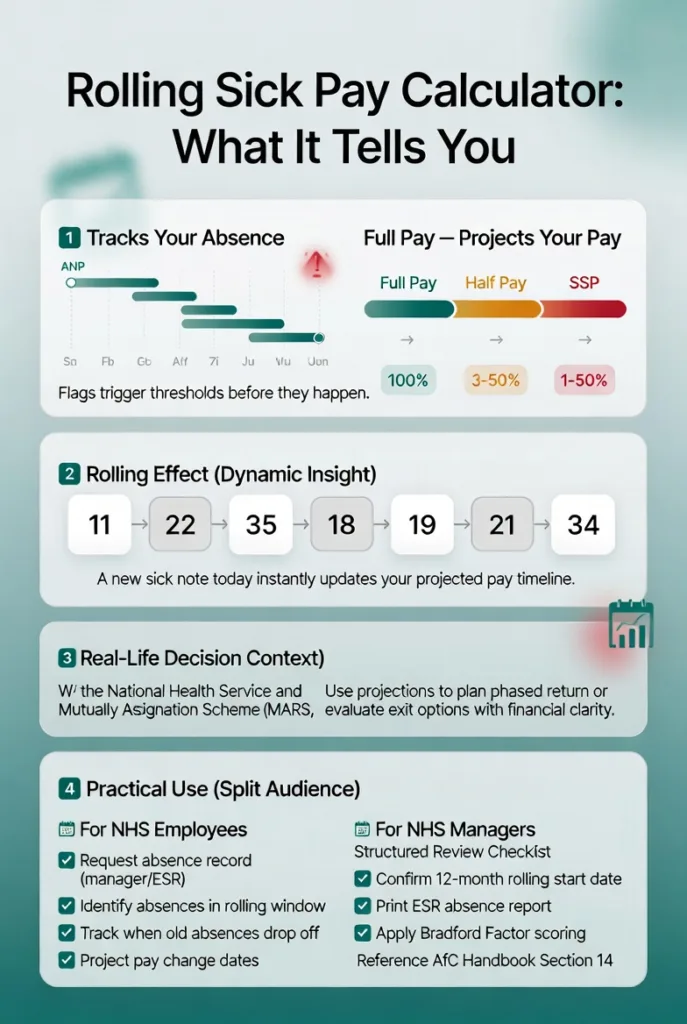
Rolling Sick Pay Calculator: What It Tells You
A rolling sick pay calculator does two things:
- Tracks your absence — flags when you’re approaching trigger thresholds
- Projects your pay — shows when full pay drops to half pay, and when half pay drops to SSP
The rolling element means the calculation refreshes constantly. A sick note submitted today changes your projected sick pay end date immediately.
This is especially important for NHS staff planning a phased return or considering Mutually Agreed Resignation Scheme (MARS) options. The NHS MARS calculator helps you model financial outcomes if long-term sickness leads you to consider leaving the NHS with a negotiated exit.
How to Use This Information Practically
If you’re an NHS employee approaching a trigger point:
- Request a copy of your absence record from your line manager or ESR self-service
- Identify which absences fall within the rolling window
- Note any upcoming dates when older absences will roll off
- Use the sick pay calculator to project when your pay status changes
If you’re an NHS manager running a review:
- Always confirm the rolling 12-month start date before the meeting
- Print the ESR absence report for the exact 12-month window
- Apply the Bradford Factor formula to score the pattern, not just the total days
- Reference Section 14 of the AfC Handbook as the policy basis
FAQ
All entitlement figures reference the NHS Terms and Conditions of Service Handbook and 2026/27 statutory rates. Always verify with your trust’s HR team for local policy variations.

Daniel Carter is a senior NHS Payroll Accountant with over 10 years of experience in Agenda for Change pay structures, tax, and pensions. He created the NHS Pay Calculators platform to help NHS staff easily understand their take-home pay, sick pay, maternity pay, and pension entitlements through simple, accurate online tools.