NHS Band 3 Salary and Take Home Pay Salary 2026/27
NHS Band 3 Take Home Pay Calculation
2026/27 • Agenda for Change
NHS Band 3 employees, such as clinical support workers, therapy assistants, and administrative staff under the Agenda for Change framework, will receive a gross annual salary of £25,760 (entry level, under 2 years) to £27,476 (top point, 2+ years) in England for the 2026/27 financial year, following the 3.3% pay uplift effective from April 2026.
After typical deductions including income tax, National Insurance, and NHS pension contributions, the estimated take-home pay generally falls between £1,790 and £1,889 per month (approximately £21,475 to £22,671 annually), depending on exact pay point, personal tax code, location, and individual circumstances.
Understanding your real net pay at Band 3 matters for rent, bills, and every financial decision in between. This guide covers exact take-home figures at every pay point, all four UK nations, part-time scenarios, unsocial hours, and the full range of roles that sit at this level.
Band 3 Pay Points 2026/27: Gross Salary at Every Step
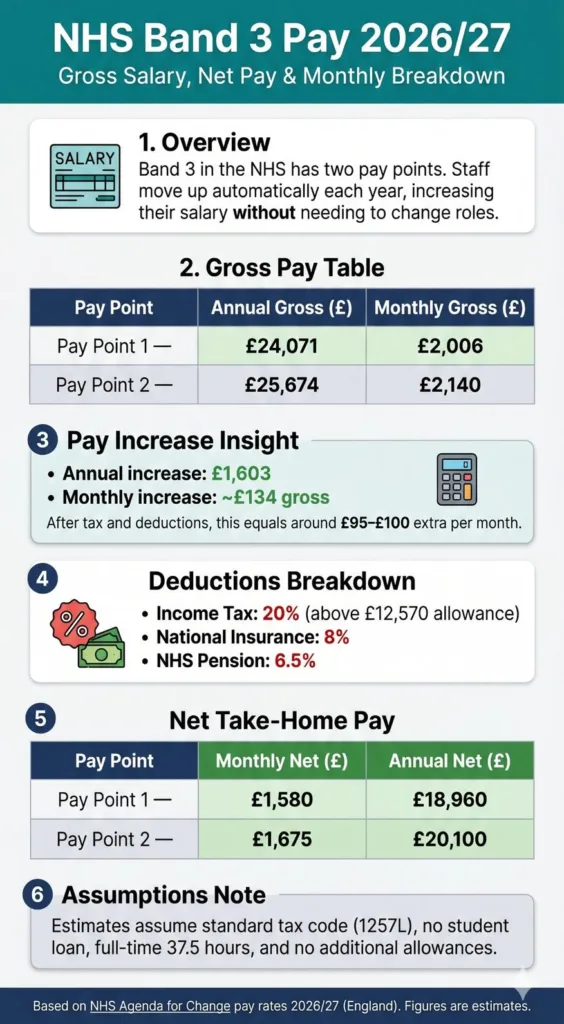
Band 3 has two pay points in England under Agenda for Change. Progression is automatic — one step per year on your incremental date.
Pay Point | Annual Gross | Monthly Gross |
|---|---|---|
Pay Point 1 | £24,071 | £2,006 |
Pay Point 2 | £25,674 | £2,140 |
The gross difference between Pay Point 1 and Pay Point 2 is £1,603 per year — approximately £134 per month gross. In net terms, after deductions, that narrows to approximately £95–£100 per month.
Band 3 Take Home Pay After Deductions: England 2026/27
Three deductions apply to every Band 3 payslip. Income tax at 20% basic rate applies to earnings above the £12,570 personal allowance. National Insurance is charged at 8% on earnings between £12,570 and £50,270. NHS pension contributions at Band 3 sit in the 6.5% tier — both pay points fall below the £26,831 threshold for the next tier.
Estimated Monthly Take Home — Band 3 England 2026/27
Pay Point | Gross Monthly | Est. Net Monthly | Est. Net Annual |
|---|---|---|---|
Pay Point 1 | £2,006 | £1,580 | £18,960 |
Pay Point 2 | £2,140 | £1,675 | £20,100 |
These estimates assume a standard 1257L tax code, no student loan, no London weighting, and full-time 37.5 hours per week. Use the NHS Pay Calculator for a personalised net figure based on your exact tax code, contracted hours, and location.
Breaking Down Band 3 Deductions at Pay Point 1
For a Band 3 employee on £24,071, here is exactly where each pound goes per month:
Monthly gross: £2,006
- Income tax (20% on earnings above £12,570): approximately £192
- National Insurance (8% on earnings between £12,570–£50,270): approximately £114
- NHS pension at 6.5%: approximately £130
Total monthly deductions: approximately £436 Net monthly take home: approximately £1,570–£1,580
That equates to approximately £363 per week, or roughly £8.41 per hour net for a standard 37.5-hour week — compared to a gross hourly rate of £12.33.
The NHS pension deduction of £130 per month is significant on a Band 3 salary. However, it is building a guaranteed retirement income at a contribution rate that is subsidised heavily by the employer — context that matters when comparing NHS employment to private sector alternatives.
Band 3 Hourly Rate 2026/27
Your gross hourly rate at Band 3 uses the standard AfC formula: annual salary ÷ 52.14 ÷ 37.5.
Pay Point | Annual Salary | Gross Hourly Rate |
|---|---|---|
Pay Point 1 | £24,071 | £12.33 |
Pay Point 2 | £25,674 | £13.15 |
Net effective hourly rate after all deductions sits between approximately £8.10 and £8.60 per hour. This figure is essential when evaluating bank shifts, overtime decisions, and agency rate comparisons at this band level.
The Band 3 hourly rate at Pay Point 1 sits just above the 2026 national living wage, which makes it one of the most closely watched pay points in the entire NHS — particularly for support worker recruitment and retention in high cost-of-living areas.
Who Works at NHS Band 3?
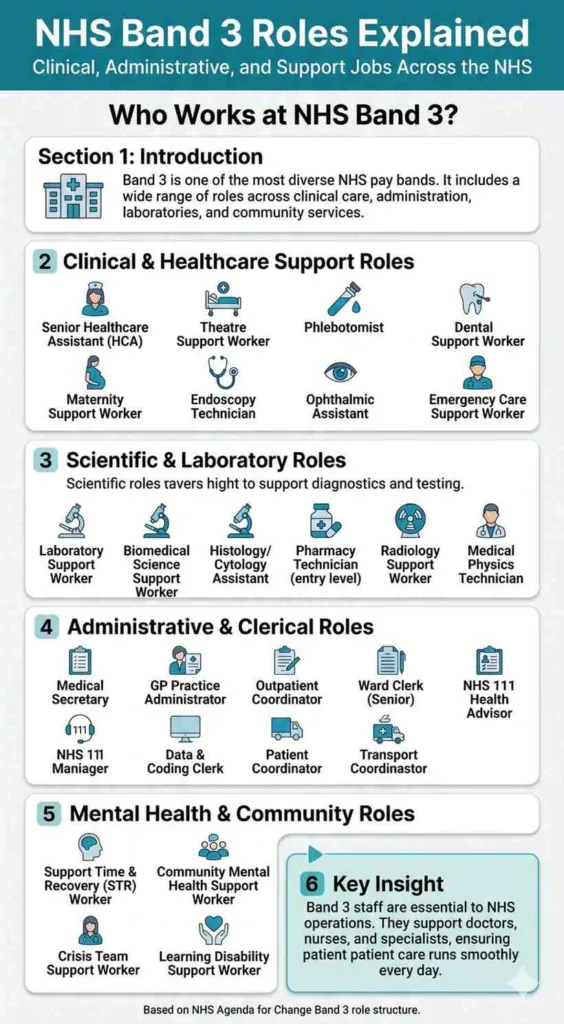
Band 3 is one of the most diverse bands in the Agenda for Change framework. It spans clinical support, administrative, scientific, and technical functions across almost every NHS department and specialty.
Clinical and Healthcare Support Roles at Band 3
- Senior healthcare assistant (HCA) on acute, surgical, or specialist wards
- Senior healthcare support worker in community or mental health settings
- Theatre support worker (scrub or anaesthetic assistant)
- Sterile services technician
- Endoscopy decontamination technician
- Senior maternity support worker
- Phlebotomist (experienced or lead)
- Dental nurse (qualified, non-senior)
- Ophthalmic technician (assistant level)
- First responder / emergency care support worker
Scientific and Laboratory Roles at Band 3
- Laboratory support worker (senior, pathology or microbiology)
- Biomedical science support worker (senior)
- Histology or cytology technical officer (assistant level)
- Pharmacy dispensary technician (pre-registration or early career)
- Radiology helper or imaging support worker (senior)
- Medical physics support technician
Administrative and Clerical Roles at Band 3
- Medical secretary (qualified/experienced)
- GP practice administrator (NHS-employed)
- Outpatient booking coordinator
- Ward clerk (senior grade)
- Patient transport coordinator
- NHS 111 health advisor (in some trusts)
- Data entry and coding clerk (senior)
- Facilities and estates operative (skilled)
Mental Health and Community Roles at Band 3
- Support time and recovery (STR) worker
- Community mental health support worker (senior)
- Crisis resolution team support worker
- Learning disability support worker (experienced)
The breadth of Band 3 reflects how essential these roles are to everyday NHS functioning. Behind every consultant, nurse, or physiotherapist is a Band 3 professional keeping services running.
Case Study: Band 3 Senior Healthcare Assistant — Acute Ward
Blessing is a senior HCA on a busy surgical ward in Birmingham. She has been in post for three years and progressed to Pay Point 2, earning £25,674 per year.
Monthly gross: £2,140 Income tax: approximately £226 National Insurance: approximately £123 NHS pension at 6.5%: approximately £139
Net monthly take home: approximately £1,652
Blessing works a rotating shift pattern that includes nights and weekends. In a typical month she works four night shifts and two Sunday shifts.
Night shift enhancement (37% above base): £13.15 × 1.37 = £18.02/hr gross Sunday enhancement (60% above base): £13.15 × 1.60 = £21.04/hr gross
Her four night shifts (12 hours each) add approximately £865 gross. Her two Sunday shifts (12 hours each) add approximately £505 gross. Combined monthly enhancement gross: approximately £1,370.
After tax and NI (no pension on bank shifts in many trusts): approximately £870 net from enhancements.
Total monthly take home with enhancements: approximately £2,522
This more than doubles her base net pay — a reality that many Band 3 shift workers experience but that gross salary tables completely fail to show.
Case Study: Band 3 Medical Secretary, Pay Point 1
Tariq is a newly appointed medical secretary at an NHS trust in Manchester. He is at Pay Point 1 earning £24,071 per year, working standard Monday–Friday office hours with no unsocial hours supplements.
Monthly gross: £2,006 Income tax: £192 National Insurance: £114 NHS pension at 6.5%: £130
Net monthly take home: approximately £1,570
Tariq’s role is entirely Monday–Friday, so he receives no shift enhancements. His take-home pay is the baseline Band 3 figure with no additions. He is considering whether to pursue a Band 4 medical PA role — the entry-level Band 4 salary of £26,530 would add approximately £150/month net, which is meaningful but requires taking on broader responsibilities.
Case Study: Band 3 Pharmacy Technician, Part-Time
Nina is a dispensary technician at a community pharmacy operated by an NHS trust. She works 22.5 hours per week (0.6 WTE) and is at Pay Point 2.
- Pro-rated annual salary: £25,674 × 0.6 = £15,404
- Monthly gross: £1,284
- Income tax: approximately £23 (most income sheltered by personal allowance)
- National Insurance: approximately £22
- NHS pension at 6.5%: approximately £83
Net monthly take home: approximately £1,156
At 0.6 WTE, almost all of Nina’s income sits within or just above the personal allowance — dramatically reducing her income tax liability. She retains approximately 90p in every pound after deductions at this hours level, compared to approximately 79p per pound for a full-time Band 3 colleague. Part-time working at Band 3 is one of the most tax-efficient working arrangements in the AfC framework.
Band 3 Pay Across All Four UK Nations
NHS pay is devolved and set independently in Scotland, Wales, and Northern Ireland.
Nation | Band 3 Min (Approx) | Band 3 Max (Approx) |
|---|---|---|
England | £24,071 | £25,674 |
Scotland | £25,468 | £27,486 |
Wales | £24,433 | £26,060 |
Northern Ireland | £24,071 | £25,674 |
Scotland offers significantly higher Band 3 pay — approximately £1,397 more at the entry point than England. In net terms that is approximately £890/year, or around £74/month extra — meaningful at this salary level. Wales offers a smaller but still real premium over England. You can also read about NHS Scotland Pay Rise 2026.
Unsocial Hours Pay at Band 3: The Real Earnings Picture
Many Band 3 roles — particularly in clinical, ward, and laboratory settings — involve shift work with unsocial hours enhancements. These can dramatically increase actual earnings beyond the headline AfC salary.
AfC unsocial hours enhancement rates at Band 3:
- Monday–Friday, 8pm–6am: base rate + 37%
- Saturday (all hours): base rate + 30%
- Sunday and bank holidays: base rate + 60%
At Pay Point 2 (£13.15/hr gross):
- Night rate: £13.15 × 1.37 = £18.02/hr
- Saturday rate: £13.15 × 1.30 = £17.10/hr
- Sunday/bank holiday rate: £13.15 × 1.60 = £21.04/hr
A full-time Band 3 shift worker with regular nights and weekend cover can add £5,000–£8,000 gross per year in enhancements — pushing effective annual earnings to £30,000–£33,000 despite a base AfC salary of £25,674.
This is why two Band 3 employees in the same trust, at the same pay point, can have very different annual incomes depending on their shift pattern.
NHS Pension at Band 3: Contribution Rate and What It Builds
The NHS pension contribution for all Band 3 pay points is 6.5%. Both Pay Point 1 and Pay Point 2 fall within the £13,260–£26,831 tier.
Pay Point | Annual Pension Deduction | Monthly Deduction |
|---|---|---|
Pay Point 1 | £1,565 | £130 |
Pay Point 2 | £1,669 | £139 |
In the 2015 NHS CARE scheme, you accrue 1/54th of your pensionable earnings each year as a guaranteed pension. At Pay Point 2 (£25,674), that is approximately £476 of annual pension built per year — index-linked and payable from your pension age.
Over 25 years at Band 3 and above, this builds a substantial retirement income that private sector employees at similar wages rarely access. The employer contributes 23.7% on top — approximately £6,085 per year on a £25,674 salary — making the NHS pension one of the most valuable elements of Band 3 employment.
Use the NHS Pension Calculator to model your projected pension based on your current pay point, years of service, and expected retirement age.
Income Tax at Band 3: What You Actually Owe
Band 3 staff pay income tax at the basic rate of 20% on all earnings above the personal allowance (£12,570 in 2026/27). No Band 3 pay point comes close to the higher rate threshold of £50,270.
At Pay Point 1 (£24,071):
- Taxable income: £24,071 − £12,570 = £11,501
- Annual tax: £11,501 × 20% = £2,300
- Monthly tax: approximately £192
At Pay Point 2 (£25,674):
- Taxable income: £25,674 − £12,570 = £13,104
- Annual tax: £13,104 × 20% = £2,621
- Monthly tax: approximately £218
If your tax code is anything other than 1257L — for example if you have multiple jobs, unpaid tax from previous years, or benefits-in-kind — your deduction will differ from these estimates. Use the NHS Tax Calculator to model your specific tax position accurately.
Student Loan Repayments at Band 3
Most Band 3 employees completed vocational training or apprenticeships rather than university degrees, meaning student loan deductions are less common than at Band 5 and above. However, some Band 3 laboratory and administrative staff do hold degrees and carry Plan 2 loan balances.
Plan 2 repayment at Band 3 Pay Point 2 (£25,674):
- Threshold: £27,295
- Band 3 earnings sit below this threshold
- Monthly repayment: £0
Band 3 salaries fall below the Plan 2 repayment threshold entirely. Even at Pay Point 2 (£25,674), no Plan 2 repayment is triggered. This means student loans have zero impact on Band 3 take-home pay for the vast majority of staff — a genuine financial advantage compared to higher bands.
Postgraduate loan repayments (threshold £21,000, rate 6%) would apply at Band 3:
At Pay Point 2: £25,674 − £21,000 = £4,674 × 6% = £280/year, approximately £23/month. A small but real deduction for those with postgraduate debt.
Band 3 vs Band 2 and Band 4: The Career Pay Steps
Understanding where Band 3 sits in the pay structure helps with career planning and promotion decisions.
Band | Gross Range | Est. Net Monthly (Entry) |
|---|---|---|
Band 2 | £23,615 | £1,540 |
Band 3 | £24,071–£25,674 | £1,580 |
Band 4 | £26,530–£29,114 | £1,720 |
The step from Band 2 to Band 3 entry delivers approximately £40/month net — a modest gain that reflects the relatively small gross gap between these two bands. The step from Band 3 top to Band 4 entry is more meaningful: approximately £145/month net, alongside a significant increase in role responsibility.
Many Band 3 staff pursuing Band 4 assistant practitioner or senior administrator roles find the net pay increase underwhelming initially — but by Pay Point 2 of Band 4, the cumulative gap widens, and the pension accrual on higher pay becomes increasingly valuable.
Band 3 Overtime and Bank Shift Pay
NHS bank shifts for Band 3 staff are paid at the same AfC hourly rate as substantive posts, plus any applicable unsocial hours enhancements. Most NHS trusts do not pay overtime premiums for Band 3 within the first eight hours above the standard 37.5-hour week — plain time applies up to that point.
For hours beyond eight above the standard week, time plus 50% applies.
At Pay Point 2 (£13.15/hr):
- Overtime rate (beyond eight extra hours): £13.15 × 1.50 = £19.73/hr gross
Bank shifts on Sundays with overtime stacking (rare but possible in short-staffed departments): £21.04/hr base Sunday enhancement, with overtime rate on top for hours above the threshold.
For many Band 3 support workers, bank and overtime pay is an essential income supplement — not a luxury. The official AfC rates make this achievable without moving to agency work, which would sacrifice pension and employment benefits.
Band 3 London Weighting: Exact Net Impact
High Cost Area Supplement for Band 3 staff in London 2026/27:
- Inner London HCAS: 20% of salary (minimum £4,857, maximum £8,065)
- Outer London HCAS: 15% of salary (minimum £4,218, maximum £5,332)
- Fringe zone HCAS: 5% of salary (minimum £1,136, maximum £2,079)
At Pay Point 1 (£24,071) in Inner London:
- 20% HCAS = £4,814 — below the minimum, so the floor of £4,857 applies
- Total gross: £28,928
- Monthly gross: £2,411
- Income tax: approximately £272
- NI: approximately £156
- NHS pension at 9.8% (HCAS pushes total pay above £26,831 threshold): approximately £236
Net monthly take home with Inner London HCAS: approximately £1,747
Without HCAS the net is approximately £1,580. The supplement adds approximately £167/month net — a real uplift, though London’s cost of living premium over comparable cities often exceeds this by a significant margin.
One important note: London HCAS at Band 3 Pay Point 1 pushes pensionable pay above the £26,831 tier threshold, jumping pension contributions from 6.5% to 9.8%. This means the gross HCAS benefit is partially offset by higher pension deductions.
Band 3 and the National Living Wage: How Close Is the Gap?
The 2026 national living wage (for workers aged 21 and over) is approximately £12.21 per hour. Band 3 Pay Point 1 gross hourly rate is £12.33 — just £0.12 per hour above the legal minimum.
This proximity is a significant policy issue within NHS workforce planning. Band 3 roles requiring specialist skills, clinical knowledge, and years of experience command only marginally more than the legal wage floor. It is one of the driving factors behind ongoing NHS retention difficulties in support worker grades and the pressure to review Band 2 and Band 3 pay more fundamentally.
For context, a Band 3 senior HCA managing clinical equipment, training junior colleagues, and supporting registered nurses earns approximately £12.33/hr gross — compared to many retail management roles offering £13–£15/hr with far less responsibility.
Part-Time Band 3 Pay: How WTE Affects Your Income
Many Band 3 employees work part-time — particularly those with caring responsibilities or those combining NHS work with study or a second income.
Band 3 Pay Point 2 at different WTE fractions:
WTE | Contracted Hours | Approx Net Monthly |
|---|---|---|
1.0 | 37.5 hrs | £1,675 |
0.8 | 30.0 hrs | £1,388 |
0.6 | 22.5 hrs | £1,156 |
0.5 | 18.75 hrs | £1,005 |
At 0.5 WTE, annual pro-rated salary falls to £12,837 — almost entirely within the personal allowance, meaning very little income tax is paid. This creates a highly tax-efficient working arrangement, though obviously at the cost of absolute income level.
Band 3 Tax and Pension: Planning Your Finances
At Band 3, the combined effect of income tax and pension on monthly pay leaves many employees surprised by how much smaller their net pay is than their contract suggests.
A quick rule of thumb for Band 3 full-time staff: expect to take home approximately 79–80p in every pound of gross pay after all standard deductions. This is slightly more efficient than higher bands because Band 3 sits entirely within the basic rate tax band and the lower 6.5% pension tier.
Planning around this means understanding:
- Your monthly net figure for budgeting (covered in the tables above)
- Your pension accrual and projected retirement income
- How your tax code affects deductions — a wrong code at Band 3 can cost £50–£100/month
For pension modelling, the NHS Pension Calculator shows projected retirement income based on your current pay point and service length. For tax code queries and deduction checks, the NHS Tax Calculator handles Band 3 scenarios accurately.
Band 3 Take Home Pay: Quick Reference Summary
For anyone who needs the headline figures without working through the full breakdown:
- Pay Point 1 (£24,071 gross): approximately £1,580/month net, £18,960/year net
- Pay Point 2 (£25,674 gross): approximately £1,675/month net, £20,100/year net
Both figures are for England, standard 1257L tax code, no student loan, no London weighting, full-time 37.5 hours per week.
Variables that will change your figure: London or fringe HCAS, part-time WTE fraction, postgraduate student loan, non-standard tax code, and any salary sacrifice arrangements your trust offers.
FAQs
What is the NHS Band 3 take home pay per month in 2026/27?
Approximately £1,580 at Pay Point 1 and £1,675 at Pay Point 2 — based on England rates, standard 1257L tax code, no student loan, full-time 37.5 hours.
What pension rate applies to Band 3 in 2026/27?
6.5% for both pay points. The entire Band 3 salary range sits below the £26,831 threshold for the next pension tier of 9.8%. London HCAS can push total pensionable pay into the 9.8% tier at Pay Point 1.
What is the Band 3 hourly rate in 2026?
£12.33/hr gross at Pay Point 1 and £13.15/hr at Pay Point 2. Net effective rate after all deductions is approximately £8.10–£8.60/hr.
Do Band 3 staff pay student loan repayments?
Plan 2 loan repayments are zero at both Band 3 pay points — the threshold of £27,295 is above the Band 3 maximum. Postgraduate loan repayments of approximately £23/month apply at Pay Point 2.
How does Band 3 pay differ in Scotland?
Scotland’s Band 3 entry point is approximately £25,468 — around £1,397 more than England’s £24,071, worth approximately £74/month extra net.
How much does London weighting add to Band 3 take home pay?
Inner London HCAS adds approximately £167/month net at Pay Point 1, though it also triggers the higher 9.8% pension tier, which reduces the gross benefit by approximately £65–£70/month.
Is Band 3 affected by higher rate income tax?
No. Both Band 3 pay points sit well below the £50,270 higher rate threshold. All earnings above the personal allowance are taxed at 20% basic rate only.

Daniel Carter is a senior NHS Payroll Accountant with over 10 years of experience in Agenda for Change pay structures, tax, and pensions. He created the NHS Pay Calculators platform to help NHS staff easily understand their take-home pay, sick pay, maternity pay, and pension entitlements through simple, accurate online tools.