
NHS Personal Assistant Salary 2026/27
An NHS Personal Assistant salary in 2026/27 ranges from £25,272 per year (Band 2, entry level) to £27,476 per year (Band 3, top of band), following the 3.3% Agenda for Change pay rise effective 1 April 2026. That works out to roughly £12.92 to £14.05 per hour, or approximately £1,450 to £1,720 per month after tax, pension, and National Insurance.
If you are an NHS Personal Assistant wondering exactly what you should be earning this year — you are in the right place. Pay can feel confusing when you hear words like Agenda for Change, pay bands, pension contributions, and take-home pay all at once. This guide cuts through all of that and gives you straight, plain-English answers.
From 1 April 2026, NHS Personal Assistants received a 3.3% pay rise as part of the confirmed Agenda for Change pay award — the first time in six years that the rise was delivered on time, in April payslips, with no waiting for backdated lump sums. For many PAs and healthcare support workers, this means a real increase of between £800 and £900 per year on paper.
In this guide you will find: exactly which pay band NHS Personal Assistants sit in, what the 2026/27 salary figures are (yearly, monthly, and hourly), how much you actually take home after tax and pension, how London weighting works, what unsocial hours pay adds to your wage, and how to move up the pay scale. No jargon, no complicated formulas — just clear answers. Check the NHS Healthcare Assistant Salary in 2026.
What Is an NHS Personal Assistant Salary?
An NHS Personal Assistant salary refers to the gross annual pay received by Personal Assistants employed by the National Health Service under the Agenda for Change (AfC) national pay framework. AfC is the standardised pay system that covers the vast majority of NHS staff in the UK — everyone except doctors, dentists, and very senior managers.
Think of Agenda for Change like a ladder. Each rung of the ladder is called a pay band, numbered 1 to 9. The higher the band, the more responsibility the role carries and the more it pays. Personal Assistants in the NHS typically sit on Band 2 or Band 3, depending on their specific duties and level of experience.
Unlike a private company where your salary might be negotiated individually, AfC means that every NHS Personal Assistant doing a Band 2 job in England earns the same base rate — making the system transparent and fair. Your pay only differs based on your band, your years of experience within that band, and where in the country you work.
| Simple Analogy: Imagine AfC as a nationwide price list for NHS jobs. Just as a cup of tea from a hospital canteen costs the same whether you are in Newcastle or Norwich, an NHS Band 2 Personal Assistant earns the same base salary everywhere in England. Regional supplements (like London weighting) are added on top — they are the ‘extras’ on the menu. |
Which Pay Band Is an NHS Personal Assistant On?
This is one of the most commonly asked questions — and the answer depends on exactly what your job involves. Here is the straightforward breakdown:
| Pay Band | Typical Role & Duties | Who This Usually Is |
| Band 2 | Basic admin and clerical support, scheduling appointments, managing diaries, reception duties, filing patient records, and answering phones under close supervision. | Entry-level NHS PAs, admin assistants, receptionists, and clerical officers new to the NHS. |
| Band 3 | More complex admin tasks, supporting clinicians directly, managing patient communications, maintaining confidential records, coordinating meetings, and working more independently. | Experienced NHS PAs, medical secretaries, senior clerical officers, and PAs supporting senior clinical or management staff. |
| Band 4 | Senior executive or high-level PA support, complex diary and project management, significant autonomy, supporting directors or heads of service. | Executive PAs, PA to senior managers or clinical leads. Less common but worth aiming for with experience. |
If you are new to the NHS as a Personal Assistant — for example, you have just joined the admin team or you are supporting a ward manager — you will almost certainly start at Band 2. After gaining experience and demonstrating you can take on more responsibility, you would typically move to Band 3.
Important: Your band is decided by a process called job evaluation, not by your job title alone. Two people with the title ‘Personal Assistant’ could be on different bands if their duties differ significantly. If you are unsure, ask your line manager or HR department which band your post has been evaluated at.
NHS Personal Assistant Salary 2026/27: The Full Numbers
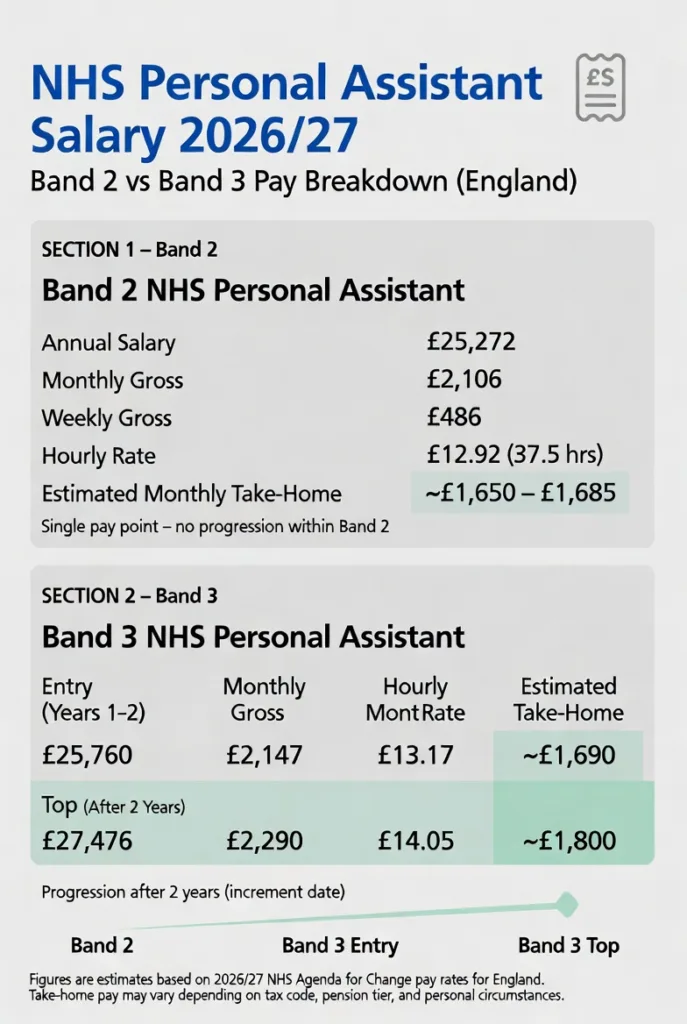
Band 2 NHS Personal Assistant Salary (England)
Band 2 has a single pay point in 2026/27. Whether you are in your first month or your fifth year as a Band 2 NHS PA, the annual salary is the same.
| Pay Frequency | Gross Amount | After Tax & Pension (approx.) |
| Per Year (Annual) | £25,272 | ~£19,800–£20,200 |
| Per Month | £2,106 | ~£1,650–£1,685 |
| Per Week | £486 | ~£381–£388 |
| Per Hour (37.5hrs/wk) | £12.92 | ~£9.92–£10.12 |
Note: The ‘after tax’ figures above are estimates for a standard England employee with a 1257L tax code, paying 5.2% NHS pension contributions, and no student loan. Individual circumstances vary. Use an NHS pay calculator for your exact figure.
Band 3 NHS Personal Assistant Salary (England)
Band 3 has two pay points. You start at the entry point and move to the higher point after two years of satisfactory performance. This is sometimes called your ‘increment date’.
| Pay Point | Annual (Gross) | Monthly (Gross) | Hourly (Gross) | Monthly Take-Home (approx.) |
| Entry (Year 1–2) | £25,760 | £2,147 | £13.17 | ~£1,690 |
| Top (After 2 Years) | £27,476 | £2,290 | £14.05 | ~£1,800 |
Hourly rates calculated at 37.5 standard hours per week (1,957.5 annual hours). Take-home estimates assume England tax code 1257L, 5.2% NHS pension tier, no student loan. Source: NHS Employers AfC Pay Circular 2026/27.
How Does NHS Personal Assistant Pay Actually Work?
Understanding where your pay comes from — and what gets taken out — makes a huge difference to how you feel about your payslip. Here is exactly how it works, step by step.
Step 1: Your Pay Band Is Decided by Job Evaluation
Before you even start a job, NHS HR teams evaluate the role using a nationally agreed system. They assess things like: how much training is required, how complex the decisions are, whether you work unsupervised, and how much responsibility you carry. The outcome of this evaluation decides whether the post is Band 2, Band 3, or higher. This is set for the role, not negotiated individually.
Step 2: You Start at the Entry Point of Your Band
When you join, your salary starts at the first pay point of your band. For Band 2, there is only one pay point — so you earn £25,272 from day one and stay there until you are promoted to Band 3. For Band 3, you start at £25,760 (the entry point) and move to £27,476 after two years of satisfactory performance — this is automatic, not something you have to apply for, as long as your annual appraisal shows you are meeting the requirements of your role.
Step 3: Three Deductions Come Out of Your Gross Pay
Your payslip will show your gross pay (the full salary before anything is taken out) and your net pay (what actually lands in your bank account). Three things reduce your gross pay:
- Income Tax (PAYE): In England, you pay 20% on earnings between £12,571 and £50,270. Because Band 2 and Band 3 salaries fall in this range, most NHS PAs pay 20% income tax on the portion of salary above the personal allowance of £12,570. You do not pay tax on the first £12,570 you earn each year.
- National Insurance (NI): You pay 8% on earnings between £12,570 and £50,270. This funds state benefits including the NHS itself, ironically.
- NHS Pension Contribution: The NHS Pension Scheme is one of the best workplace pensions in the UK — a defined benefit scheme meaning your pension is guaranteed regardless of investment markets. Band 2 and Band 3 PAs in 2026/27 contribute 5.2% of their gross salary. Your employer (the NHS Trust) adds a further 23.7% — so for every pound you put in, your employer puts in roughly four. This is exceptional value.
Step 4: What Lands in Your Bank Account
After these three deductions, here is a realistic monthly take-home breakdown for an NHS Personal Assistant in England in 2026/27:
| Band 2 | Band 3 (Entry) | |
| Gross Monthly Pay | £2,106 | £2,147 |
| Less: Income Tax (20%) | −£254 | −£263 |
| Less: National Insurance (8%) | −£121 | −£125 |
| Less: NHS Pension (5.2%) | −£110 | −£112 |
| Estimated Take-Home (Monthly) | ~£1,621 | ~£1,647 |
Important: These figures are approximations for a standard England employee. If you have a student loan, your take-home will be slightly lower. If you are part-time, everything is calculated proportionally based on your contracted hours. Scotland uses different income tax bands (starting at 19% and rising to 47%), which is why Scottish NHS workers use a separate calculation.
NHS Personal Assistant Hourly Pay Rate 2026/27
The standard NHS working week is 37.5 hours. Hourly rates are calculated by dividing the annual salary by 52.143 weeks and then by 37.5 hours.
| Pay Band | Annual Salary | Hourly Rate |
| Band 2 | £25,272 | £12.92 per hour |
| Band 3 (Entry) | £25,760 | £13.17 per hour |
| Band 3 (Top) | £27,476 | £14.05 per hour |
Worth noting: The National Minimum Wage rose to £12.71 per hour from April 2026 — a 6.7% increase. Band 2 NHS Personal Assistants at £12.92 per hour now sit only 21p above the National Minimum Wage. This very narrow gap has been widely discussed within the NHS and is a key reason why many Band 2 staff seek progression to Band 3.
NHS Personal Assistant London Weighting & High Cost Area Supplement (HCAS)
If you work in or around London, you receive a High Cost Area Supplement (HCAS) on top of your basic band salary. This is to reflect the higher cost of living in the capital. HCAS is calculated as a percentage of your basic salary, subject to a minimum and maximum payment.
For 2026/27, the HCAS rates are: 5% of basic salary (minimum £1,346, maximum £2,270) for Fringe areas (parts of the Home Counties near London); 15% of basic salary (minimum £3,898, maximum £5,054) for Outer London; and 20% of basic salary (minimum £5,794, maximum £8,746) for Inner London.
In practice, this means a Band 2 NHS Personal Assistant working in Inner London earns £25,272 plus a minimum of £5,794 = at least £31,066 per year. That is a meaningful boost that significantly changes your take-home pay compared to the same role elsewhere in England.
| Location | Band 2 Base | HCAS Added | Total Salary |
| England (outside London) | £25,272 | None | £25,272 |
| London Fringe | £25,272 | £1,346 min | ~£26,618 |
| Outer London | £25,272 | £3,898 min | ~£29,170 |
| Inner London | £25,272 | £5,794 min | ~£31,066 |
Scotland applies a different approach: Scottish AfC staff received a 3.75% pay rise for 2026/27, and from April 2026 the standard working week reduced from 37.5 to 36 hours. The same annual salary across fewer hours means Scottish staff effectively receive a hidden hourly rate boost of approximately 2.8% on top of the headline pay rise.
Unsocial Hours Pay: Evenings, Nights, Weekends & Bank Holidays
If your PA role requires you to work outside of standard Monday-to-Friday office hours — for example, if you support a ward manager on rotating shifts — you are entitled to unsocial hours enhancements on top of your basic hourly rate.
For Band 2 and Band 3 NHS staff, the unsocial hours rates in 2026/27 are: 41% above the basic hourly rate for weekday evenings and nights, and for Saturday shifts; and 83% above the basic hourly rate for Sunday and bank holiday shifts.
To put that in plain money: a Band 3 NHS Personal Assistant at the top of the band earns £14.05 per hour as their standard rate. On a Sunday shift, that rises to £14.05 multiplied by 1.83, which equals approximately £25.71 per hour. Working even a handful of unsocial hours shifts per month can add several hundred pounds to your monthly earnings.
| Shift Type | Band 2 Rate | Band 3 Top Rate |
| Standard (Mon–Fri, daytime) | £12.92/hr | £14.05/hr |
| Evening / Night / Saturday (+41%) | £18.22/hr | £19.81/hr |
| Sunday / Bank Holiday (+83%) | £23.64/hr | £25.71/hr |
Important note: Many NHS Personal Assistant roles are purely administrative and operate Monday to Friday, 9am to 5pm — in which case unsocial hours pay does not apply. However, some PAs support clinical managers or ward teams and may be required to work shifts. Check your contract to see whether your post attracts unsocial hours enhancements.
NHS Pension: The Hidden Benefit Most PAs Don’t Realise They Have
The NHS Pension Scheme is widely regarded as one of the best workplace pensions in the UK — and it is something every NHS Personal Assistant should understand, because it is a major part of your total package.
The NHS scheme is a defined benefit pension. That means when you retire, you receive a guaranteed income for life based on your years of service and salary — not based on how stock markets performed. This is extremely rare in the modern jobs market, where most private sector workers are in defined contribution schemes where the pension pot can go up or down with investments.
How Much Do You Contribute?
Your contribution is a percentage of your pensionable pay, taken directly from your gross salary before tax is calculated. This actually reduces the amount of income tax you pay, because pension contributions come off your pay before HMRC gets involved.
In 2026/27, Band 2 and Band 3 NHS Personal Assistants earning up to £37,800 pay a pension contribution rate of 5.2% of their pensionable pay. Your employer (the NHS Trust) adds a further 23.7% employer contribution — making the total pension contribution around 28.9% of your salary going into your pension pot, of which you personally only pay 5.2%.
| Real ExampleA Band 3 NHS Personal Assistant at the top of the band earns £27,476 per year. Their personal pension contribution at 5.2% is £1,429 per year — that is £119 per month out of their pay. Meanwhile, the NHS Trust contributes 23.7% = £6,512 per year on their behalf. For £119 per month from the employee, the NHS puts in £542 per month. That is the pension deal NHS staff receive — and it is why the NHS pension is considered far more valuable than most private sector alternatives. |
NHS Personal Assistant Career Progression & Pay Progression
One of the best things about working as an NHS Personal Assistant is that the career pathway is clear and structured. You do not have to guess or wait for your manager to notice you — the system is designed to reward development.
Pay Progression Within Your Band
Pay progression means moving from the entry pay point to the top pay point within your current band. For Band 3, this happens after two years of satisfactory service. It is automatic, provided your annual appraisal shows you are meeting the requirements of your role and developing your knowledge and skills in line with the Knowledge and Skills Framework (KSF). You do not need to apply for it or negotiate.
Moving to a Higher Band
Moving from Band 2 to Band 3, or from Band 3 to Band 4, is different — this requires you to apply for and be appointed to a post that has been evaluated at the higher band. It is not automatic with time. Here is the typical route for NHS Personal Assistants:
- Band 2 to Band 3: Gain experience in your current role. Complete any relevant training offered by your Trust. NVQ Level 3 or equivalent in Business Administration or Health and Social Care is desirable for Band 3. Apply for Band 3 vacancies internally — many Trusts prefer to promote from within.
- Band 3 to Band 4: Band 4 roles such as executive PA or senior medical secretary require a higher level of autonomy and often a foundation degree or equivalent experience. Roles at this level may involve supporting senior clinical or management staff with complex diary management, project coordination, and confidential communications.
- Band 4 and Beyond: Some experienced PAs move into management, administration management roles (Band 5 or 6), or specialist roles such as governance support or project management.
| Real Career ExampleSarah joined an NHS Trust as a Band 2 receptionist and admin assistant. After 18 months, she completed a Level 3 Business Administration Diploma through her Trust’s apprenticeship scheme and applied for an internal Band 3 PA vacancy supporting the head of a therapy department. Two years later, she progressed to the top Band 3 pay point (£27,476) and is now studying for a foundation degree with the goal of moving to Band 4 as an executive PA. Her NHS pension contributions during this time are building a retirement income she would struggle to replicate in any private sector admin role. |
Qualifications Needed to Become an NHS Personal Assistant
The NHS is accessible. You do not need a degree to start as a Band 2 NHS Personal Assistant — but knowing what qualifications help at each level will save you time and focus your development.
For Band 2 NHS Personal Assistant Roles
- GCSEs in English and Maths (grade C/4 or above) are usually required, though some Trusts accept equivalent qualifications or demonstrated literacy and numeracy.
- Basic IT skills and experience with Microsoft Office (Word, Outlook, Excel) are almost always expected.
- Prior admin or customer-facing experience is helpful but not always essential — some Trusts recruit on values and attitude and provide full training on the job.
- No formal healthcare qualifications are required for purely administrative PA roles.
For Band 3 NHS Personal Assistant Roles
- NVQ Level 3 or equivalent in Business Administration, Customer Service, or a relevant healthcare support discipline is desirable and often listed as a requirement.
- Experience working in an NHS or healthcare environment is a strong advantage — even experience in a Band 2 role.
- Excellent organisational skills, discretion with confidential information, and the ability to work independently are essential at Band 3.
- Knowledge of NHS systems (such as SystmOne, EMIS, or Lorenzo) is an advantage for roles supporting clinical teams.
| Do You Need a Nursing Qualification?No. NHS Personal Assistants are administrative professionals, not clinical staff. You do not need nursing registration, a Care Certificate, or any clinical qualification to work as an NHS PA. These are office-based and administrative support roles. That said, if your PA role sits within a clinical team and involves any direct patient contact, your Trust may ask you to complete some basic health and safety or patient-handling training — this would be provided on the job. |
NHS Personal Assistant Pay Benefits Beyond the Basic Salary
When you compare NHS Personal Assistant pay to a similar admin role in the private sector, it is important to factor in the full package — not just the headline salary number. NHS employment comes with a significant benefits package that substantially adds to the total value of your role.
- NHS Pension (Defined Benefit): As explained above, this is worth far more than any private sector pension. The employer contribution alone of 23.7% of salary is exceptional. In a private sector role, most employer contributions are 3–5%.
- Annual Leave: NHS AfC staff start with 27 days of annual leave per year (plus 8 bank holidays = 35 days total). After 5 years of NHS service, this rises to 29 days (37 total), and after 10 years to 33 days (41 total). This is well above the UK legal minimum of 28 days.
- NHS Staff Discounts: Being an NHS employee gives you access to the Blue Light Card and NHS Discounts programmes, providing savings on retail, food, holidays, and entertainment.
- NHS Sick Pay: Full pay sick leave in the NHS is significantly more generous than statutory sick pay. After your first year, you receive 1 month full pay and 2 months half pay. After 10 years, this rises to 6 months full pay and 6 months half pay.
- Job Security: NHS employment comes with strong job security, union representation (via Unison, Unite, or GMB), and robust employment rights protections.
- Learning and Development: NHS Trusts invest in staff development, offering access to apprenticeships, diplomas, and funded training courses that can accelerate your career and pay progression.
The 2026/27 NHS Pay Rise: What Changed and Why
On 12 February 2026, Health and Social Care Secretary Wes Streeting accepted the NHS Pay Review Body recommendation in full — a 3.3% consolidated pay rise for all Agenda for Change staff, effective from 1 April 2026.
A ‘consolidated’ pay rise means the increase is permanently built into your base salary. It is not a one-off bonus. From April 2026, your Band 2 or Band 3 salary is permanently higher, and future pay rises will be calculated on top of this new base.
This was the first time in six years that NHS staff received their pay rise in their April payslips — with no waiting for backdated lump sums. For NHS Personal Assistants, the 3.3% rise translated to approximately £807 per year more for a Band 2 PA (compared to their 2025/26 salary of £24,465) and between £822 and £877 per year for a Band 3 PA.
| Band | 2025/26 Salary | 2026/27 Salary | Annual Increase |
| Band 2 | £24,465 | £25,272 | +£807 per year |
| Band 3 (Entry) | £24,937 | £25,760 | +£823 per year |
| Band 3 (Top) | £26,594 | £27,476 | +£882 per year |
Important watch-out: The 3.3% pay rise may push some staff into a higher NHS pension contribution tier, which means a slightly higher percentage of your salary goes to pension. If your salary crosses a tier threshold, your take-home pay increase may be slightly lower than the gross increase suggests. Use an NHS salary calculator to check your specific situation.
Frequently Asked Questions: NHS Personal Assistant Salary
How much does an NHS Personal Assistant earn per hour in 2026/27?
An NHS Personal Assistant earns £12.92 per hour at Band 2, or between £13.17 and £14.05 per hour at Band 3, based on a standard 37.5-hour working week. If your role includes unsocial hours (evenings, nights, weekends), your effective hourly pay can be significantly higher.
How much does an NHS Personal Assistant take home per month?
After income tax, National Insurance, and NHS pension contributions, a Band 2 NHS Personal Assistant takes home approximately £1,620 per month, and a Band 3 NHS Personal Assistant takes home between approximately £1,690 and £1,800 per month. These are estimates for a standard England employee with no student loan.
What band is an NHS Personal Assistant on?
Most NHS Personal Assistants are employed at Band 2 (entry level, basic admin and clerical support) or Band 3 (more experienced, complex admin, independent working). Some senior executive PA roles are evaluated at Band 4. Your specific band depends on a job evaluation of your post’s duties and responsibilities.
Is the NHS a government job in the UK?
Yes. The NHS is a publicly funded national institution and NHS staff are public sector employees, though not technically civil servants. Employment is usually with an NHS Trust, NHS Foundation Trust, Clinical Commissioning Group successor body, or NHS England directly. Being an NHS employee means your pay and conditions are set nationally by the government’s Agenda for Change framework, and you benefit from public sector protections and one of the best workplace pension schemes in the UK.
What qualifications do you need to be an NHS Personal Assistant?
For Band 2 roles, GCSEs in English and Maths plus basic IT skills are typically sufficient. For Band 3 roles, NVQ Level 3 in Business Administration or equivalent is desirable, along with relevant experience. No healthcare or nursing qualifications are required for purely administrative PA roles.
Does an NHS Personal Assistant get NHS pension contributions?
Yes. All NHS staff on substantive (permanent or fixed-term) contracts are automatically enrolled in the NHS Pension Scheme. In 2026/27, Band 2 and Band 3 NHS Personal Assistants contribute 5.2% of their pensionable pay, while the NHS employer contributes an additional 23.7%. This is one of the most valuable workplace pension schemes in the UK.
How does pay progression work for NHS Personal Assistants?
Within your band, you automatically move from the entry pay point to the top pay point after the required number of years — two years for Band 3 — provided your annual appraisal is satisfactory. To move to a higher band (e.g. from Band 3 to Band 4), you need to apply for and be appointed to a post that has been evaluated at the higher band. This requires demonstrating new skills, gaining relevant qualifications, and successfully going through a competitive recruitment process.
Do NHS Personal Assistants receive London weighting?
Yes. If you work in London or certain high-cost areas surrounding London, you receive a High Cost Area Supplement (HCAS) on top of your base salary. The supplement ranges from 5% for Fringe areas to 20% for Inner London, subject to minimum and maximum payment caps. This can add between £1,346 and £8,746 per year depending on your band and location.
Case Study: What Does a Band 3 NHS PA Actually Earn Each Month?
Meet Alex. Alex works as a Band 3 Personal Assistant in a large NHS Trust in the East Midlands, supporting a clinical department head. Alex is at the top of Band 3 (two years in the role) and works full time, 37.5 hours per week, Monday to Friday. Alex does not work unsocial hours shifts and is not in London.
| Alex’s Monthly Payslip Breakdown | Amount |
| Gross Monthly Salary (Band 3 Top: £27,476 ÷ 12) | £2,290 |
| Less: NHS Pension at 5.2% | −£119 |
| Taxable Pay (after pension) | £2,171 |
| Less: Income Tax (20% on amount above personal allowance) | −£265 |
| Less: National Insurance (8%) | −£128 |
| Alex’s Estimated Monthly Take-Home Pay | ~£1,778 |
Alex’s annual take-home is therefore approximately £21,336. On top of this, Alex’s employer is contributing £6,512 per year to Alex’s pension — giving a true total compensation value of around £33,988 per year, even though the headline salary is £27,476. This is why experienced NHS staff often say ‘never compare your NHS salary to a private sector salary without adding the pension value’.
Summary: Key NHS Personal Assistant Salary Facts for 2026/27
| Key Fact | 2026/27 Figure |
| Band 2 Annual Salary (England) | £25,272 |
| Band 3 Annual Salary (Entry) | £25,760 |
| Band 3 Annual Salary (Top) | £27,476 |
| Band 2 Hourly Rate | £12.92 |
| Band 3 Hourly Rate (Top) | £14.05 |
| Approx. Monthly Take-Home (Band 2) | ~£1,620 |
| Approx. Monthly Take-Home (Band 3 Top) | ~£1,778 |
| NHS Pension Employee Contribution | 5.2% |
| NHS Employer Pension Contribution | 23.7% |
| Pay Rise 2026/27 | +3.3% (effective 1 April 2026) |
| Sunday / Bank Holiday Pay Enhancement | +83% above standard hourly rate |
| Inner London HCAS (minimum) | +£5,794 per year on top of base |
NHS Personal Assistant pay in 2026/27 sits within a well-structured, transparent system that rewards loyalty, development, and progression. While the starting salary at Band 2 is modest — particularly given how close it now sits to the National Minimum Wage — the total package including the NHS pension, generous annual leave, sick pay, and career development opportunities makes NHS employment genuinely competitive over the long term.
If you are currently a Band 2 NHS PA, the most effective thing you can do right now is understand your increment date, speak to your line manager about Band 3 opportunities, and look into any funded training your Trust offers. The path from Band 2 to Band 3 is achievable within two to three years for most motivated staff — and it adds up to over £2,000 per year more on your salary.
| Final Tip: Check Your PayslipWhen your April 2026 payslip arrived, it should have reflected the 3.3% pay rise. If your gross pay did not increase from March to April 2026, raise this with your payroll team immediately. ESR (Electronic Staff Record) confirmed the update was processed for April payslips — so if yours did not change, something needs investigating. |
Disclaimer
All salary figures in this article are sourced from the official NHS Employers Agenda for Change pay circular 2026/27, effective 1 April 2026, and from NHS Employers published HCAS rates. Take-home pay estimates are approximations only and are based on a standard England tax code (1257L), no student loan, full-time 37.5 hours, and the 2026/27 PAYE and National Insurance thresholds. Individual tax circumstances vary. For a precise take-home figure, use an HMRC-compliant NHS salary calculator or contact your NHS Trust’s payroll department. This article does not constitute financial advice.

Daniel Carter is a senior NHS Payroll Accountant with over 10 years of experience in Agenda for Change pay structures, tax, and pensions. He created the NHS Pay Calculators platform to help NHS staff easily understand their take-home pay, sick pay, maternity pay, and pension entitlements through simple, accurate online tools.