NHS Redundancy Pay Calculator 2026/27 – Rules & Entitlements
Use this free NHS redundancy calculator to see your exact 2026/27 entitlement under Agenda for Change Section 16. It applies the official rules: one month’s pay for each complete year of reckonable service (max 24 years), with the £23,000 FTE floor, £80,000 FTE ceiling and £160,000 overall cap. Compare it side-by-side with the statutory minimum (weekly pay now capped at £751 from 6 April 2026). Results include the tax-free first £30,000 and an estimated net figure. Works for England, Scotland, Wales and Northern Ireland (devolved terms noted where different).
Your redundancy details
Optional 2026/27 take-home estimate
How to Use the NHS Redundancy Calculator
- Step 1: Go to the website → https://nhspaycalculatorss.co.uk/nhs-redundancy-calculator/
- Step 2: Select your Region (England, Scotland, Wales or Northern Ireland)
- Step 3: Enter your Gross Annual Salary (full-time equivalent / WTE)
- Step 4: Enter your Contracted Weekly Hours (e.g. 37.5 for full-time)
- Step 5: Enter your NHS Service Length (complete years only)
- Step 6: Enter your Age at Redundancy (if the field appears)
- Step 7: Click the Calculate button
- Step 8: Review your results (NHS Section 16 payment, statutory amount, tax-free total, etc.)
What Is NHS Redundancy Pay? (Quick Answer)
NHS redundancy pay under Agenda for Change is one month’s actual pay for each complete year of reckonable NHS service, capped at 24 years of service and a total payment of £160,000. A salary floor of £23,000 and a ceiling of £80,000 (both based on your full-time equivalent salary) also apply. This is governed by Section 16 of the NHS Terms and Conditions of Service (TCS) Handbook.
The NHS contractual payment is far more generous than the statutory minimum. A Band 6 nurse with 15 years of service would receive around £50,000 under NHS terms — versus roughly £13,000 under statutory rules.
Who Is Eligible for NHS Redundancy Pay?
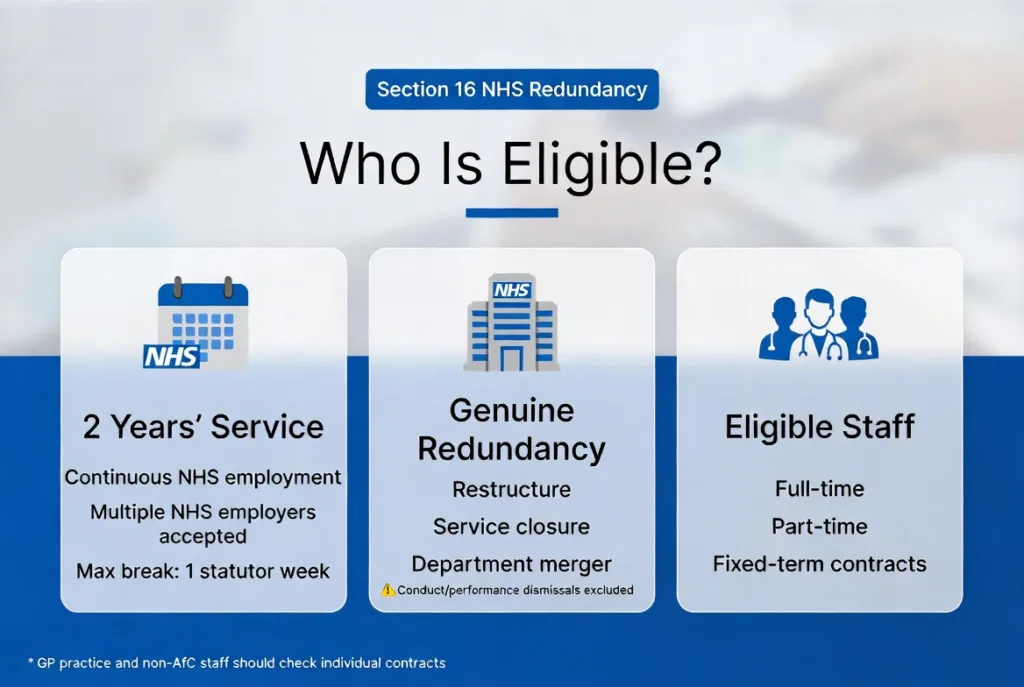
To qualify for an NHS contractual redundancy payment under Section 16, you must meet two conditions:
- Two years of continuous NHS service. This can span multiple NHS employers, including NHS trusts, ICBs (Integrated Care Boards), and CSUs, as long as there has been no break in service of more than one statutory week (Sunday to Saturday). It does not need to be all with your current employer.
- Genuine redundancy. Your role must be disappearing due to organisational restructuring, service closure, a departmental merger, or a facility closure. Dismissal for performance, conduct, or personal reasons does not count as redundancy and does not trigger Section 16 protections.
Eligibility extends to full-time, part-time, and fixed-term contract staff. GP practice workers and those not on Agenda for Change terms should check their individual contract, as entitlements may differ.
Continuous Service vs Reckonable Service: A Critical Distinction
These two terms are often confused, and mixing them up is one of the most expensive mistakes NHS staff make during a redundancy settlement.
Continuous service determines your eligibility. You need a minimum of two years of unbroken NHS service to qualify for any contractual redundancy payment.
Reckonable service is what is used to calculate the amount you receive. It is almost always lower than your continuous service figure, because certain periods are excluded:
- Service already counted in a previous NHS redundancy or loss of office payment (Section 16, paragraph 16.6)
- Service covered by a previous MARS (Mutually Agreed Resignation Scheme) severance payment (paragraph 20.18)
- Any period of employment for which you have already received NHS pension benefits
- Breaks in NHS service exceeding 12 months
Always request written confirmation of both your continuous service date and your reckonable service figure from HR before accepting any settlement. Even a one-day discrepancy in your Electronic Staff Record (ESR) start date can significantly reduce your payment.
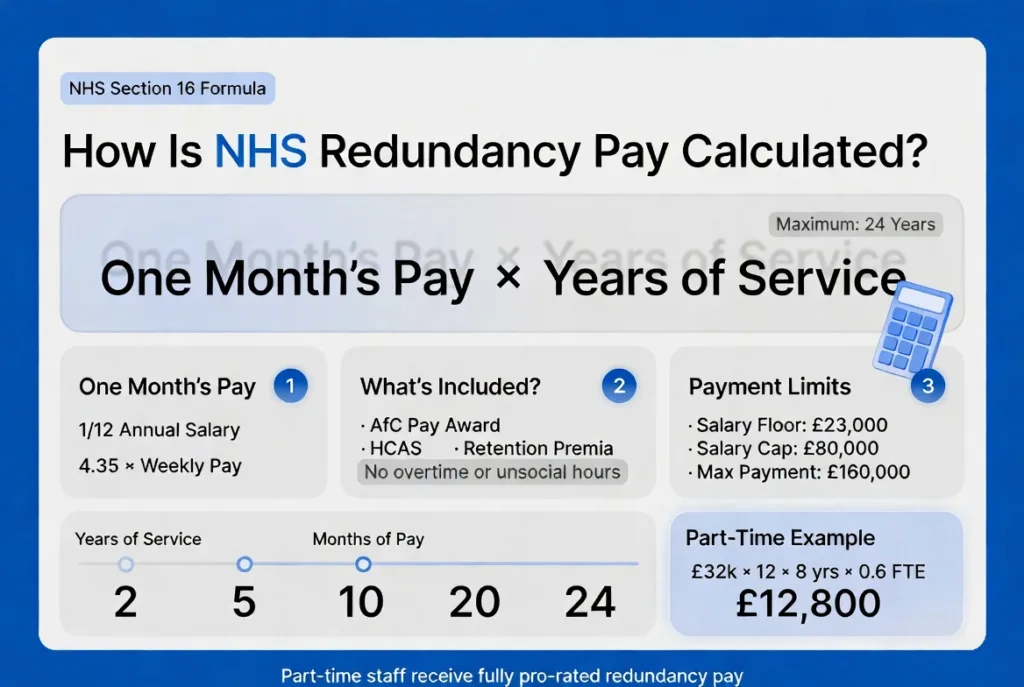
How Is NHS Redundancy Pay Calculated? (Section 16 Formula)
The NHS contractual redundancy formula is straightforward:
One month’s pay × complete years of reckonable service (capped at 24 years)
One month’s pay is the higher of:
- 1/12th of your annual basic salary at the date of termination, OR
- 4.35 times your actual weekly pay (calculated in line with the Employment Rights Act 1996)
For 2026/27, your basic pay includes the Agenda for Change pay award, any High Cost Area Supplement (HCAS), and regular recruitment and retention premia. It does not normally include unsocial hours enhancements or overtime.
The salary floor (£23,000 FTE) means that staff earning below this amount have their calculation based on £23,000 — so their redundancy payment is higher than their actual pay would produce. The salary ceiling (£80,000 FTE) caps the monthly pay figure regardless of how much more senior staff earn.
The maximum total NHS contractual redundancy payment is £160,000, pro-rated for part-time staff.
| Years of Reckonable Service | NHS Contractual Payment | Statutory Minimum* |
| 2 years | 2 months’ pay | ∼1–3 weeks’ pay |
| 5 years | 5 months’ pay | ∼2.5–7.5 weeks’ pay |
| 10 years | 10 months’ pay | ∼5–15 weeks’ pay |
| 15 years | 15 months’ pay | ∼7.5–22.5 weeks’ pay |
| 20 years | 20 months’ pay | ∼10–30 weeks’ pay |
| 24 years (maximum) | 24 months’ pay | ∼12–30 weeks’ pay |
*Statutory minimum depends on age. Weekly pay is capped at £751 from April 2026. Maximum 20 years counted.
Part-Time Staff and Pro-Rata Adjustments
Part-time staff are fully entitled to redundancy pay. The salary floor (£23,000) and ceiling (£80,000) are applied to your full-time equivalent (FTE) salary first, and then the result is pro-rated by your FTE fraction.
Example: A Band 5 HCA working 22.5 hours per week (0.6 FTE) on an FTE salary of £32,000 with 8 years’ reckonable service: £32,000 ÷ 12 = £2,667/month × 8 years = £21,333 × 0.6 FTE = £12,800 gross redundancy pay.
The maximum payment of £160,000 is also pro-rated — a 0.5 FTE employee has a maximum of £80,000.
NHS Contractual vs UK Statutory Redundancy Pay: Side by Side
| Feature | NHS Contractual (AfC Section 16) | UK Statutory Minimum |
| Calculation basis | 1 month’s actual pay per year | 0.5–1.5 weeks’ capped pay per year |
| Pay cap | No weekly pay cap (salary ceiling £80,000 FTE) | £751 per week (from April 2026) |
| Maximum service counted | 24 years | 20 years |
| Age weighting | None — flat rate for all ages | 0.5 (under 22), 1.0 (22–40), 1.5 (41+) weeks |
| Salary floor | £23,000 FTE | None |
| Maximum total payment | £160,000 (pro-rated for part-time) | £22,530 (from April 2026) |
| Minimum qualifying service | 2 years continuous | 2 years continuous |
For the vast majority of Agenda for Change staff, the NHS contractual figure will be significantly higher than the statutory minimum. Statutory redundancy is the legal floor — the NHS TCS Handbook sets a far more generous contractual entitlement on top of it.
Voluntary vs Compulsory Redundancy in the NHS
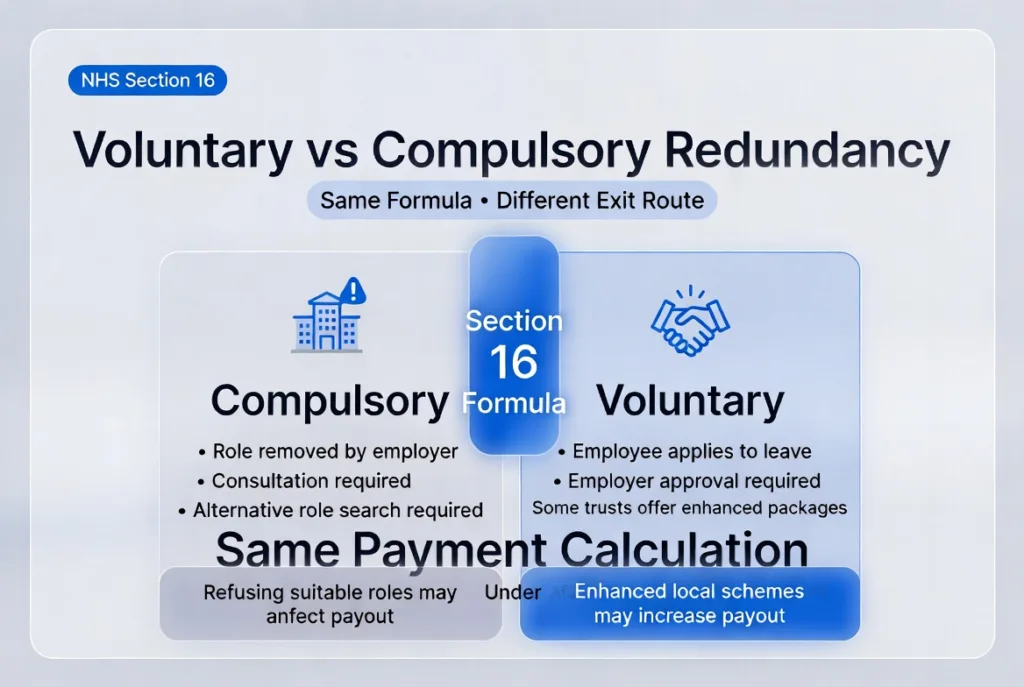
The core Section 16 formula is identical for both voluntary and compulsory redundancy under standard Agenda for Change terms. The difference lies in how you come to leave, not in the amount you receive.
Compulsory Redundancy
This is where your employer formally selects your role for deletion. You do not have a choice about whether to leave — but you can challenge the selection process and must be consulted on a collective basis (if 20 or more roles are being made redundant simultaneously) under the Trade Union and Labour Relations (Consolidation) Act 1992.
Your employer has a legal duty to seek suitable alternative employment for you before making you compulsorily redundant. If they offer you a role that is deemed suitable and you unreasonably refuse it, you may lose your right to a redundancy payment.
Voluntary Redundancy
NHS England, ICBs, trusts, and CSUs have periodically opened national or local voluntary redundancy (VR) schemes. In 2025–26, NHS England ran a National Voluntary Redundancy Scheme targeting primarily managerial and administrative staff during the programme to reduce NHS England headcount.
Under a voluntary scheme, you express interest in leaving and your application must be approved by your employer. Approval is not guaranteed — your employer can decline if your skills are essential to service delivery.
Some trusts offer enhanced voluntary redundancy terms on top of the standard Section 16 formula. Always check your local scheme documentation before comparing it against compulsory terms. Is voluntary redundancy better than compulsory? In purely financial terms under standard AfC, the payment formula is the same. Enhanced local VR schemes may offer additional top-ups.
MARS vs Voluntary Redundancy: A Crucial Legal Difference
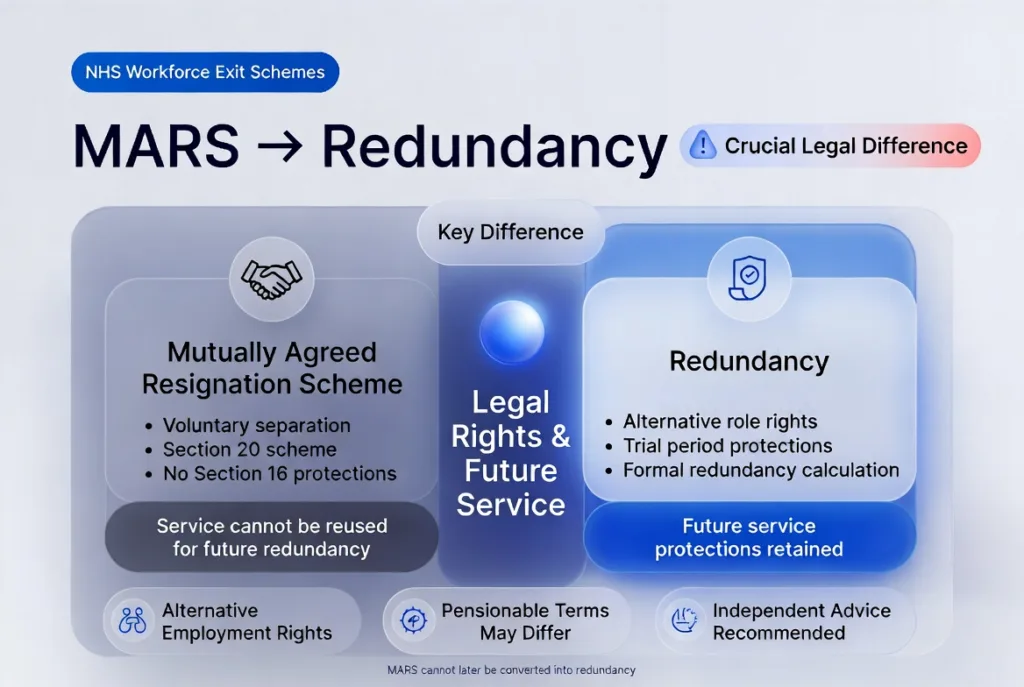
MARS (Mutually Agreed Resignation Scheme) is not redundancy. This is a vital distinction many NHS staff overlook when faced with a MARS offer.
MARS is a voluntary separation under Section 20 of the NHS TCS Handbook. It is typically used by NHS England, ICBs, and CSUs when workforce numbers need to reduce without triggering formal redundancy. Key differences:
- MARS does not trigger Section 16 protections. You do not have a right to suitable alternative employment, a trial period in a new role, or the specific calculation methodology that redundancy provides.
- MARS service is excluded from future redundancy calculations. Under paragraph 20.18 of the NHS TCS Handbook, service already covered by a MARS payment cannot be counted again in any future redundancy calculation if you rejoin the NHS.
- MARS is pensionable under certain conditions. Unlike redundancy, some MARS packages may be treated as pensionable pay, depending on the terms of the individual scheme.
If you are offered a MARS deal, get independent legal or union advice before signing. Once accepted, you cannot convert it into a redundancy. The NHS MARS calculator can help you compare the financial value of a MARS offer against what a redundancy would pay.
Suitable Alternative Employment and Your Right to Refuse
Under Section 16 and the Employment Rights Act 1996, your NHS employer has a duty to actively seek suitable alternative employment for you before making you redundant. If they fail to do so, this may constitute an unfair dismissal, which can be challenged at an Employment Tribunal.
Whether a role is ‘suitable’ is assessed on a case-by-case basis and considers:
- Similarity of the role to your current job (skills, responsibilities)
- Terms and conditions, including pay band and hours
- Location and reasonable travel distance
- Your personal circumstances
You are entitled to a four-week trial period in any new role. If, during those four weeks, it becomes clear the role genuinely does not suit your skills, you can leave and retain your full redundancy entitlement. If you unreasonably refuse a suitable alternative without a trial, you may forfeit the payment entirely.
A Band 7 nurse offered a Band 7 role within a 10-mile radius with comparable hours is very likely to be considered a suitable alternative. A Band 7 clinician offered a Band 5 administrative role would have strong grounds to argue the role is not suitable.
Is NHS Redundancy Pay Taxable?
The first £30,000 of any redundancy payment is completely free of both income tax and National Insurance contributions. This applies to both NHS contractual and statutory redundancy payments.
Any amount above £30,000 is subject to income tax at your marginal rate (20%, 40%, or 45%) but is not subject to National Insurance. This can result in a significantly higher net take-home from a large redundancy payment than from the equivalent amount received as salary.
Example: A Band 8a manager with 20 years of reckonable service and a salary of £65,000 would receive a gross NHS redundancy payment of approximately £108,333. The first £30,000 is tax-free. The remaining £78,333 is taxed at marginal rates (assuming 40% applies to a significant portion), resulting in around £36,667 in tax on the excess. Net take-home: approximately £71,667.
Pay in Lieu of Notice (PILON) is taxed separately and does not come out of the £30,000 tax-free allowance. PILON is treated as employment income and is subject to both income tax and National Insurance in full.
Use the NHS tax calculator alongside the redundancy calculator to estimate your full net position.
NHS Redundancy and Your Pension: What Happens?
Redundancy has important implications for your NHS pension, and the options available to you depend on your age and which section of the NHS Pension Scheme you are in.
Over 55: Accessing Your Pension at Redundancy
If you are aged 55 or over at the date of redundancy and have at least two years of pensionable NHS service, you may be entitled to access your NHS pension immediately, without the usual actuarial reduction that applies to early retirement.
The mechanism works as follows: your employer uses the redundancy payment to fund the capital cost of paying out your pension early on an unreduced basis. If the redundancy payment is sufficient to cover that cost, you receive your full pension and nothing extra. If there is a surplus (i.e. the redundancy payment is more than the cost of early retirement), you receive the balance. If there is a shortfall, you have the option to make up the difference from personal funds.
This combined package — immediate unreduced pension plus any balance of redundancy pay — can be extremely valuable. However, it is a one-time irrevocable decision. Once the redundancy payment is directed to the pension scheme, it cannot be reclaimed as cash. Always take independent financial advice before choosing this route.
Under 55: Deferred Pension
If you are made redundant before age 55, your NHS pension benefits are preserved (deferred) and will be paid at your Normal Pension Age, currently 67 for 2015 Scheme members. Your deferred pension is increased each year in line with CPI.
Use the NHS pension calculator to estimate the value of your deferred pension alongside your redundancy payment.
Does Redundancy Affect Your NHS Pension?
Redundancy itself does not reduce your accrued pension entitlement. The pension you have built up remains yours. What changes is when and how you access it. Taking your pension early (before Normal Pension Age) through the redundancy route at age 55+ allows you to avoid actuarial reduction.
Pension contributions are not deducted from redundancy pay. The redundancy payment is not pensionable pay, so you will not pay pension contributions on it, and it will not increase your pension accrual.
For information on how your pension works more broadly, including the 2015 Scheme, 1995 Section and 2008 Section rules, see the full NHS pension explained guide.
NHS Redundancy Notice Period
Your notice period under Agenda for Change depends on your length of service:
| Length of Service | Minimum Notice Period |
| Less than 4 years | 4 weeks |
| 4 to 12 years | 1 week per year of service |
| 12 years or more | 12 weeks |
Your employer may offer a Payment in Lieu of Notice (PILON) instead of requiring you to work your notice. PILON is taxed as normal earnings (income tax and National Insurance apply) and does not form part of the £30,000 tax-free redundancy allowance.
During your notice period, you continue to accrue annual leave at your normal rate. Any accrued but untaken leave should be paid out on termination.
NHS Redundancy Clawback: Returning to the NHS After Redundancy
One of the most significant restrictions in NHS redundancy is the clawback rule. If you return to any NHS employment within a specified period after receiving a redundancy payment, you may be required to repay some or all of it.
The clawback period and repayment calculation are set out in Section 16 of the NHS TCS Handbook. In broad terms, if you return to any NHS-funded role within the clawback window (which varies depending on your agreement), your former employer can recover a proportion of the redundancy payment equivalent to the unexpired portion of the period covered by that payment.
Example: If you receive 20 months’ pay as a redundancy settlement and return to NHS employment after 10 months, you may be required to repay approximately 10 months’ worth of the redundancy payment.
The clawback applies regardless of which NHS employer you join. It covers the entire NHS family, not just your former trust or ICB.
NHS England’s 2025–26 National Voluntary Redundancy Scheme included specific clawback provisions and received widespread attention due to ‘widespread confusion’ among staff about the eligibility rules and clawback periods. Always read the specific terms of your scheme documentation carefully.
NHS Redundancy in Scotland and Wales
NHS Scotland
NHS Scotland operates under a separate no compulsory redundancy policy, which has historically been stronger than the rest of the UK. However, voluntary redundancy and MARS-type schemes are available when workforce reductions are necessary. The core calculation principles are broadly similar to Agenda for Change, but the specific terms are set by Scottish Government directions and Scottish pay circulars.
NHS Scotland staff should contact their HR department or consult their trade union (RCN, UNISON, BMA) for the specific terms applicable to their Health Board.
NHS Wales
NHS Wales redundancy terms are governed by the Welsh Government’s All Wales Employment Policy, which follows Agenda for Change principles but has some differences in application. Staff on standard AfC contracts in Wales broadly receive the same formula (one month’s pay per reckonable year, capped at 24 years), but local trust policy may add additional protections.
The NHS Wales pay information guide covers the latest pay award for Wales, which affects the monthly pay figure used in any redundancy calculation.
NHS Redundancy Pay: Worked Examples (2026/27)
Example 1: Band 6 Nurse, Full-Time, 15 Years’ Service, Age 45
Annual salary 2026/27: £40,588 | Full-time (37.5 hrs) | Reckonable service: 15 years
Monthly pay: £40,588 ÷ 12 = £3,382.33
NHS redundancy gross: £3,382.33 × 15 = £50,735
Tax-free: £30,000 | Taxable at 40%: £20,735 | Tax due: £8,294
Net take-home: £42,441
Example 2: Band 3 Admin, Part-Time (0.5 FTE), 8 Years’ Service, Age 38
FTE salary: £26,530 | Contracted hours: 18.75 per week | Reckonable service: 8 years
FTE salary (£26,530) is above the £23,000 floor. Monthly pay FTE: £2,211 | Pro-rated: £2,211 × 0.5 = £1,105.50
NHS redundancy gross: £1,105.50 × 8 = £8,844
Fully tax-free (under £30,000 threshold).
Net take-home: £8,844
Example 3: Band 8b Manager, Full-Time, 22 Years’ Service, Age 57
Annual salary 2026/27: £74,290 | However, salary cap applies at £80,000 FTE (under cap) | Reckonable service: 22 years
Monthly pay: £74,290 ÷ 12 = £6,191 (capped at £80,000 FTE — salary is below cap, so actual salary used)
NHS redundancy gross: £6,191 × 22 = £136,202
Tax-free: £30,000 | Taxable: £106,202 | Estimated tax (mixed rates): ∼£42,000
Net take-home: ∼£94,202
At age 57 with 2+ years pensionable service, this manager may also qualify to access their NHS pension immediately at redundancy without actuarial reduction.
To calculate your own figure instantly, use the NHS redundancy calculator. For context on how your pay compares to others in your band, the NHS pay bands 2026–27 guide has the full Agenda for Change salary tables.
Common Mistakes That Reduce Your NHS Redundancy Pay
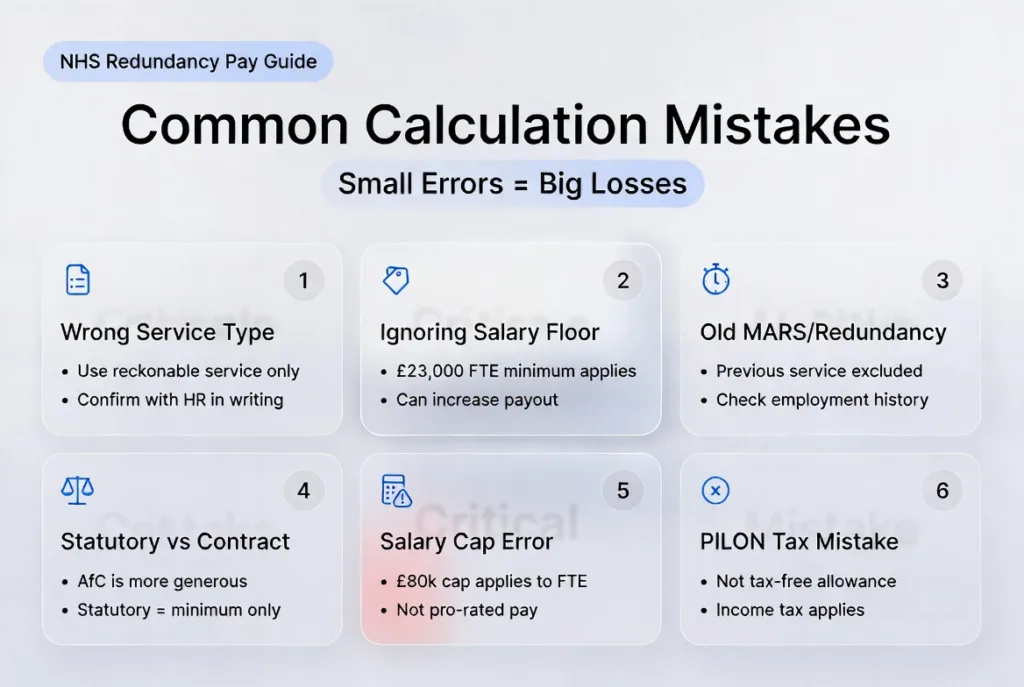
- Using total service instead of reckonable service. Not all NHS employment automatically counts. Always get your reckonable service figure confirmed in writing by HR.
- Ignoring the salary floor. Staff on less than £23,000 FTE should have their calculation based on £23,000, which increases their payment above what their actual salary alone would produce.
- Not accounting for prior redundancy or MARS. Service covered by a previous payment cannot be counted again. Check your history carefully.
- Confusing contractual with statutory. NHS AfC contractual terms are far more generous. Statutory is the legal minimum, not the NHS standard.
- Applying the salary cap to actual part-time pay. The £80,000 ceiling applies to your FTE salary first, not your pro-rated actual pay. This is a common calculation error.
- Missing the PILON tax point. PILON does not sit within the £30,000 tax-free allowance. Budget for income tax and NI on any PILON element separately.
- Accepting a MARS offer without comparing it to redundancy. MARS and redundancy are legally different. A MARS payment excludes that service from any future NHS redundancy calculation.
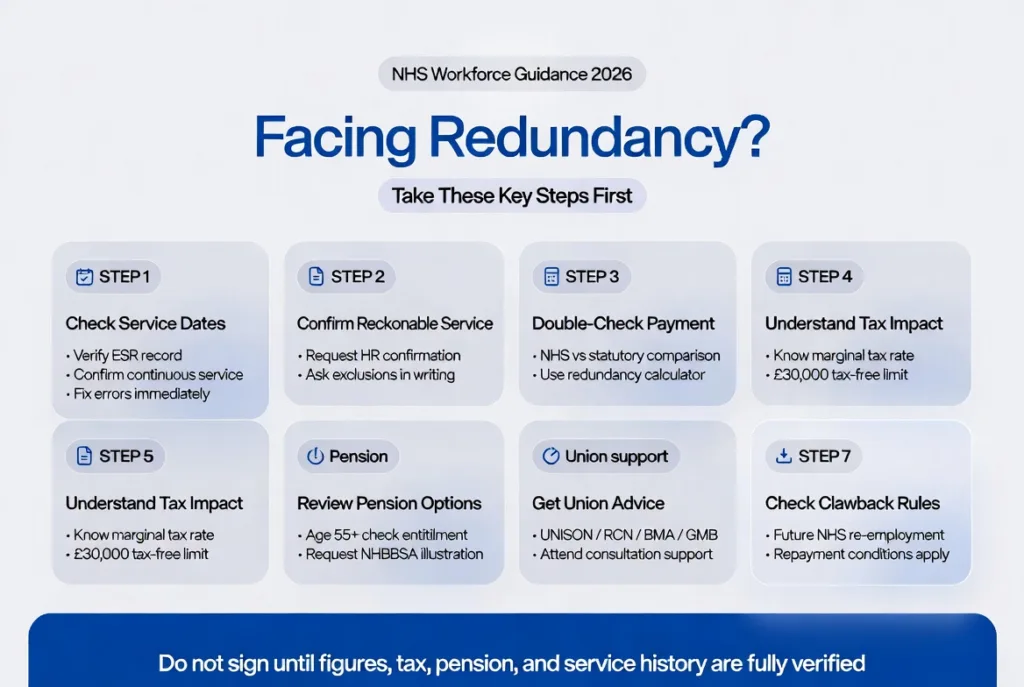
What to Do If You Are Facing NHS Redundancy in 2026
- Verify your service dates. Log in to ESR and check your continuous service start date. Challenge any inaccuracies immediately in writing.
- Request your reckonable service figure. Ask HR in writing to confirm both your continuous service and reckonable service, and why any periods have been excluded.
- Calculate both NHS and statutory figures. Use the NHS redundancy calculator to verify the figure HR presents.
- Understand the tax position. Know your marginal rate and how much of your payment will be subject to tax above £30,000.
- Check your pension options. If you are 55 or over, request a pension illustration from NHSBSA or SPPA (Scotland) before making any decision.
- Contact your trade union. UNISON, RCN, BMA, Unite, and GMB all provide redundancy support. They can review any offer and accompany you to consultation meetings.
- Consider the clawback implications. If you plan to return to NHS employment, understand the repayment rules before accepting the payment.
If your budget is under pressure during a redundancy process, the family budget guide for NHS staff and NHS sick pay calculator can help you understand your other entitlements during this period.
Frequently Asked Questions
How much is NHS redundancy pay in 2026?
NHS redundancy pay in 2026 is one month’s actual pay for each complete year of reckonable NHS service, capped at 24 years. The maximum total payment is £160,000. A salary floor of £23,000 FTE and a cap of £80,000 FTE apply. For a personalised figure, use the NHS redundancy calculator.
Is NHS redundancy pay tax free?
The first £30,000 of any NHS redundancy payment is completely free of income tax and National Insurance. Any amount above £30,000 is subject to income tax at your marginal rate (20%, 40%, or 45%) but is not subject to National Insurance. Pay in Lieu of Notice is fully taxable and does not use any of the £30,000 allowance.
How many years do I need for NHS redundancy pay?
You need at least two years of continuous NHS service to qualify for any contractual redundancy payment under Section 16 of the NHS TCS Handbook. The two years does not need to be with the same NHS employer but must be unbroken by any gap of more than one statutory week.
What is the maximum NHS redundancy payment?
The maximum NHS contractual redundancy payment is £160,000 (pro-rated for part-time staff). This is reached at 24 years of reckonable service at a salary of £80,000 FTE or above (£80,000 ÷ 12 × 24 = £160,000). NHS redundancy payments are capped at 24 years of service regardless of actual length of service.
Is NHS redundancy pay based on reckonable or continuous service?
The amount of NHS redundancy pay is based on reckonable service, not continuous service. Continuous service determines eligibility (minimum two years required). Reckonable service determines the amount, and it may be lower if you have had a previous redundancy payment, MARS payment, or break in service exceeding 12 months.
Can I access my NHS pension if made redundant over 55?
Yes. If you are aged 55 or over at the date of redundancy and have at least two years of pensionable NHS service, your employer can use the redundancy payment to fund early access to your pension on an unreduced basis. This is separate from your redundancy entitlement and applies across the 1995, 2008 and 2015 scheme sections. Contact NHSBSA for a personalised illustration before making this decision.
What is the difference between NHS redundancy and MARS?
MARS (Mutually Agreed Resignation Scheme) is a voluntary resignation arrangement under Section 20 of the NHS TCS Handbook. It is not redundancy and does not trigger Section 16 protections, including the right to suitable alternative employment or a four-week trial period. Service covered by a MARS payment cannot be counted in any future NHS redundancy calculation. MARS and redundancy are legally distinct — always get advice before accepting a MARS offer.
Does redundancy affect my NHS pension?
Redundancy does not reduce your accrued NHS pension entitlement. Your pension is preserved and will be paid at your Normal Pension Age. However, if you are 55 or over, you may have the option to access it immediately on an unreduced basis via the redundancy process. Pension contributions are not payable on redundancy payments.
Can I return to the NHS after taking redundancy?
You can return to NHS employment after redundancy, but a clawback may apply. If you rejoin any NHS-funded role within the clawback period, you may be required to repay a proportion of your redundancy payment equivalent to the unexpired portion of the period covered by the payment. Always check the specific clawback terms in your redundancy documentation before returning to NHS work.
What is the NHS redundancy clawback period?
The clawback period is linked to the number of months’ pay received. In broad terms, if your redundancy covers 20 months’ pay and you return after 10 months, around 10 months’ worth of the payment may be reclaimed. The exact rules are set out in your redundancy agreement and may vary by scheme. Get written confirmation from HR before accepting any role that is NHS-funded.
Is voluntary redundancy the same as compulsory in the NHS?
The base calculation formula under Section 16 AfC is the same for both voluntary and compulsory redundancy. The difference is in the process: compulsory redundancy is employer-led, while voluntary redundancy requires an expression of interest that must be approved. Some local VR schemes offer enhanced terms above the standard formula. Always compare the specific scheme document against standard Section 16 entitlements.
Does NHS redundancy include High Cost Area Supplements?
Yes. Under NHS TCS Handbook guidance, the monthly pay figure for redundancy calculations includes your basic pay, regular recruitment and retention premia, and High Cost Area Supplements (HCAS) that form part of your contractual pay. Variable elements such as unsocial hours payments and overtime are not included.
Disclaimer: This article is for general information only and does not constitute legal or financial advice. NHS redundancy rules are subject to change. Always verify figures with your HR department, consult your trade union, and seek independent advice for complex situations involving pensions, tax, or legal disputes. Sources: NHS Terms and Conditions of Service Handbook (Section 16), Employment Rights Act 1996, NHSBSA, NHS Employers.
Testimonials

Daniel Carter is a senior NHS Payroll Accountant with over 10 years of experience in Agenda for Change pay structures, tax, and pensions. He created the NHS Pay Calculators platform to help NHS staff easily understand their take-home pay, sick pay, maternity pay, and pension entitlements through simple, accurate online tools.
Daniel Carter is a senior NHS Payroll Accountant with over 10 years of experience in Agenda for Change pay structures, tax, and pensions. He created the NHS Pay Calculators platform to help NHS staff easily understand their take-home pay, sick pay, maternity pay, and pension entitlements through simple, accurate online tools.