
NHS Pension Calculator 2015 Scheme | Agenda for Change 2026/27
The NHS Pension Scheme remains one of the most valuable benefits for NHS staff. This updated 2026/27 calculator shows your exact employee contributions, employer 23.7% top-up, net cost after tax relief, and pension you build this year across the 2015 CARE scheme and any legacy 1995/2008 benefits.
Enter your pensionable pay below to instantly see your tier rate, monthly deductions, and retirement forecast — including McCloud remedy impacts.
| Pensionable Gross Payout Reference | £3,166.67 |
| Gross Pension Contribution Outflow | -£310.33 |
| HMRC Net Tax Relief Offset (Net Benefit) | +£62.07 |
| True Net Out-of-Pocket Cost | -£248.26 |
| Employer Pension Investment Added | £750.50 |
Because contribution allocations are taken pre-tax (under net pay arrangements), full structural tax relief applies instantly. For a basic rate earner, a £100 gross outgo reduces net take-home by only £80.
Employer Injection: The NHS Employer match injection is locked across healthcare infrastructure boundaries at an absolute baseline rate of 23.7% of your total pensionable earnings.
What Is the NHS Pension Scheme?
The NHS Pension Scheme is a defined benefit occupational pension provided to NHS employees in the United Kingdom. Because it is a defined benefit scheme, your retirement income is guaranteed and calculated by a formula — it does not depend on investment performance the way a private pension pot does.
The scheme is administered separately across the four nations:
- England and Wales: NHS Business Services Authority (NHSBSA)
- Scotland: Scottish Public Pensions Agency (SPPA)
- Northern Ireland: HSC Pension Service
The scheme is index-linked, meaning your pension rises each year in line with inflation (measured by the Consumer Prices Index). For most NHS workers, this combination of guaranteed income and inflation protection makes it one of the best workplace pensions available anywhere in the UK.
You can also build NHS pension benefits on top of your State Pension. Every UK worker who pays sufficient National Insurance contributions qualifies for the State Pension — your NHS pension is paid separately and in addition to it.
Which NHS Pension Scheme Are You In?
There are three sections of the NHS Pension Scheme. The section you are in depends on when you joined.
| Scheme | Who it covers | Pension type | Normal Pension Age |
| 1995 Section | Joined before 1 April 2008 | Final salary | 60 |
| 2008 Section | Joined 1 Apr 2008 – 31 Mar 2015 | Final salary | 65 |
| 2015 Scheme (CARE) | All new members from 1 April 2015 | Career average | State Pension Age (currently 67) |
All NHS employees who joined on or after 1 April 2015 are in the 2015 Scheme. The 1995 and 2008 sections are closed to new entrants. However, many long-serving staff have benefits built up in the older schemes as well — these are paid separately at the relevant retirement age.

Members who joined on or before 31 March 2012 and were still in service after 1 April 2015 may be affected by the McCloud remedy. This requires them to make a choice between their legacy scheme benefits and reformed scheme benefits for service between 1 April 2015 and 31 March 2022.
How Is the NHS Pension Calculated?
The 2015 Scheme (Career Average Revalued Earnings — CARE)
In the 2015 Scheme, you build up 1/54th of your pensionable pay each scheme year. That amount is then revalued each year in line with a Treasury Order (broadly linked to CPI), so it keeps its real value until you retire.
Example: If your pensionable pay is £35,000 in a given year, you earn £35,000 ÷ 54 = £648 of pension that year. Over a 20-year career, even without any pay increases, that gives you around £12,963 per year in today’s money.
Because the 2015 Scheme uses career average earnings, pay rises in the final years of your career do not produce the large pension jumps they could under the old final salary arrangements.
The 1995 Section (Final Salary)
Your annual pension is 1/80th of your best year of pensionable pay, multiplied by the number of qualifying years of membership (capped at 45 years). You also receive an automatic lump sum of three times your pension.
Example: 40 years of service at a final salary of £40,000 gives 40 ÷ 80 × £40,000 = £20,000 per year, plus a lump sum of £60,000.
The 2008 Section (Final Salary)
Your annual pension is 1/60th of your reckonable pay for each year of membership (up to 45 years). There is no automatic lump sum, but you can commute pension for a lump sum at a rate of £12 of lump sum for every £1 of annual pension given up.
For a detailed breakdown of how your pay affects your pension — and to see your net take-home pay after contributions — try the NHS pension calculator on this site. You can also check NHS pay bands 2026–27 to see how Agenda for Change salaries are structured.

NHS Pension Contribution Rates 2026/27
Your contributions to the NHS Pension Scheme are calculated as a percentage of your pensionable pay. The 2015 Scheme uses a tiered structure — the more you earn, the higher the percentage you contribute. Contributions are deducted from your pay before income tax is calculated, giving you immediate tax relief.
England and Wales — 2026/27 member contribution tiers:
| Pensionable Pay (per year) | Contribution Rate |
| Up to £13,259 | 5.1% |
| £13,260 to £26,831 | 6.5% |
| £26,832 to £37,336 | 8.3% |
| £37,337 to £45,996 | 9.8% |
| £45,997 to £61,779 | 10.7% |
| Above £61,779 | 12.5% |
Your employer also pays a substantial contribution — currently around 23.7% of your pensionable pay — on top of your own contribution. This employer contribution is not deducted from your pay; it is an additional cost borne entirely by the NHS. It is one of the clearest illustrations of the true value of the NHS pension.
In Scotland, contribution tiers differ slightly. Northern Ireland follows rates set by the HSC Pension Service. Use the NHS tax calculator to see the combined impact of pension contributions, income tax and National Insurance on your monthly pay packet.
For Band-specific take-home pay figures including pension deductions, see the relevant calculator for your band — for example, Band 5 take-home pay, Band 6 take-home pay or Band 7 take-home pay.

How Much NHS Pension Will I Get at Retirement?
Your pension depends on three things: the scheme you are in, how many years you have been a member, and how much you earned during those years. There is no single fixed amount — it is always personal to you.
The maximum pensionable service across all NHS Pension Scheme sections is 45 years. If you retire before completing 45 years of service, you receive a proportionate pension based on actual membership.
Here are illustrative examples for the 2015 Scheme (career average), assuming contributions are revalued at 2% per year for simplicity:
| Years of Service | Average Pensionable Pay | Estimated Annual Pension |
| 10 years | £30,000 | Approx. £5,556/yr |
| 20 years | £35,000 | Approx. £12,963/yr |
| 30 years | £40,000 | Approx. £22,222/yr |
| 40 years | £45,000 | Approx. £33,333/yr |
These are simplified figures before tax and before any lump sum commutation. Actual pensions will differ based on annual revaluation, part-time working and other factors. To get a personal projection, use the NHS pension calculator.
NHS Pension Lump Sum — Are You Entitled to One?
Whether you receive an automatic lump sum depends on which section of the scheme you are in.
- 1995 Section: You receive an automatic tax-free lump sum of three times your annual pension. You can also take a larger lump sum by commuting part of your pension (giving up £1 of annual pension for £12 of additional lump sum).
- 2008 Section and 2015 Scheme: There is no automatic lump sum. You can choose to commute pension for a lump sum at the rate of £1 of annual pension for £12 of lump sum, up to a maximum of 25% of the total capital value of your pension.
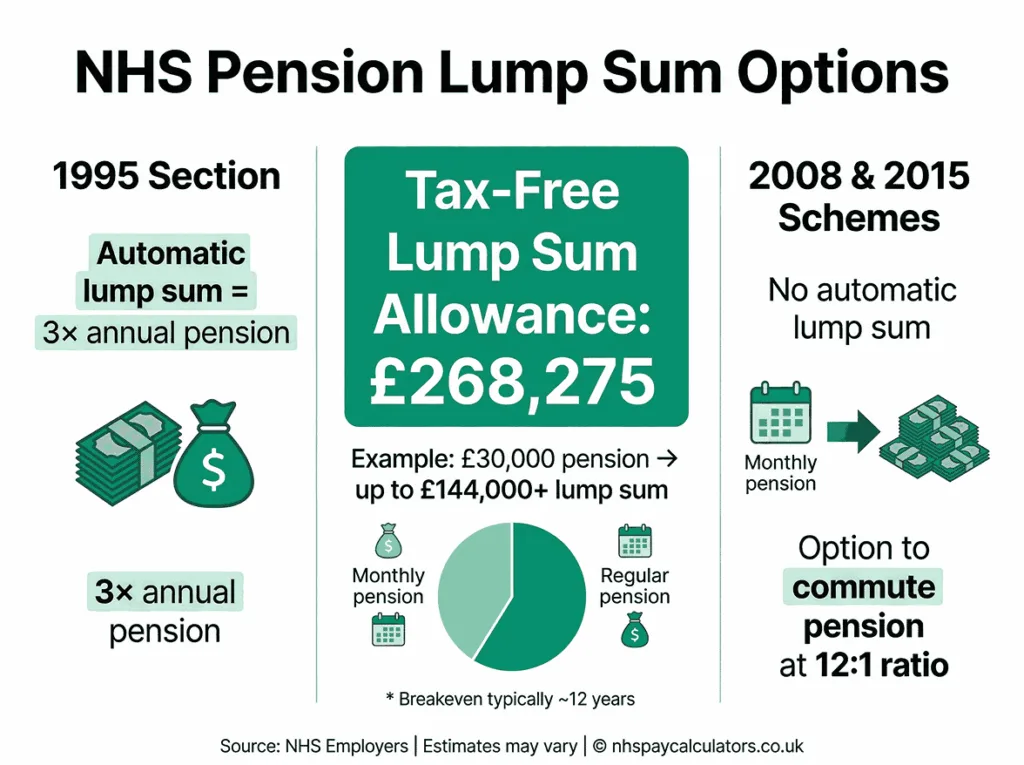
The maximum tax-free lump sum is capped at the Lump Sum Allowance (LSA) of £268,275. Any lump sum above this limit is taxed at your marginal rate of income tax.
Think carefully before maximising your lump sum. Every £12,000 you take as a lump sum reduces your index-linked annual pension by £1,000 for the rest of your life. For many people, especially those expecting a long retirement, preserving the annual income is better value.
When Can You Take Your NHS Pension?
The age at which you can draw your NHS pension depends on which section you are in:
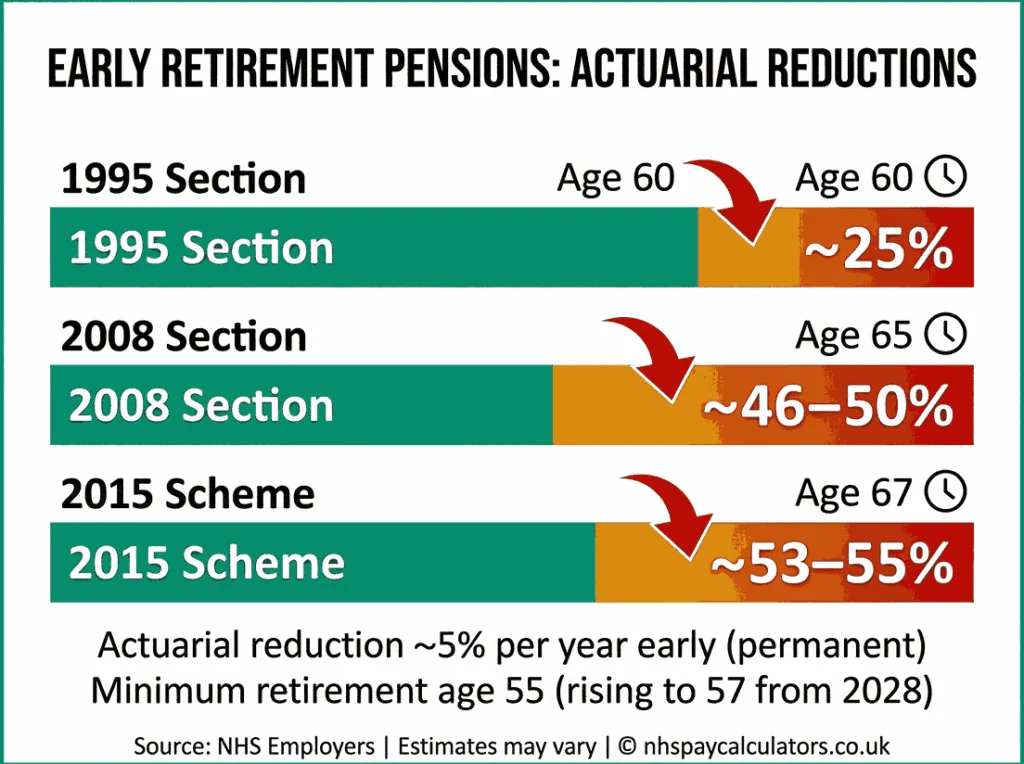
- 1995 Section: Normal Pension Age (NPA) is 60. You can take benefits from age 50 if you have 25 years of qualifying service (if this right was established before 2007).
- 2008 Section: NPA is 65. You can take benefits from age 55 with an actuarial reduction applied.
- 2015 Scheme: NPA is linked to your State Pension Age (currently 67 for those born after April 1960). You can retire from age 55, but benefits will be actuarially reduced for each year taken early.
Taking your pension early permanently reduces the annual amount you receive. The actuarial reduction factors are significant — in some cases, retiring just two or three years early can reduce your pension by 10–15%. Use the NHS early retirement calculator to see exactly what difference early retirement makes to your income.
The NHS also allows partial retirement. Under partial retirement, you can take up to 80% of your pension benefits while continuing to work reduced hours. The NHSBSA Partial Retirement Calculator shows how much lump sum and pension you would receive alongside any ‘abatement’ (reduction) if your pay after partial retirement is higher than your pension).
NHS Pension Across the Four Nations
Although the NHS Pension Scheme shares the same core structure across England, Wales, Scotland and Northern Ireland, there are differences in how the schemes are administered and some differences in contribution tier thresholds.
- England and Wales: Administered by NHSBSA. Members can access Annual Benefit Statements via Electronic Staff Record (ESR) or the My NHS Pension portal.
- Scotland: Administered by SPPA. Members affected by the McCloud remedy can use the SPPA NHS Remedy Calculator for an illustration of their pension entitlement. The SPPA also operates an online member service.
- Northern Ireland: Administered by HSC Pension Service. Excel-based calculators are available for the 2015 Scheme, ERRBO, pension commutation, additional pension and the McCloud Remedy Modeller. Phone lines are open Monday to Thursday 10am–12pm and 2pm–4pm, and Friday 10am–12pm (Tel: 028 7131 9111).
- Wales: Wales follows the same Agenda for Change pay structure and pension rules as England but has a separate pay award negotiation process. See the NHS Wales pay rise information for the latest figures.
NHS Pension Rise: What Happens Each April?
Every April, pensions in payment and deferred pensions are increased in line with the Consumer Prices Index (CPI) from the previous September. This is known as the Pensions Increase. For the 2026/27 tax year, active member contributions were revalued by the Treasury Order rate.
For the 2026 NHS pension rise, the April 2026 increase applied to pensions already in payment. NHS workers who are still active members see their accrued pension ‘pot’ revalued each year in line with a Treasury Order rate, which is designed to broadly match inflation.
This index-linking is one of the most valuable features of the NHS pension. A private pension drawdown pot has no guaranteed inflation protection — you bear the investment and inflation risk yourself. The NHS scheme removes both of those risks entirely.

Is the NHS Pension Worth It? Should You Opt Out?
The NHS pension is widely regarded as one of the best occupational pensions in the UK. Here is why:
- Defined benefit: Your retirement income is guaranteed and not subject to stock market risk.
- Inflation-proofed: Your pension rises each year with CPI, protecting your spending power.
- Employer contribution: Your employer contributes around 23.7% of your salary on your behalf — a significant addition to the value of what you receive.
- Tax relief: Member contributions come from pre-tax pay, meaning higher-rate taxpayers save 40% on every contribution.
- Death and survivor benefits: The scheme provides a death-in-service lump sum and a dependant’s pension to a nominated beneficiary or spouse.
Opting out means losing all of these benefits for the period you are not a member. You do not receive the employer contribution as cash — it simply stops. Given that the employer contribution alone is worth nearly a quarter of your salary, opting out is rarely a good financial decision for most NHS workers.
That said, some staff on very tight household budgets opt out temporarily to manage cash flow, with the intention of rejoining later. If you are weighing up the numbers, read the full analysis on opting out of the NHS pension: costs vs gains before making any decision.
If you have previous workplace or personal pensions from before joining the NHS, it may also be worth exploring transferring previous pensions into the NHS scheme. This is not always the right move, but it is worth understanding the rules.
Some NHS workers also explore salary sacrifice arrangements. While standard NHS pension contributions are not salary sacrifice, certain additional voluntary contribution schemes (AVCs) may be. See the NHS salary sacrifice calculator for more detail.
How to Get an Estimate of Your NHS Pension
There are several ways to find out how much your NHS pension is likely to be:
- Annual Benefit Statement (ABS): Also known as the Total Reward Statement (TRS), this is issued annually and shows your current accrued pension. In England and Wales, access it via the Electronic Staff Record (ESR) system or the My NHS Pension portal.
- Request a formal estimate: NHSBSA prioritises estimates for members who are within one year of retirement, terminally ill, or require one for legal proceedings (such as a divorce). Download the estimate request form from the NHSBSA Member Hub.
- Use an online calculator: For a quick projection, use the NHS pension calculator on this site. You will need your current pensionable pay, years of membership and the section of the scheme you are in.
For Scotland, the SPPA offers an NHS Remedy Calculator online (available in Microsoft Edge or Google Chrome). For Northern Ireland, the HSC Pension Service provides Excel-based calculators for different scheme sections via its website.
Member guides for each section (1995/2008 and 2015) are available to download from the NHSBSA Member Hub and cover: how your pension is worked out, survivor benefits, retirement lump sums, pay information, pensions increases and pension sharing on divorce.
Buying Additional NHS Pension
If you want to boost your NHS pension above what you will build up through normal membership, there are several options:
- Additional Pension (AP): You pay a regular or lump-sum contribution to buy a set amount of extra annual pension (up to £8,000 per year for the 2015 Scheme). The cost depends on your age and how many years remain until your NPA.
- Early Retirement Reduction Buy Out (ERRBO): This lets 2015 Scheme members pay extra contributions now so they can retire before NPA without an actuarial reduction. ERRBO is only available if you are more than three years from retirement.
- Additional Voluntary Contributions (AVCs): These sit outside the main scheme and are invested in funds of your choice. They can provide a tax-free lump sum at retirement to sit alongside your NHS pension income.
The decision to buy additional pension depends on your age, health, remaining service and personal financial situation. Speaking to an independent financial adviser who specialises in NHS pensions is advisable before committing to additional contributions.
Annual Allowance and Tax Charges
The Annual Allowance (AA) is the maximum amount by which your pension benefits can grow in a year without a tax charge. For 2026/27 the standard Annual Allowance is £60,000.
For high earners in the NHS — particularly senior doctors, consultants and Band 8–9 managers — the tapering of the Annual Allowance can result in significant tax charges if pension growth exceeds the threshold. If you are affected, ‘Scheme Pays’ allows you to meet an Annual Allowance charge from your pension pot rather than from your cash income.
NHS consultants and other senior clinicians should check their Annual Benefit Statement carefully each year. The NHS consultant salary guide includes information on how seniority affects both pay and pension accrual rates.
Frequently Asked Questions
How much is the average NHS pension per month?
There is no single average figure — it depends on years of service and career earnings. A nurse who works 30 years at an average pay of £35,000 in the 2015 Scheme would build up roughly £19,444 per year (approximately £1,620 per month before tax), assuming modest annual revaluation. Use the NHS pension calculator for a personalised projection.
Is the NHS pension a final salary or career average scheme?
The 2015 Scheme (which covers all current entrants) is a career average revalued earnings (CARE) scheme. The 1995 and 2008 sections were final salary arrangements, but both are now closed to new members.
Can I take my NHS pension at 55 and still work?
In the 2015 Scheme, you can access benefits from age 55 (rising to 57 in 2028), but doing so before your Normal Pension Age triggers an actuarial reduction. Under partial retirement rules, you can draw some pension benefits and continue working reduced hours simultaneously. The NHSBSA Partial Retirement Calculator shows the financial impact.
Is my NHS pension lump sum tax-free?
Yes, up to the Lump Sum Allowance of £268,275. The automatic lump sum paid to 1995 Section members is tax-free up to this limit. Any excess above £268,275 is taxed at your marginal income tax rate.
Does the NHS pension increase each year?
Yes. Pensions in payment are increased each April in line with CPI (the Consumer Prices Index from the previous September). Active member benefits are revalued annually under the Treasury Order rate. This inflation-proofing is one of the key advantages of the NHS pension over a private pension pot.
What happens to my NHS pension when I die?
If you die in service, the scheme pays a lump sum of twice your pensionable pay to your nominated beneficiary, plus a dependant’s pension. If you die after retirement, your surviving spouse or civil partner receives a dependant’s pension (typically half your pension). You should always keep your nomination of beneficiary form up to date with the NHSBSA.
Can I opt out and rejoin the NHS pension later?
Yes. You can opt out at any time using the SD502 form. You can also rejoin the NHS Pension Scheme at any time if you are still eligible. However, any period when you were opted out will not count towards your pension, so you will build up fewer benefits overall. Read the full analysis on opting out of the NHS pension before deciding.
What is the NHS pension contribution rate for Band 5?
A Band 5 nurse on the 2026/27 salary of £29,969 to £36,483 would pay a contribution rate of 8.3% (for earnings in the £26,832–£37,336 tier) or 9.8% (for earnings in the £37,337–£45,996 tier), depending on their exact pay point. These contributions are taken before income tax, so your net cost is lower than the headline rate. See the Band 5 take-home pay calculator for a full breakdown.
How do I check my NHS pension online?
In England and Wales, log in to the My NHS Pension portal or access your Annual Benefit Statement through the Electronic Staff Record (ESR) system. In Scotland, use the SPPA online member service. In Northern Ireland, use the HSC Pension Service Engage portal at mypension.hscni.net.
Can I transfer a previous pension into the NHS scheme?
Yes, the NHS Pension Scheme accepts transfers-in from other registered pension schemes. Transferred benefits are converted into added years of membership or added pension. The value you receive depends on actuarial factors current at the time of transfer. For more detail, see the guide on transferring previous pensions into the NHS.
Disclaimer: This article is for general information only and does not constitute financial advice. NHS pension rules are subject to change. Always check the latest information from NHSBSA, SPPA or HSC Pension Service, and consider speaking to an independent financial adviser for personalised guidance.

Daniel Carter is a senior NHS Payroll Accountant with over 10 years of experience in Agenda for Change pay structures, tax, and pensions. He created the NHS Pay Calculators platform to help NHS staff easily understand their take-home pay, sick pay, maternity pay, and pension entitlements through simple, accurate online tools.
One Comment