NHS Expense Claims Guide 2026/27: How to Claim Reimbursable
NHS staff are entitled to reimbursement for a defined range of work-related expenses under the Agenda for Change framework and NHS Travel and Expenses Policy. Reimbursable costs include business mileage at 28p to 45p per mile, excess travel costs when moving base, subsistence allowances, professional fees and uniform costs where applicable. Many NHS staff underclaim because they are unaware of what qualifies or how the process works.
This guide covers every major reimbursable category, the current rates, how to submit correctly and the most commonly missed claims. You can easily calculate your NHS take home salary 2026 on our website. Many NHS employees complain burnout, you should also give it a read.
What Governs NHS Expense Reimbursement?
NHS expense reimbursement is governed by two frameworks:
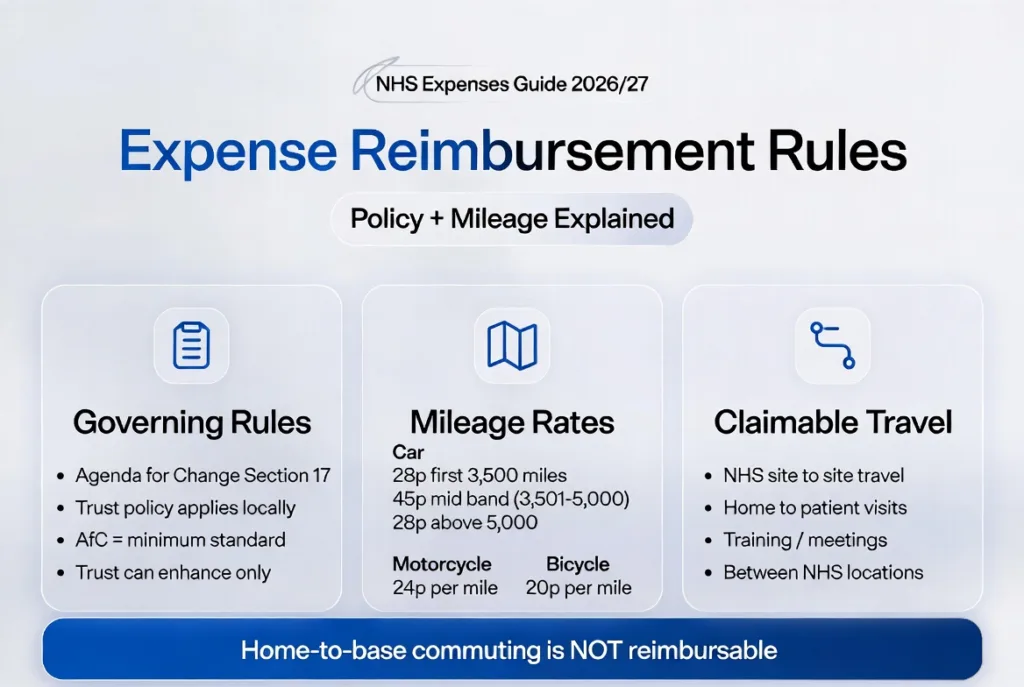
- Agenda for Change Terms and Conditions — Section 17 covers travel and subsistence entitlements for AfC staff
- Individual Trust Expenses Policies — each NHS trust operates its own policy within AfC parameters; rates and processes vary
Your trust’s expenses policy takes precedence for the specifics of how to claim and what local rates apply. AfC sets the minimum entitlements — your trust may be more generous but cannot be less. Always obtain a copy of your trust’s current expenses policy from your HR intranet before submitting claims.
NHS Mileage Reimbursement Rates 2026/27
Mileage is the most commonly claimed NHS expense and the area where most underclaiming occurs. NHS mileage rates depend on your annual business mileage and vehicle type.
Standard NHS Car Mileage Rates 2026/27
| Annual Business Miles | Rate Per Mile |
|---|---|
| First 3,500 miles | 28p |
| 3,501 — 5,000 miles | 45p* |
| Above 5,000 miles | 28p |
*The 45p rate applies only to the band between 3,501 and 5,000 miles for eligible staff. Some trusts apply HMRC approved mileage rates (45p for first 10,000 miles) for staff without reserved parking — check your trust policy.
Motorcycle and Bicycle Rates
| Vehicle | Rate Per Mile |
|---|---|
| Motorcycle | 24p |
| Bicycle | 20p |
What Counts as Reimbursable Business Mileage
Reimbursable mileage is travel between work locations during a working day — not your home-to-base commute. Qualifying journeys include:
- Travelling from your base to a patient’s home or clinic site
- Travel between two NHS sites during the same shift
- Attending mandatory training at a different location
- Travelling to a meeting at another trust site
Your regular home-to-base commute is never reimbursable, even if your base changes temporarily.
Claiming Back Dental Charges
Claiming back NHS dental charges is possible if you were entitled to free or reduced-cost treatment at the time you paid. This usually applies if you qualify for the NHS Low Income Scheme, income-related benefits, or exemption categories such as pregnancy or certain welfare support. If you paid in error, you can apply for a refund using form HC5 (England, Wales, and Northern Ireland) with proof of payment and evidence of eligibility. Claims are normally limited to a three-month window from the date of payment, and refunds are based on NHS charging bands, not private dental costs. Always check your eligibility before applying, as incorrect claims may be rejected or delayed.
Claim Back Travel Costs NHS
If your base is permanently or temporarily changed by your employer and the new base increases your home-to-work travel distance, you are entitled to excess travel reimbursement for the additional distance above your previous commute.
Key conditions:
- The change must be employer-initiated — not a voluntary transfer
- Reimbursement covers only the excess distance above your previous home-to-base travel
- Temporary reimbursement typically applies for up to four years for permanent moves
- Rates are the standard business mileage rates above
This is one of the most commonly missed entitlements. If your trust has moved your base, reconfigured services or placed you on a different site — even temporarily — you may be entitled to excess travel reimbursement from the date of the change.
Subsistence — Meals and Accommodation
NHS staff who work away from their base beyond defined time thresholds are entitled to subsistence allowances. Rates vary by trust but AfC sets the framework.
Typical NHS Subsistence Rates 2026/27
| Scenario | Typical Rate |
|---|---|
| Breakfast (departure before 7am) | £5 — £8 |
| Lunch (away from base over midday) | £5 — £8 |
| Evening meal (return after 7pm) | £10 — £15 |
| Overnight accommodation (London) | Up to £150 |
| Overnight accommodation (elsewhere) | Up to £90 |
| Overnight incidentals | £5 — £10 |
Actual receipts are required for most subsistence claims above a minimum threshold. Flat-rate claims without receipts are accepted at lower amounts in many trusts — check your policy for the specific threshold.
Subsistence is only claimable for genuine work-related absence from base. A training day at your own trust site does not qualify. A mandatory conference requiring travel to another city does.
Professional Fees and Registration Costs
NHS AfC employees are entitled to reimbursement of statutory registration fees where registration is a contractual requirement of their post.
Reimbursable professional fees:
| Fee | Eligible Staff | Notes |
|---|---|---|
| NMC registration fee | Nurses and midwives | Full reimbursement where registration required for post |
| HCPC registration fee | AHPs and scientists | Full reimbursement where registration required for post |
| GMC registration fee | Doctors in NHS employment | Trust-dependent; most reimburse |
| Royal College membership | Some senior clinical roles | Trust-dependent; not universally reimbursed |
The NMC annual registration fee is currently £120 per year. Where your NMC or HCPC registration is a contractual requirement — which it is for all registered nurses, AHPs and healthcare scientists — this should be reimbursed by your employer. Many staff pay this personally without claiming. Submit a claim with your registration renewal confirmation as evidence.
Uniform and Clothing Allowances
Where your trust requires you to wear a uniform and does not provide laundry facilities or a laundry allowance, you may be entitled to a flat-rate uniform tax relief from HMRC — not from your trust, but as a tax deduction.
HMRC Uniform Tax Relief for NHS Staff
| Staff Group | Annual Flat Rate Relief | Tax Saving (20%) | Tax Saving (40%) |
|---|---|---|---|
| Nurses | £125 | £25/year | £50/year |
| Doctors | £185 | £37/year | £74/year |
| AHPs | £125 | £25/year | £50/year |
| Support workers | £125 | £25/year | £50/year |
This is claimed directly from HMRC via your Self Assessment return or by completing a P87 form. You can backdate claims for up to four tax years. A nurse who has not claimed this relief for four years is owed approximately £100 in tax refunds at the basic rate — submitted in a single backdated claim.
Working From Home — Tax Relief for NHS Staff
NHS clinical staff rarely qualify for working from home tax relief as their role requires physical presence. However, administrative, managerial and some community staff who genuinely work from home as a contractual requirement may claim.
HMRC working from home allowance 2026/27: £6 per week flat rate (£312 per year) — claimable without receipts. At 20% tax, this saves £62.40 per year. At 40%, it saves £124.80 per year.
You can also claim actual additional costs — heating, electricity — if you can evidence them, but the flat rate is simpler and accepted without receipts.
CPD, Training and Conference Costs
NHS employers are responsible for funding mandatory training. For non-mandatory CPD, reimbursement depends on trust policy and whether the training is supported by your line manager.
What is typically reimbursable for training:
- Travel to mandatory training at an external venue — mileage at standard rates
- Accommodation for overnight training — up to trust subsistence limits
- Course fees for trust-approved CPD — varies significantly by trust
- Professional journal subscriptions directly related to your role — some trusts reimburse; check policy
What is not reimbursable:
- Personal CPD undertaken without employer approval
- Training that benefits a secondary employment or private practice
- Exam fees for qualifications your employer has not agreed to fund
Get written approval before attending any external training if you intend to claim. Retrospective approval is difficult to obtain and many trusts will not reimburse without prior authorisation.
Equipment and Technology Claims
NHS staff who are required to use personal equipment for work — mobile phone, laptop, specific tools — may be able to claim reimbursement or tax relief.
- Trust-provided equipment — if your trust requires you to use personal equipment because trust equipment is not available, you can claim actual costs with receipts
- HMRC equipment relief — if you purchase equipment wholly and exclusively for work use, you can claim tax relief through Self Assessment; mixed personal/work use equipment is apportioned
- Phone costs — a proportion of your personal mobile bill is claimable if you use it for work calls; most trusts accept 25% to 50% of monthly bill as a reasonable work proportion with supporting evidence
How to Submit an NHS Expense Claim — Step by Step
The process varies by trust but the general framework is consistent:
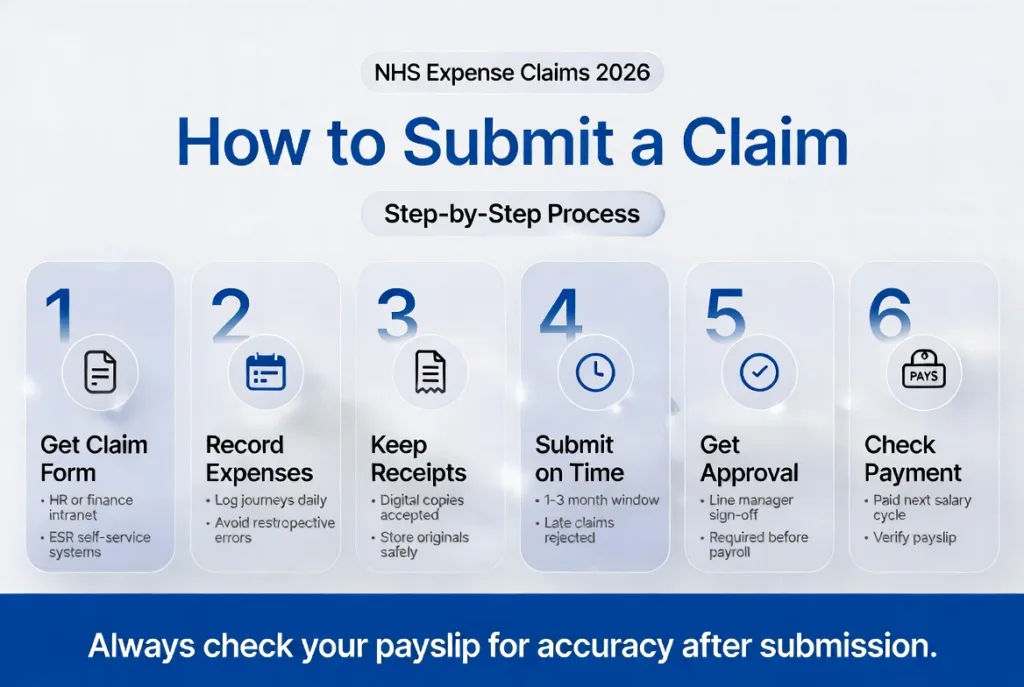
- Obtain your trust’s claim form — usually on the HR or finance intranet; some trusts use electronic systems such as ESR self-service
- Record journeys and costs as they occur — retrospective reconstruction is less accurate and harder to verify
- Retain all receipts — digital photos of receipts are accepted by most trusts; keep originals for 12 months
- Submit within your trust’s deadline — most trusts require claims within one to three months of the expense being incurred; late claims are commonly rejected
- Include authorisation — most claims require line manager sign-off before submission to payroll
- Verify payment — expenses are usually paid with the following month’s salary; check your payslip to confirm
Most Commonly Missed NHS Expense Claims
Many NHS staff leave money unclaimed every year. The most frequently missed entitlements are:
| Missed Claim | Estimated Annual Value | How to Claim |
|---|---|---|
| HMRC uniform tax relief | £25 — £74 | P87 form or Self Assessment |
| NMC / HCPC registration reimbursement | £120 | Submit to trust HR/payroll |
| Excess travel after base change | Variable — often £500–£2,000 | Trust expenses form |
| Working from home allowance | £62 — £125 | HMRC P87 or Self Assessment |
| Backdated uniform relief (4 years) | £100 — £296 | Single backdated HMRC claim |
| Mileage for training days | Variable | Standard mileage claim form |
The backdated HMRC uniform allowance claim is the simplest — it requires no employer involvement, takes approximately 15 minutes to complete online at gov.uk, and can return up to four years of unclaimed tax relief in a single payment.
What Gets NHS Expense Claims Rejected
Common reasons for rejection:
- No receipt — claims above the receipt-free threshold without supporting evidence
- Late submission — outside the trust’s claim window, typically one to three months
- Commuting mileage claimed as business mileage — home-to-base travel is never reimbursable
- No prior approval for training — courses attended without line manager authorisation
- Incorrect mileage calculation — using shortest route rather than actual route travelled; most trusts accept AA or Google Maps distance
- Missing authorisation signature — unsigned claims are returned automatically by most payroll teams
Frequently Asked Questions
What is the NHS mileage rate for 2026/27?
The standard NHS car mileage rate is 28p per mile for the first 3,500 business miles and 45p per mile between 3,501 and 5,000 miles, returning to 28p above 5,000 miles. Some trusts apply HMRC approved rates of 45p for the first 10,000 miles — check your trust policy.
Can NHS staff claim back NMC registration fees?
Yes. Where NMC registration is a contractual requirement of your post — which it is for all registered nurses and midwives — your employer must reimburse the registration fee. Submit your renewal confirmation to HR or payroll with a completed expenses form.
How do I claim HMRC uniform tax relief as an NHS employee?
Complete a P87 form at gov.uk or include the claim in your Self Assessment return. NHS nurses and AHPs can claim £125 flat rate relief per year without receipts. Claims can be backdated four tax years — a first-time claimant can recover up to £100 at the basic rate in a single submission.
What counts as reimbursable mileage for NHS staff?
Business mileage between work locations during a working day — home visits, inter-site travel, mandatory training at external venues. Your regular home-to-base commute is never reimbursable even if your base changes temporarily.
What happens if I miss the expense claim deadline?
Most NHS trusts will not reimburse claims submitted outside their deadline — typically one to three months from the date of expenditure. Some trusts have a discretionary appeals process for late claims with valid reasons. Submit as promptly as possible and check your trust’s specific deadline policy.
Can I claim working from home expenses as an NHS community nurse?
If your contract designates your home as your base and you genuinely work from home as a requirement, yes. The HMRC flat rate of £6 per week (£312 per year) is claimable without receipts. Most ward-based clinical staff do not qualify, but community and administrative staff with home-based contracts do.
Summary
NHS staff are entitled to reimbursement for business mileage at 28p to 45p per mile, subsistence costs for work-related absence from base, professional registration fees where registration is contractually required, and excess travel costs when their base is changed by their employer. HMRC provides separate entitlements including uniform tax relief of £125 per year for nurses and AHPs — claimable for up to four previous tax years — and a £6 per week working from home allowance for eligible staff.
The most commonly missed claims are backdated uniform relief, NMC and HCPC registration reimbursement, and excess travel after a trust-initiated base change. Claims must be submitted within trust deadlines — typically one to three months — with receipts and line manager authorisation. All rates and processes are trust-specific within AfC minimum entitlements; always verify against your trust’s current expenses policy before submitting.
This article provides general guidance based on AfC terms and HMRC rules current for 2026/27. Trust-specific policies vary. Consult your trust’s expenses policy, HR department and HMRC guidance at gov.uk for advice specific to your circumstances.

Daniel Carter is a senior NHS Payroll Accountant with over 10 years of experience in Agenda for Change pay structures, tax, and pensions. He created the NHS Pay Calculators platform to help NHS staff easily understand their take-home pay, sick pay, maternity pay, and pension entitlements through simple, accurate online tools.