NHS Band 7 Nurse: Career, Roles and Progression 2026/27
Reaching Band 7 is one of the most significant steps in a nursing career. It marks the transition from clinical practitioner to senior clinician — a role that carries genuine leadership responsibility, greater autonomy, and a wider scope of practice.
This guide covers what Band 7 actually means in the NHS, the roles it covers, what getting there requires, and where it leads next. For a full salary breakdown including take-home pay across all four UK nations, use our NHS Band 7 take-home pay calculator.
What Is NHS Band 7?
Band 7 sits within the Agenda for Change (AfC) pay structure, which covers the majority of NHS employees in England, Scotland, Wales, and Northern Ireland. It is classified as a senior clinical or specialist grade.
In practical terms, Band 7 nurses lead teams, manage caseloads independently, and are accountable for clinical decisions without requiring direct supervision. This distinguishes Band 7 from Band 6, where clinical work is still carried out under a degree of oversight.
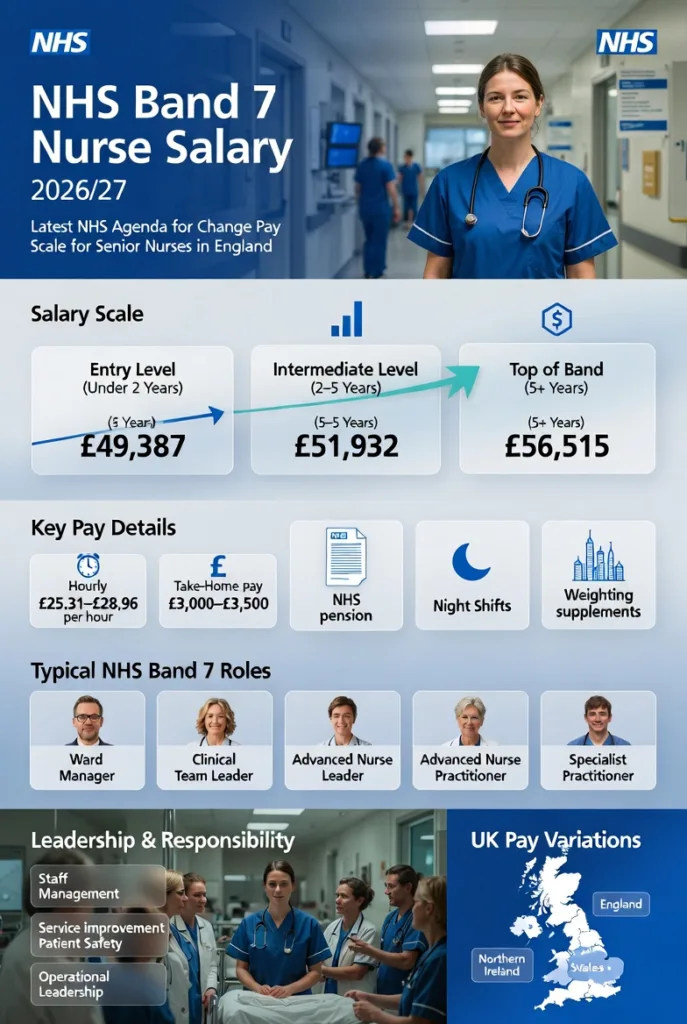
The salary range in England for 2026/27 runs from £46,148 at entry to £52,809 at the top of the band. For exact monthly take-home figures after tax, NI, and pension deductions, use our Band 7 take-home pay calculator. To compare with the band below, see the Band 6 take-home pay calculator.
Typical Roles Paid at Band 7
Band 7 covers a wide range of nursing and allied health specialisms. The common thread is clinical leadership, specialist expertise, or both.
| Ward Manager / Matron | Operational responsibility for an entire ward or clinical area — staffing, rostering, patient flow, clinical governance, and service quality. May sit at Band 7 in smaller trusts or Band 8a in larger acute hospitals. |
| Advanced Nurse Practitioner (ANP) | Work at the top of clinical scope — diagnosing, requesting investigations, prescribing, and managing complex presentations independently. Found in emergency departments, GP practices, community health, and specialist clinics. |
| Clinical Nurse Specialist (CNS) | Expert knowledge in a defined specialism (oncology, diabetes, palliative care, mental health). Lead clinical pathways, manage complex cases, educate staff, and act as the primary patient contact for long-term conditions. |
| Community Team Leader | Lead a community nursing, mental health, or health visiting team across a geographic area. Manage caseloads, supervise Band 5 and Band 6 staff, and liaise with GPs, social care, and secondary services. |
| Specialist Midwife | Specialist roles in perinatal mental health, safeguarding, or bereavement support. Sit outside standard labour ward or community structures and require postgraduate-level expertise. |
| Senior AHP (Physio, OT, SALT, Radiographer) | Band 7 is not exclusive to nursing. Senior physiotherapists, occupational therapists, speech and language therapists, and diagnostic radiographers hold Band 7 posts in specialist or leadership positions. |
How Do You Progress to Band 7?
Most nurses reach Band 7 from Band 6, typically after several years of specialist or senior clinical experience. There is no single pathway — progression depends on the trust, the specialty, and individual development.
| 1 | Experience in Band 6Most Band 7 applicants have at least three to five years of Band 6 experience. Trusts expect evidence of autonomous clinical practice, supervision of junior staff, and contribution to service development — not just time served. |
| 2 | Postgraduate StudyMany Band 7 roles — particularly ANP and CNS positions — require or strongly favour postgraduate qualifications. A Master’s in advanced clinical practice, a V300 prescribing qualification, or a specialist pathway certificate is increasingly expected rather than optional. NHS funding through Health Education England pathways is available but competitive. |
| 3 | Leadership DevelopmentThe NHS Leadership Academy runs programmes specifically for nurses moving into senior roles. The Edward Jenner Programme and the Mary Seacole Programme are frequently referenced in Band 7 person specifications. Completing one before applying demonstrates intent and readiness. |
| 4 | Acting Up and SecondmentsMany nurses gain Band 7 experience before formally moving into the grade through acting-up arrangements or fixed-term secondments. These provide practical evidence of capability and often lead directly to a substantive Band 7 post. |
What Changes at Band 7?
The shift from Band 6 to Band 7 is not simply a pay increase. The nature of the work changes substantially.
At Band 6, clinical decisions are made with access to a senior colleague for advice or sign-off. At Band 7, accountability is yours. You are expected to manage complex situations, make autonomous clinical judgements, and take responsibility for outcomes — both for individual patients and for your team.
Staffing and People Management
Band 7 roles almost always include line management responsibility. Managing rosters, conducting appraisals, handling performance concerns, and supporting staff wellbeing are part of the role in a way they typically are not at Band 6.
Governance and Quality
Band 7 nurses are expected to contribute actively to clinical governance — auditing practice, leading service improvement, investigating incidents, and implementing policy changes. This is a significant shift from the execution of care to the design and oversight of it.
Relationships With Other Professions
At Band 7, you work as an equal peer with consultants, GPs, allied health leads, and operational managers. The nature of multidisciplinary working changes — you are expected to advocate for your service and your patients at a strategic level, not just at the bedside.
Is the Move From Band 6 to Band 7 Worth It?
The honest answer depends on what you are looking for from your career. The Pay Gap at Entry PointA nurse at the top of Band 6 (£44,962) who moves to Band 7 entry at £46,148 sees a gross increase of around £1,186 per year — roughly £65 to £80 extra per month in take-home pay after deductions. That is not a transformative financial jump at the point of entry.What grows is earning potential over time. A nurse who reaches the top of Band 7 at £52,809 earns around £7,847 more per year gross than a nurse at the Band 6 ceiling — approximately £400 to £450 more per month take-home. Progression through the band typically takes four to five years.
More importantly, Band 7 opens doors that Band 6 does not. Band 8a posts, consultant nurse roles, NHS management, advanced practice leadership, and clinical director pathways are all significantly more accessible from Band 7. If long-term career development matters to you, Band 7 is the gateway, not just the destination. There is a slight difference of pay between working in private or public sector, give it a read.
What Comes After Band 7?
Band 7 is not a ceiling. The three most common next steps are:
| Band 8aConsultant Nurse, Service Manager, Advanced Practice Lead, or Head of Nursing. Starts at £55,690 in England 2026/27. See Band 8a take-home pay. | Consultant NurseBand 8b or above. Highest clinical (non-medical) NHS grade. Research-active, service-shaping. Typically requires doctorate-level study and sustained clinical leadership from Band 7. | NHS ManagementService Manager, Matron, Divisional Manager. Not purely clinical but draws heavily on nursing experience and leadership skills built at Band 7. |
Band 7 Pay Across the UK
| England | £46,148 – £52,809 (AfC 2026/27) |
| Scotland | £47,675 – £54,793 — highest gross Band 7 in the UK. See NHS Scotland pay guide |
| Wales | £46,840 – £53,602 |
| N. Ireland | £46,148 – £52,809 — mirrors England scale |
Scotland consistently pays the highest Band 7 gross salaries, but higher Scottish income tax rates partially offset this. The actual take-home difference is smaller than the headline figures suggest. Our Band 7 take-home pay calculator shows net figures for all four nations side by side. For a full picture of the AfC pay structure across all bands, see our NHS pay bands 2026/27 guide.
If pension contributions are a factor in your decision, our NHS pension calculator shows how your tier contributions change as you move up through the bands.
FAQs — NHS Band 7 Nurse Career
What qualifications do you need to be a Band 7 nurse?
There is no single mandatory qualification. Most Band 7 roles require an active NMC registration, significant Band 6 experience, and — particularly for ANP or CNS posts — a relevant postgraduate qualification. A V300 prescribing qualification is increasingly expected for advanced practice roles rather than treated as desirable.
How long does it take to reach Band 7?
Most nurses reach Band 7 between eight and twelve years after qualifying, though this varies widely by specialty and trust. Nurses in high-demand specialisms or those who complete postgraduate study early may progress faster. Community and mental health pathways sometimes move faster than acute hospital routes.
Can you go straight from Band 5 to Band 7?
In most cases, no. Band 7 person specifications typically require Band 6-level experience. Exceptional candidates in fast-track schemes or those with relevant prior experience from outside the NHS may find routes that skip Band 6, but these are rare and trust-specific.
What is the Band 7 hourly rate in 2026/27?
The Band 7 hourly rate in England ranges from approximately £23.67 at entry to £27.08 at the top of the band, based on a 37.5-hour working week. Unsocial hours enhancements, on-call payments, and London weighting (HCAS) can increase this substantially. Use our Band 7 take-home pay calculator to see how shift work and enhancements affect your net pay.
Is Band 7 a senior nurse?
Yes. Band 7 is universally recognised within the NHS as a senior nursing grade. It carries autonomous clinical accountability, leadership responsibility, and — in most trusts — formal line management duties. It is the grade at which nurses move from being practitioners operating within a team to leaders accountable for the team.
How does moving to Band 7 affect my NHS pension?
Your NHS pension contribution tier increases as your salary rises. Most Band 7 nurses contribute between 10.9% and 12.5% of pensionable pay, up from the lower tiers at Band 6. Our NHS pension calculator shows exactly how your pension deductions change at Band 7 entry and top-of-band salaries.

Daniel Carter is a senior NHS Payroll Accountant with over 10 years of experience in Agenda for Change pay structures, tax, and pensions. He created the NHS Pay Calculators platform to help NHS staff easily understand their take-home pay, sick pay, maternity pay, and pension entitlements through simple, accurate online tools.